

This English question involves literary analysis, grammar, or writing skills. The detailed response below provides a well-structured answer with supporting evidence and clear explanations.
ScanSolve AI Answer
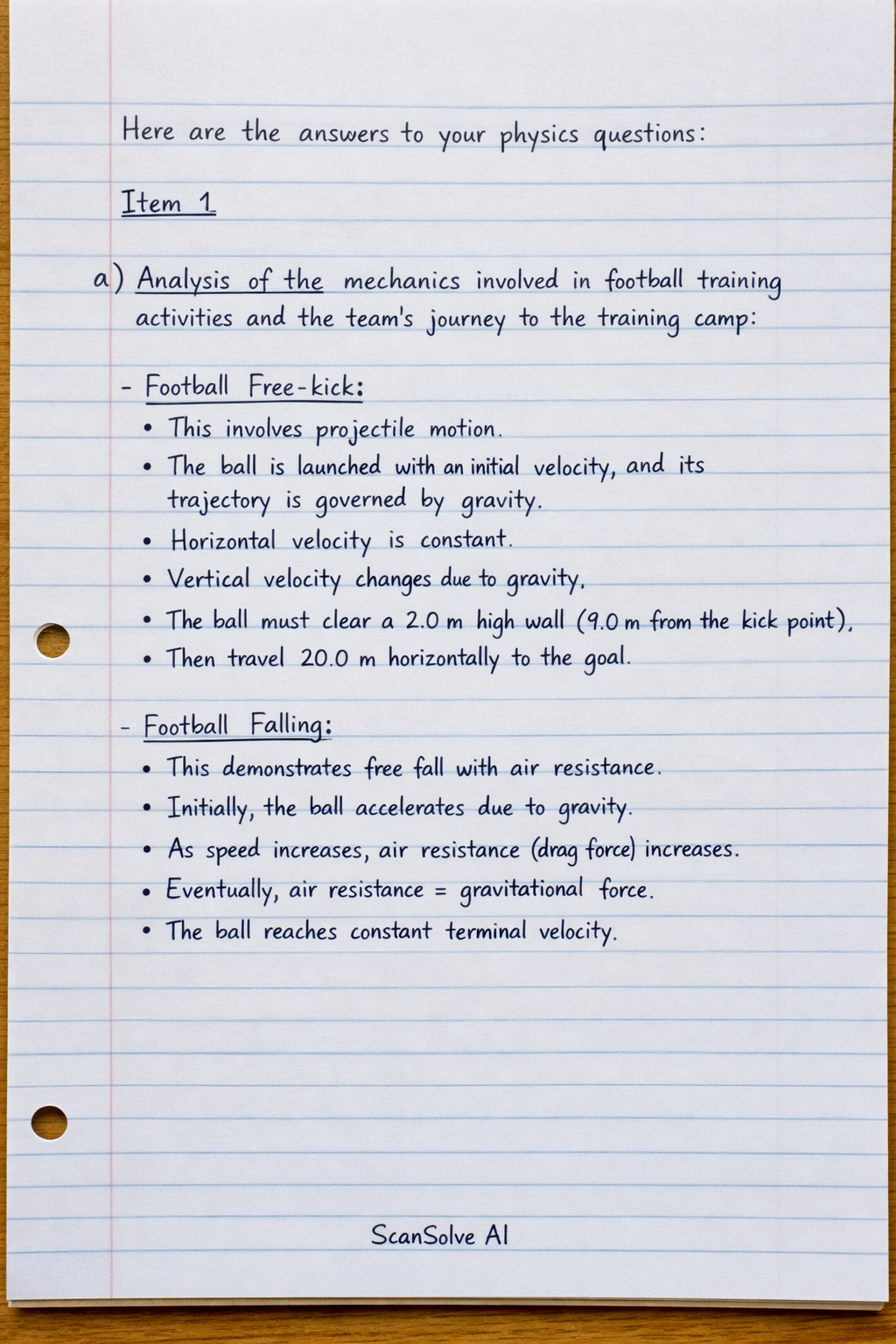
Here are the answers to your physics questions: Item 1 a) Analysis of the mechanics involved in football training activities and the team's journey to the training camp: Football Free-kick: This involves projectile motion. The ball is launched with an initial velocity, and its trajectory is governed by gravity*. The horizontal component of velocity is constant (air resistance is neglected), while the vertical component changes due to gravitational acceleration. The ball must achieve sufficient initial vertical velocity to clear the 2.0 m high wall, which is 9.0 m from the kick point, and then travel 20.0 m horizontally to the goal. Football Falling: This demonstrates free fall with air resistance. Initially, the ball accelerates due to gravity. As its speed increases, air resistance (a drag force opposing motion) also increases. Eventually, the air resistance force equals the gravitational force, resulting in zero net force, and the ball reaches a constant terminal velocity*. Football Properties: The circumference relates to the ball's size and surface area, influencing air resistance. The internal pressure* affects the ball's hardness and elasticity, which in turn impacts its rebound characteristics and how much energy is transferred during a kick or impact. Bus Journey: The bus moving up an inclined hill involves forces on an incline and kinematics of uniformly accelerated motion. The engine provides a thrust force, while a component of gravity* acts down the slope. The bus accelerates uniformly at 5.0 m/s^2 for 10 s, starting from rest. This motion can be analyzed using Newton's second law and equations of motion. b) Evaluation of the performance of the football and the team bus using appropriate principles of mechanics and recommend suitable measures to improve their performance: Football Performance: Evaluation:* The ability to clear the wall in a free-kick depends on the initial velocity and angle. The terminal velocity of the falling ball is determined by its mass, shape, and surface. The internal pressure affects its bounce and flight characteristics. Recommendations: For free-kicks, players should train to optimize the launch angle and initial speed for accuracy and power. For consistent play, the ball's internal pressure should be maintained within recommended ranges. The ball's aerodynamic design* (e.g., dimples, panel configuration) can be optimized to reduce air resistance for longer, more predictable flights. Team Bus Performance: Evaluation:* The bus accelerates uniformly at 5.0 m/s^2 up a 30^ incline, which indicates a powerful engine relative to its mass (2500 kg). This suggests good mechanical efficiency in converting fuel energy to kinetic energy and potential energy. Recommendations: Although friction is neglected, in reality, tire maintenance (proper inflation, tread) would minimize rolling resistance. Regular engine servicing ensures optimal power output and fuel efficiency. For long-term improvement, considering aerodynamic modifications* to the bus body could reduce air drag, especially at higher speeds, further improving fuel economy and performance. Item 2 Stability of nuclei, binding energy per nucleon, and energy release in nuclear processes: Stability of nuclei: Nuclei are held together by the strong nuclear force*. Stability depends on the neutron-to-proton ratio; nuclei with an optimal ratio are more stable. Binding energy per nucleon:* This is the average energy required to remove a nucleon from a nucleus. Higher binding energy per nucleon indicates greater nuclear stability, peaking around iron-56. Energy release in nuclear processes: Energy is released in nuclear fission (heavy nuclei splitting) or nuclear fusion* (light nuclei combining) when the total binding energy of the products is greater than that of the reactants. This energy comes from the conversion of a small amount of mass into energy, as described by Einstein's E=mc^2. Use of a Geiger-Muller tube in radiation detection and the concept of half-life for thorium-230: Geiger-Muller tube:* This is a radiation detector that works by ionizing a gas inside a tube when radiation passes through it, creating a detectable electrical pulse. It is used to detect alpha, beta, and gamma radiation. Thorium-230 and half-life: Thorium-230 is a radioactive isotope that undergoes radioactive decay, emitting radiation. Its half-life* of 75,400 years is the time it takes for half of the initial amount of thorium-230 to decay into a more stable element. The Geiger-Muller tube detects the radiation emitted during this decay. Emission of electrons from a metal surface when illuminated by light and the production of X-rays in a vacuum tube: Photoelectric effect: This is the phenomenon where electrons are emitted from a metal surface when light of a sufficiently high frequency shines on it. It demonstrates the particle nature of light (photons), where a photon's energy must exceed the metal's work function* to eject an electron. X-rays in a vacuum tube:* X-rays are produced when high-speed electrons, accelerated by a high voltage in a vacuum tube, strike a metal target. The sudden deceleration of these electrons (bremsstrahlung radiation) and the excitation of target atoms (characteristic X-rays) result in the emission of electromagnetic radiation in the X-ray spectrum. Motion of electrons in electric fields and how their specific charge can be determined experimentally: Motion of electrons in electric fields: Electrons, being negatively charged particles, experience a force* (F=qE) when placed in an electric field. This force causes them to accelerate in a direction opposite to the electric field. In a uniform electric field, electrons follow a parabolic path. Specific charge determination: The specific charge* of an electron (e/m_e) is the ratio of its charge to its mass. It can be determined experimentally by observing the deflection of electrons in known electric and/or magnetic fields. By measuring the deflection and knowing the field strengths and accelerating voltage, e/m_e can be calculated. Last free one today — make it count tomorrow, or type /upgrade for unlimited.