

This English question involves literary analysis, grammar, or writing skills. The detailed response below provides a well-structured answer with supporting evidence and clear explanations.
ScanSolve AI Answer
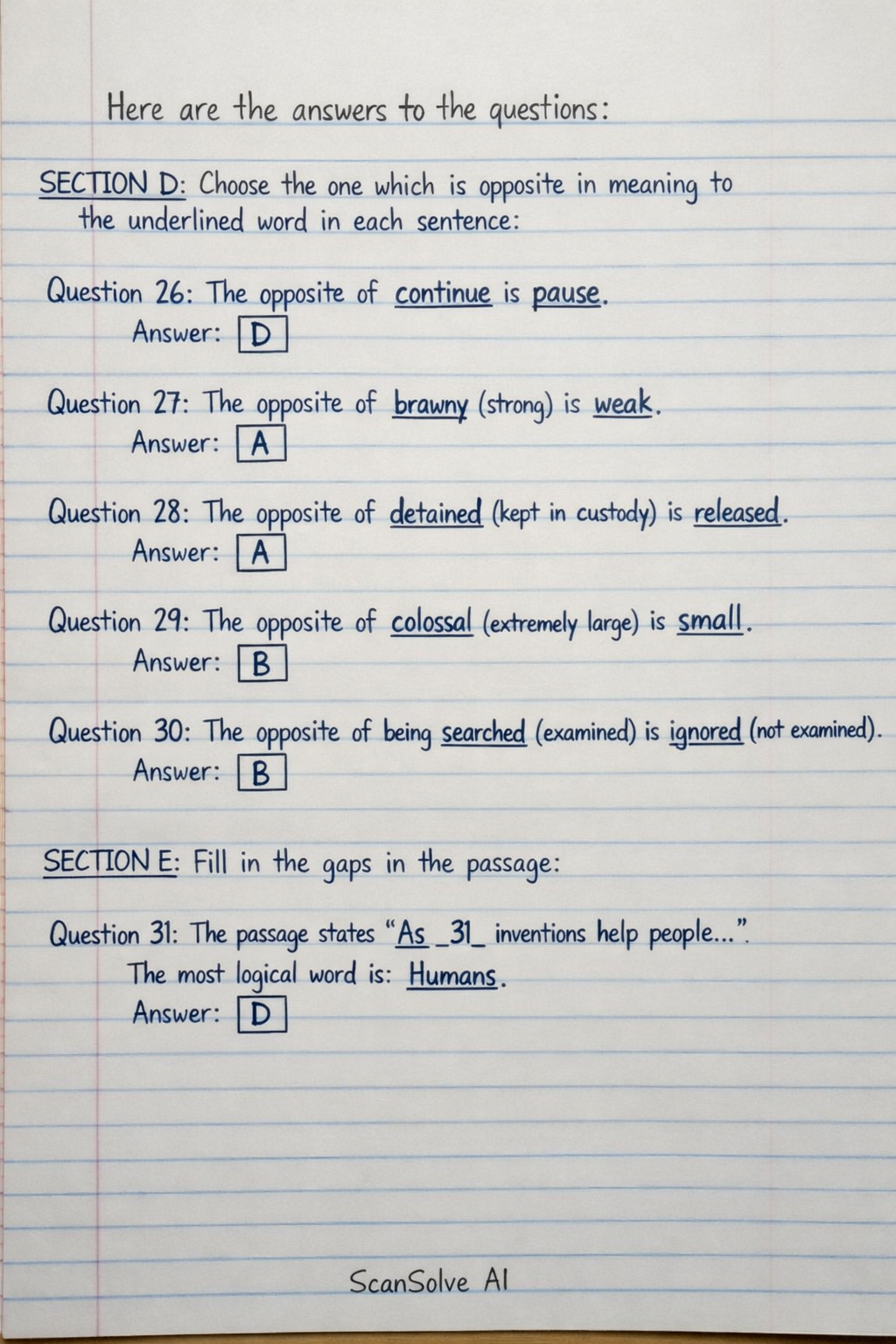
Here are the answers to the questions: SECTION D: Choose the one which is opposite in meaning to the underlined word in each sentence. Question 26: The opposite of continue is pause*. Answer: D Question 27: The opposite of brawny (meaning strong or muscular) is weak*. Answer: A Question 28: The opposite of detained (meaning kept in custody) is released*. Answer: A Question 29: The opposite of colossal (meaning extremely large) is small*. Answer: B Question 30: The opposite of being searched (examined) is to be ignored* (not examined). Answer: B SECTION E: Fill in the gaps in the passage. Question 31: The passage states "As ___31___ inventions help people...". The most logical word to complete this sentence, indicating who benefits from or creates inventions, is "Humans". Answer: D Question 32: The phrase "...help people to ___32___ longer and healthier" requires a verb that signifies existence and well-being. "Live" fits this context best. Answer: B Question 33: The sentence "They make ___33___ easier..." refers to a common benefit of inventions. Inventions often make "work" easier. Answer: A Question 34: The phrase "...and improve our ___34___ of the world" suggests that inventions enhance understanding. "Knowledge" is the appropriate word here. Answer: B Question 35: The sentence "Any good invention should identify and ___35___ a problem" describes the purpose of an invention. Inventions are designed to "solve" problems. Answer: D PART B - ORAL LANGUAGE UNIT I: Choose from the options A to D, the monosyllabic word Question 36: A. Given (giv-en) - 2 syllables B. Tedious (te-di-ous) - 3 syllables C. Goes (goes) - 1 syllable D. Money (mon-ey) - 2 syllables Answer: C Question 37: A. Died (died) - 1 syllable B. Better (bet-ter) - 2 syllables C. Children (chil-dren) - 2 syllables D. People (peo-ple) - 2 syllables Answer: A Question 38: A. Symbol (sym-bol) - 2 syllables B. Modify (mod-i-fy) - 3 syllables C. Chalk (chalk) - 1 syllable D. Topic (top-ic) - 2 syllables Answer: C UNIT II: Choose from the options A to D, the disyllabic words Question 39: A. Request (re-quest) - 2 syllables B. Energy (en-er-gy) - 3 syllables C. Board (board) - 1 syllable D. Principle (prin-ci-ple) - 3 syllables Answer: A Question 40: A. Bank (bank) - 1 syllable B. Conclusion (con-clu-sion) - 3 syllables C. Paragraph (par-a-graph) - 3 syllables D. Research (re-search) - 2 syllables Answer: D