

This English question involves literary analysis, grammar, or writing skills. The detailed response below provides a well-structured answer with supporting evidence and clear explanations.
ScanSolve AI Answer
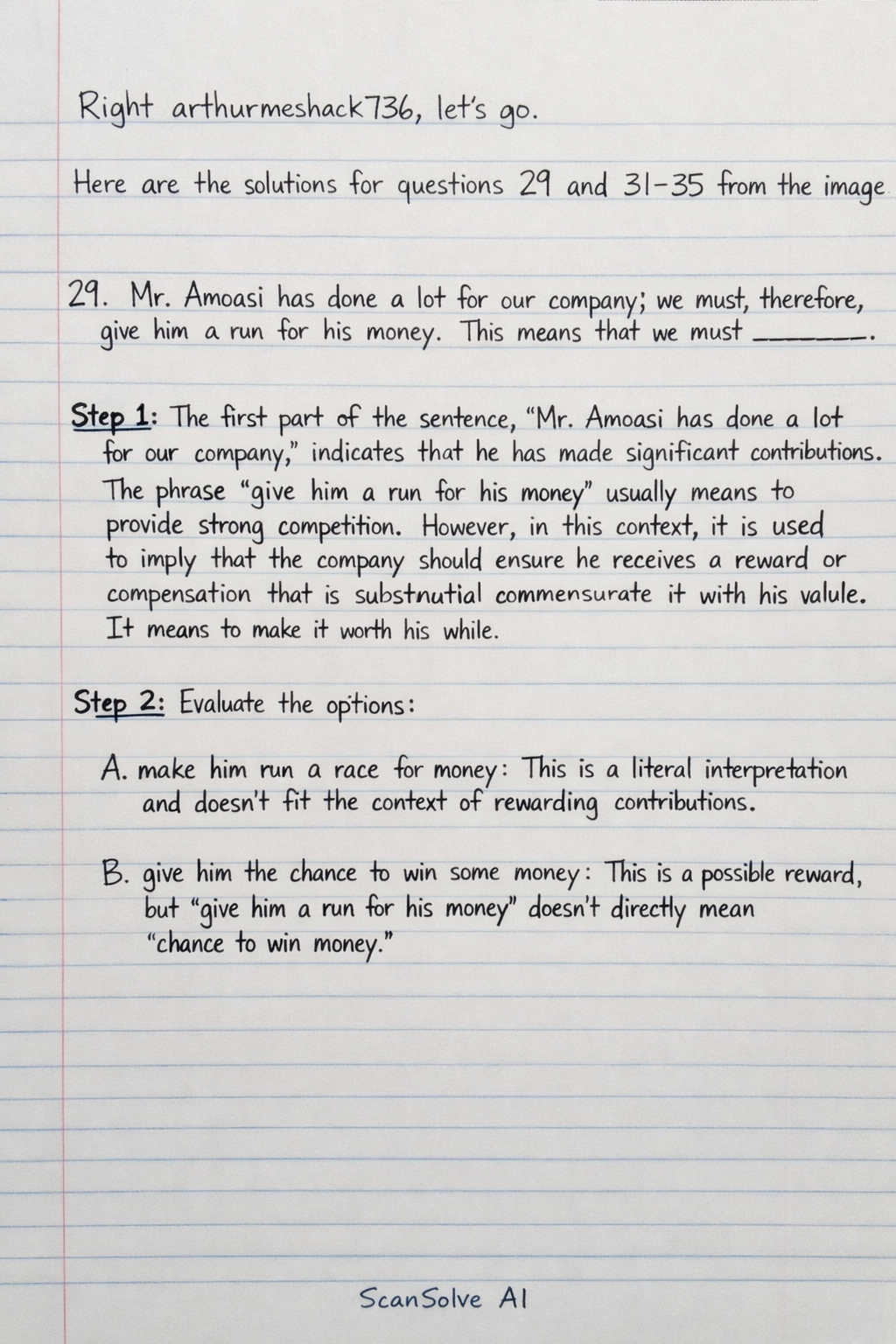
Right arthurmeshack736, let's go. Here are the solutions for questions 29 and 31-35 from the image. 29. Mr. Amoasi has done a lot for our company; we must, therefore, give him a run for his money. This means that we must \_\_\_\_\_\_ Step 1: The first part of the sentence, "Mr. Amoasi has done a lot for our company," indicates that he has made significant contributions. The phrase "give him a run for his money" usually means to provide strong competition. However, in this context, it is used to imply that the company should ensure he receives a reward or compensation that is substantial and commensurate with his valuable efforts. It means to make it worth his while. Step 2: Evaluate the options: A. make him run a race for money: This is a literal interpretation and doesn't fit the context of rewarding contributions. B. give him the chance to win some money: This is a possible reward, but "give him a run for his money" doesn't directly mean "chance to win money." C. allow him to use his money to run the company: This doesn't make sense as a reward for his* efforts. D. give him some rewards for his efforts: This option directly addresses the idea of rewarding someone for their contributions, which is the most logical consequence of "he has done a lot for our company." The correct option is D. The final answer is D 31. When the thief was arrested, he was caught \_\_\_\_\_\_ Step 1: The phrase describes catching someone in the act of committing a crime. Step 2: Evaluate the options: A. on time: refers to punctuality. B. red-handed: caught in the act of committing a crime. C. by chance: accidentally. D. in public: refers to location. Step 3: "Red-handed" is the idiom for being caught in the act. The correct option is B. The final answer is B 32. The teacher advised the students not to \_\_\_\_\_\_ but to speak clearly. Step 1: The contrasting phrase "but to speak clearly" indicates that the blank should be filled with an idiom meaning the opposite of speaking clearly, i.e., speaking indirectly or vaguely. Step 2: Evaluate the options: A. break the ice: to initiate social interaction. B. beat about the bush: to discuss a topic without coming to the point; to speak indirectly. C. face the music: to accept the unpleasant consequences of one's actions. D. call it a day: to stop working on something. Step 3: "Beat about the bush" means to avoid the main point, which is the opposite of speaking clearly. The correct option is B. The final answer is B 33. The principal decided to \_\_\_\_\_\_ to the minor offence. Step 1: The context is a "minor offence," suggesting a lenient approach or ignoring it. Step 2: Evaluate the options: A. turn a blind eye: to intentionally ignore something that one should disapprove of. B. see red: to become extremely angry. C. make ends meet: to earn just enough money to live on. D. blow his top: to lose one's temper. Step 3: "Turn a blind eye" fits the idea of ignoring a minor offence. The correct option is A. The final answer is A 34. The students are supposed to submit their assignments by tomorrow \_\_\_\_\_\_? Step 1: This is a tag question. The main clause is "The students are supposed to submit their assignments by tomorrow." The auxiliary verb is "are." Step 2: For tag questions, if the main clause is positive, the tag is negative. The auxiliary verb in the tag should match the main verb. So, the tag should be "aren't they?" Step 3: Check the options. Option A, "aren't they," is the correct tag. The correct option is A. The final answer is A 35. The invitation arrived \_\_\_\_\_\_, so many people were surprised. Step 1: The phrase "so many people were surprised" indicates that the invitation arrived unexpectedly. Step 2: Evaluate the options: A. at hand: close by; imminent. B. out of the blue: unexpectedly; without warning. C. on purpose: intentionally. D. in the long run: in the distant future. Step 3: "Out of the blue" means unexpectedly, which explains why people were surprised. The correct option is B. The final answer is B Send me the next one 📸