
We read your photo as:
Convert the actual lengths of the triangular plot to scaled lengths using the given scale.
ScanSolve AI Answer
Answer
Step-by-step solution
3 stepsPart a· 1 step
Convert the actual lengths of the triangular plot to scaled lengths using the given scale.
The actual side lengths are 80 m, 60 m, and 70 m.
The scale is 1 cm representing 10 m.
Scaled lengths:To draw the plan, you would:
- Draw a line segment of 8 cm (representing 80 m).
- From one end of this segment, use a compass to draw an arc with a radius of 6 cm (representing 60 m).
- From the other end of the 8 cm segment, use a compass to draw an arc with a radius of 7 cm (representing 70 m).
- The intersection of the two arcs is the third vertex of the triangle. Connect this vertex to the ends of the 8 cm segment to complete the triangle. The water sprinkler is placed at the incenter of the triangle, which is the point equidistant from all three sides. To locate it on your drawing, you would draw the angle bisectors of at least two angles; their intersection point is the incenter.
Reason for correct sprinkler position:
The correct position of the sprinkler, equidistant from all three sides, ensures that water is distributed uniformly across the entire triangular plot. This prevents certain areas from being over-watered or under-watered, which is crucial for the healthy growth of crops.
Part b
Calculate the total perimeter of the triangular plot.
The side lengths are 80 m, 60 m, and 70 m.
Calculate the total labour cost for fencing.
The labour cost is UGX 4,000 per metre.
The labour cost of fencing the plot is .
Try one yourself
A new problem that tests the same skill.
Still stuck on this one?
Ask a follow-up, and the answer starts from this question.
More English Questions
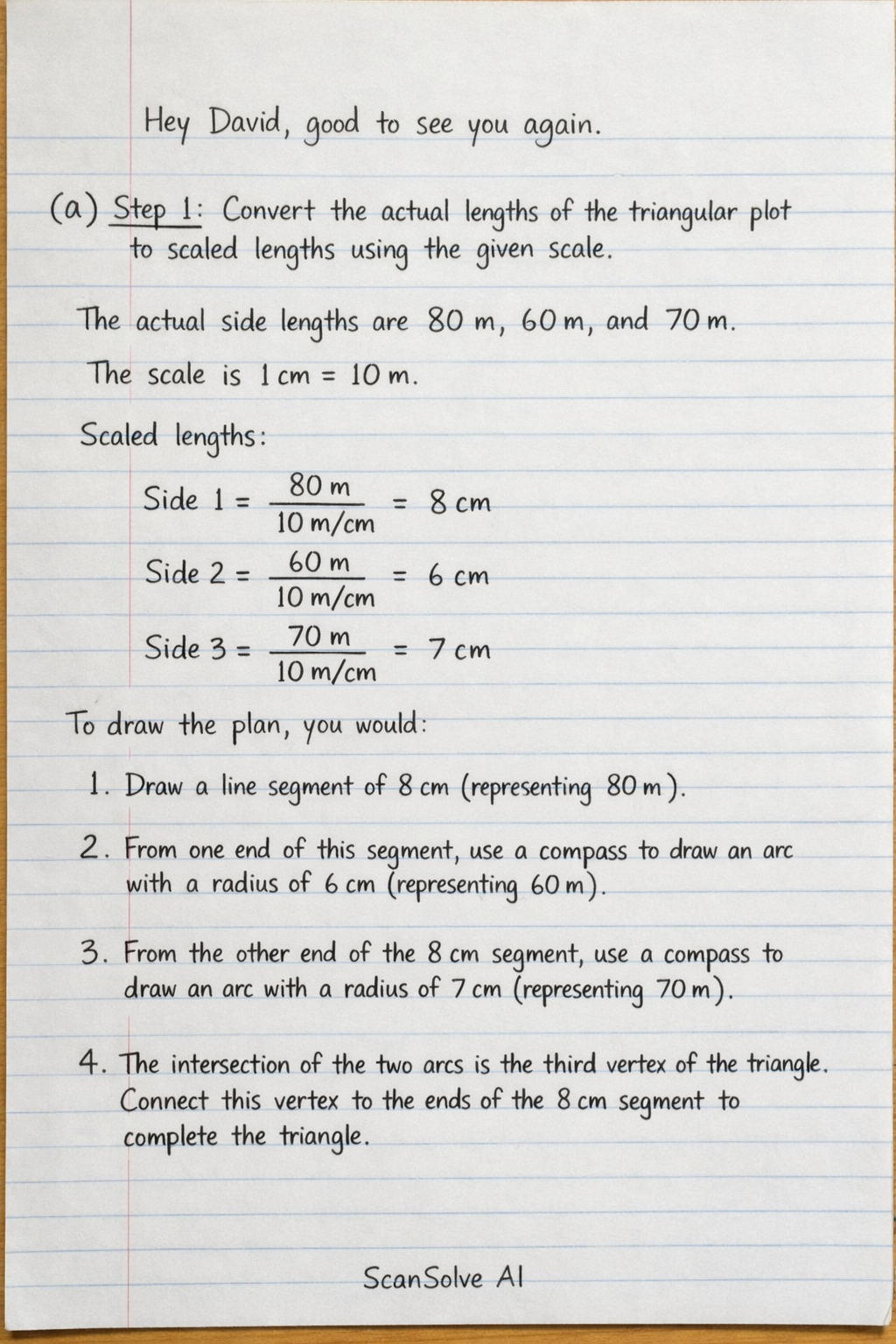
Handwritten Step-by-Step Solution
Get this as a handwritten image on WhatsApp — like a tutor wrote it for you.
Try on WhatsApp