

This English question involves literary analysis, grammar, or writing skills. The detailed response below provides a well-structured answer with supporting evidence and clear explanations.
ScanSolve AI Answer
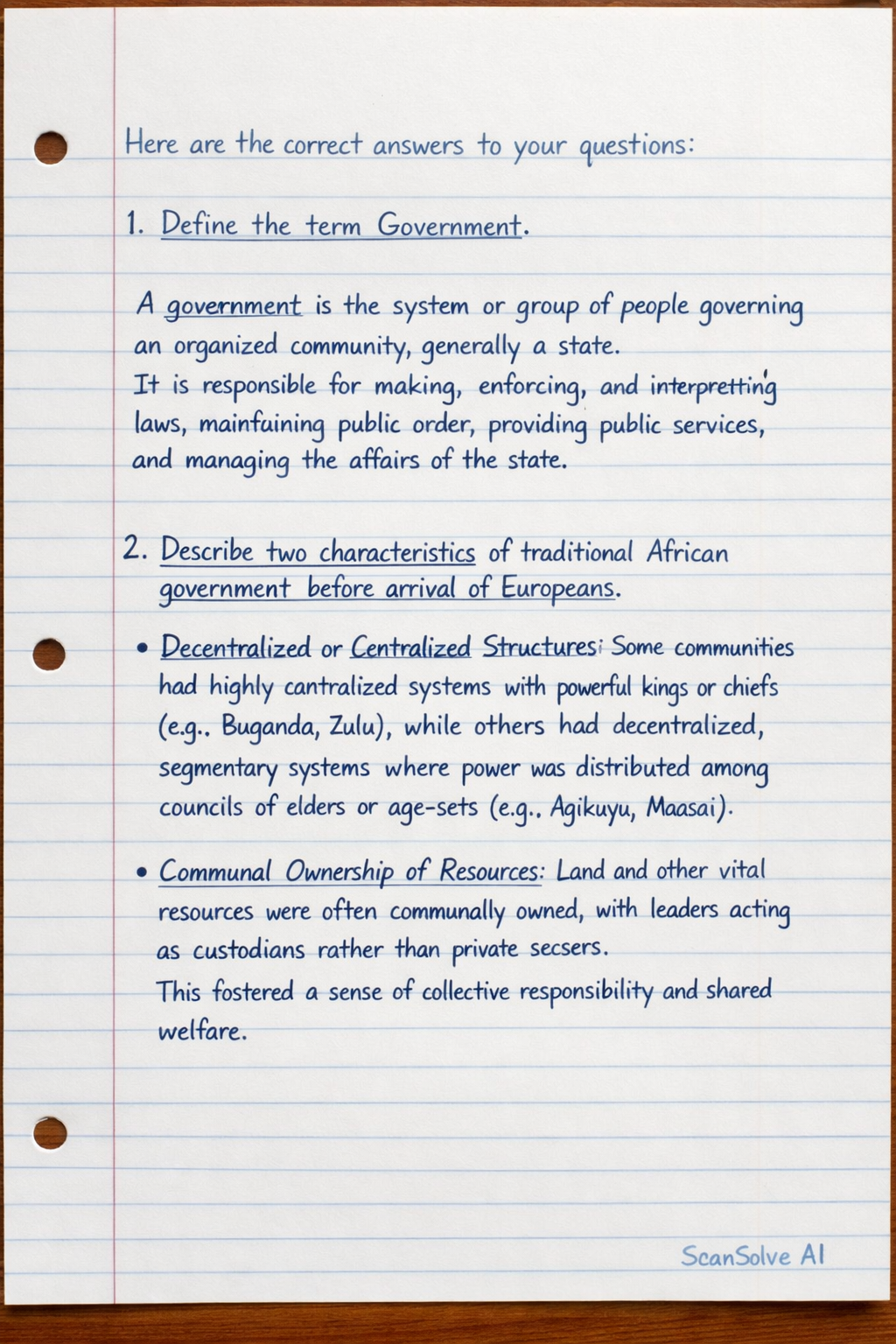
Here are the correct answers to your questions: 1. Define the term Government. A government is the system or group of people governing an organized community, generally a state. It is responsible for making, enforcing, and interpreting laws, maintaining public order, providing public services, and managing the affairs of the state. 2. Describe two characteristics of traditional African government before arrival of Europeans. Decentralized or Centralized Structures: Some communities had highly centralized systems with powerful kings or chiefs (e.g., Buganda, Zulu), while others had decentralized, segmentary systems where power was distributed among councils of elders or age-sets (e.g., Agikuyu, Maasai). Communal Ownership of Resources: Land and other vital resources were often communally owned, with leaders acting as custodians rather than private owners. This fostered a sense of collective responsibility and shared welfare. Rule by Elders/Age-Sets: In many societies, governance was based on age-set systems or councils of elders who made decisions, settled disputes, and enforced customs. Wisdom and experience were highly valued in leadership. Customary Laws: Governance was guided by unwritten customary laws and traditions passed down through generations. These laws covered aspects like marriage, inheritance, land use, and dispute resolution. Religious and Spiritual Authority: Leaders often held both political and spiritual authority, with religious beliefs and rituals playing a significant role in legitimizing their power and maintaining social cohesion. 3. Identify 3 ways in which traditional African communities maintained law and order. Customary Laws and Taboos: Communities had unwritten customary laws and taboos that dictated acceptable behavior and consequences for transgressions. These were enforced by elders or specific age-sets. Councils of Elders/Chiefs: Councils of elders or chiefs were responsible for settling disputes, mediating conflicts, and administering justice according to customary laws. Their decisions were generally respected and binding. Age-Set Systems: In many societies, age-sets played a crucial role in maintaining discipline, enforcing community norms, and even providing a military force to protect the community and enforce decisions. Religious Beliefs and Rituals: Fear of supernatural punishment or ancestral curses often served as a deterrent against breaking laws. Oaths and rituals were used to determine guilt or innocence. Sanctions and Punishments: Punishments ranged from fines, public shaming, ostracism, compensation, or in severe cases, banishment or even death, depending on the gravity of the offense. 4. Describe political organization of Agikuyu community. The Agikuyu community had a decentralized political organization based on clans and age-sets, rather than a single centralized authority like a king. Clan System: The Agikuyu were organized into nine major clans, each tracing its lineage to one of the nine daughters of Gikuyu and Mumbi. Clans were important for social identity and mutual support. Council of Elders (Kiama): The primary unit of governance was the Kiama* (council of elders) at various levels: family, sub-location, and ridge. These councils were responsible for making decisions, settling disputes, and enforcing customary laws. Elders gained their position through age, wisdom, and payment of goats. Age-Set System (Mariika): The Mariika system played a significant role in social and political life. Young men progressed through different age-sets, each with specific responsibilities, including defense of the community and public works. Senior age-sets formed the core of the Kiama*. Judicial System: Disputes were resolved through a hierarchical system of Kiama. Minor cases were handled by junior elders, while more serious matters went to higher councils. Oaths (Muma*) were used to determine guilt or innocence in complex cases. No Centralized Chief: There was no single paramount chief or king ruling the entire Agikuyu community. Power was distributed among the various councils of elders, ensuring a more democratic and participatory form of governance. Last free one today — make it count tomorrow, or type /upgrade for unlimited.