

This English question involves literary analysis, grammar, or writing skills. The detailed response below provides a well-structured answer with supporting evidence and clear explanations.
ScanSolve AI Answer
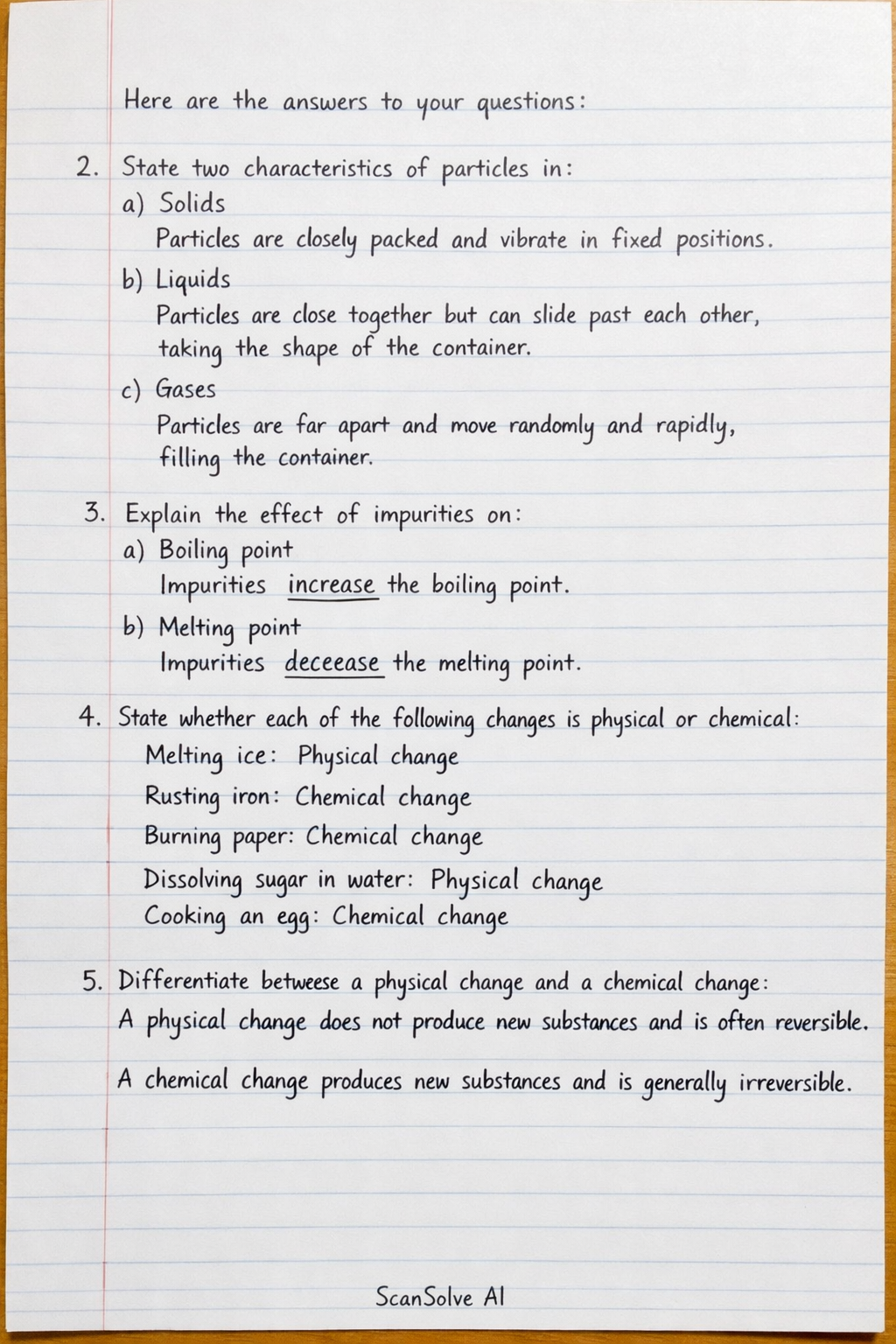
Here are the answers to your questions: 2. State two characteristics of particles in: a) Solids Particles are closely packed and vibrate in fixed positions. b) Liquids Particles are close together but can slide past each other, taking the shape of the container. c) Gases Particles are far apart and move randomly and rapidly, filling the container. 3. Explain the effect of impurities on: a) Boiling point Impurities increase the boiling point. b) Melting point Impurities decrease the melting point. 4. State whether each of the following changes is physical or chemical. Melting ice: Physical change* Rusting iron: Chemical change* Burning paper: Chemical change* Dissolving sugar in water: Physical change* Cooking an egg: Chemical change* 5. Differentiate between a physical change and a chemical change. A physical change does not produce new substances and is often reversible. A chemical change produces new substances and is generally irreversible. 6. Complete the table below. | Change of State | Process | | :-------------- | :------ | | Solid → Liquid | Melting | | Liquid → Gas | Evaporation | | Gas → Liquid | Condensation | | Liquid → Solid | Freezing | 1. Name the components of the fire triangle. a) Heat b) Fuel c) Oxygen 2. State four causes of fire in nature. a) Lightning b) Volcanic eruptions c) Friction (e.g., rubbing rocks) d) Spontaneous combustion of dry vegetation That's 2 down. 3 left today — send the next one.