
We read your photo as:
I want the answers in English
ScanSolve AI Answer
Step-by-step solution
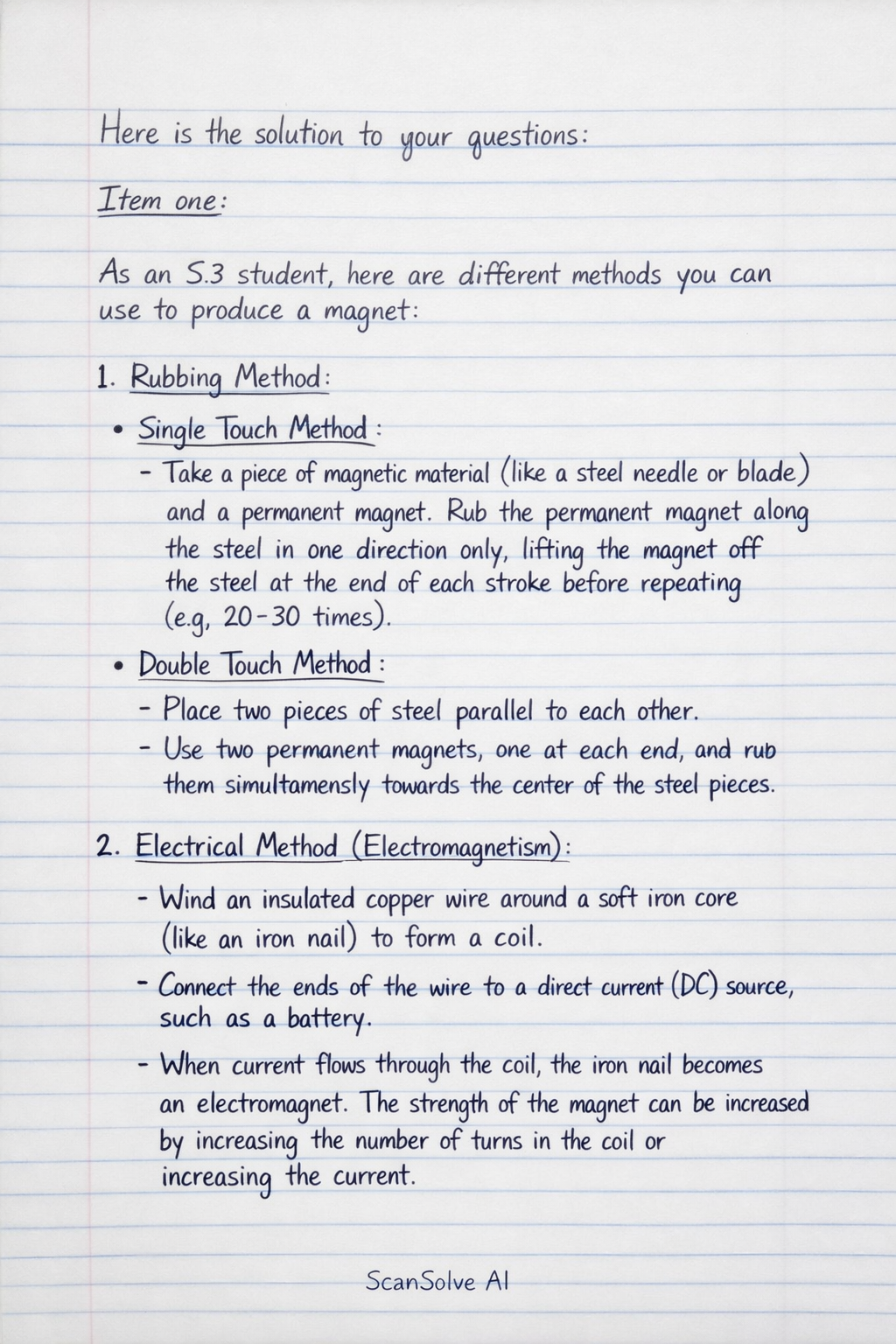
6 stepsHere is the solution to your questions:
Item one:
As an S.3 student, here are different methods you can use to produce a magnet:
-
Rubbing Method:
- Single Touch Method: Take a piece of magnetic material (like a steel needle or blade) and a permanent magnet. Rub the permanent magnet along the steel in one direction only, lifting the magnet off the steel at the end of each stroke before repeating (e.g., 20-30 times).
- Double Touch Method: Place two pieces of steel parallel to each other. Use two permanent magnets, one at each end, and rub them simultaneously towards the center of the steel pieces.
-
Electrical Method (Electromagnetism):
- Wind an insulated copper wire around a soft iron core (like an iron nail) to form a coil.
- Connect the ends of the wire to a direct current (DC) source, such as a battery.
- When current flows through the coil, the iron nail becomes an electromagnet. The strength of the magnet can be increased by increasing the number of turns in the coil or increasing the current.
-
Induction Method:
- Place a piece of magnetic material (like an iron nail) near a strong permanent magnet without touching it.
- The iron piece will become temporarily magnetized by induction and will be able to attract small magnetic objects. This is a temporary magnet.
Item two:
Part a· 6 steps
To determine which mirror forms a bigger image, we will use the mirror formula and magnification formula for each mirror.
Given data:
Object height
Object distance
For the Concave Mirror:
Focal length (positive for concave mirrors)
Find the image distance using the mirror formula
Find the magnification
Find the image height
The size of the image is . The negative sign indicates an inverted image.
For the Convex Mirror:
Focal length (negative for convex mirrors)Find the image distance using the mirror formula
Find the magnification
Find the image height
The size of the image is approximately .
Comparing the image heights, the concave mirror forms an image of , while the convex mirror forms an image of .
Therefore, the mirror that forms a bigger image is the Concave Mirror.
Part b
**Brief report on the nature of images formed by each mirror and advice on which mirror is suitable for use as a driving mirror
-
Concave Mirror:
- Nature of Image: For an object placed away from a concave mirror with a focal length of , the image formed is real, inverted, and magnified. The image is formed in front of the mirror and has a height of .
- Advice for Driving Mirror: A concave mirror is not suitable for use as a driving mirror. This is because it forms inverted and magnified images, and provides a narrow field of view, which can be dangerous for a driver.
-
Convex Mirror:
- Nature of Image: For an object placed away from a convex mirror with a focal length of , the image formed is virtual, upright, and diminished. The image is formed approximately behind the mirror and has a height of .
- Advice for Driving Mirror: A convex mirror is highly suitable for use as a driving mirror (side mirror or rear-view mirror). This is because it forms virtual, upright, and diminished images, and most importantly, provides a wider field of view, allowing the driver to see more of the road behind them.
Still stuck on this one?
Ask a follow-up, and the answer starts from this question.
More English Questions
Handwritten Step-by-Step Solution
Get this as a handwritten image on WhatsApp — like a tutor wrote it for you.
Try on WhatsApp