
We read your photo as:
Differentiate between Verbal irony, and Situational irony and dramatic Irony. Give an example of each of them. Explain the difference between the following pairs: a) climax and anti-climax b) Consonance and alliteration c) Allusion and metonymy d) Antithesis and paradox e) Sarcasm and irony.
ScanSolve AI Answer
Step-by-step solution
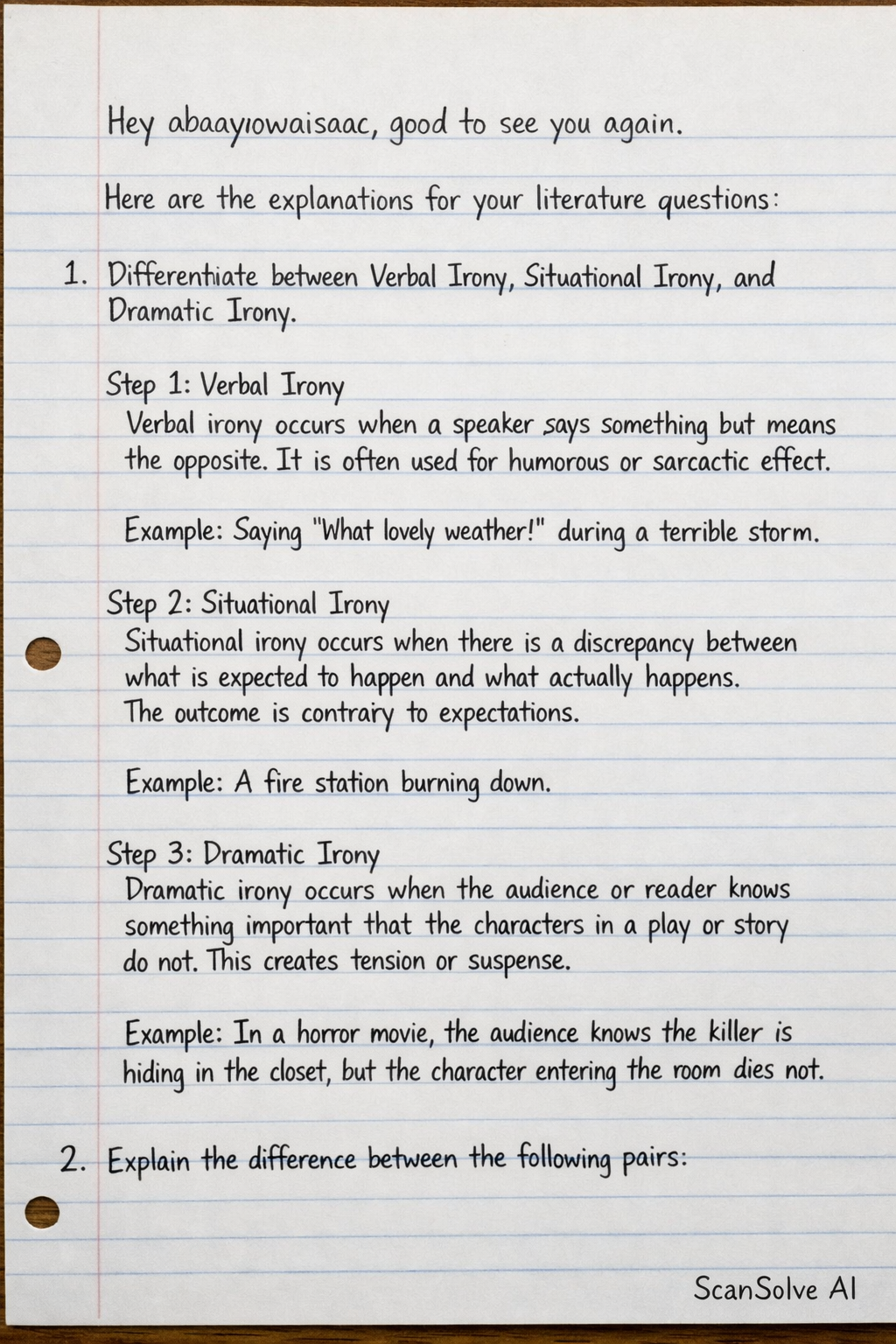
8 stepsHere are the explanations for your literature questions:
1. Differentiate between Verbal Irony, Situational Irony, and Dramatic Irony.
Verbal Irony
Verbal irony occurs when a speaker says something but means the opposite. It is often used for humorous or sarcastic effect.
Example: Saying "What lovely weather!" during a terrible storm.Situational Irony
Situational irony occurs when there is a discrepancy between what is expected to happen and what actually happens. The outcome is contrary to expectations.
Example: A fire station burning down.Dramatic Irony
Dramatic irony occurs when the audience or reader knows something important that the characters in a play or story do not. This creates tension or suspense.
Example: In a horror movie, the audience knows the killer is hiding in the closet, but the character entering the room does not.2. Explain the difference between the following pairs.
Climax and Anti-climax
Climax is the turning point of the story, where the tension or conflict reaches its peak. Anti-climax is a sudden, disappointing, or trivial end to an otherwise important or exciting series of events.
Consonance and Alliteration
Consonance is the repetition of consonant sounds within words in close proximity, such as "pitter-patter." Alliteration is the repetition of initial consonant sounds in words that are close together, like "Peter Piper picked a peck of pickled peppers."
Allusion and Metonymy
Allusion is an indirect reference to a person, place, event, or literary work. Metonymy is a figure of speech where a thing or concept is referred to by the name of something closely associated with it, such as "the crown" referring to royalty.
Antithesis and Paradox
Antithesis involves the juxtaposition of contrasting ideas in balanced phrases, like "Man proposes, God disposes." A paradox is a statement that appears self-contradictory but contains a deeper truth, such as "Less is more."
Sarcasm and Irony
Sarcasm is a form of verbal irony that is often harsh, cutting, and intended to mock or convey contempt. Irony is a broader literary device where there is a contrast between expectation and reality, or what is said and what is meant; sarcasm is a specific type of verbal irony.
Still stuck on this one?
Ask a follow-up, and the answer starts from this question.
More English Questions
Handwritten Step-by-Step Solution
Get this as a handwritten image on WhatsApp — like a tutor wrote it for you.
Try on WhatsApp