
We read your photo as:
Don't put answer in exercise book paper answer in normal,and give out more explanation for each answer and in English language
ScanSolve AI Answer
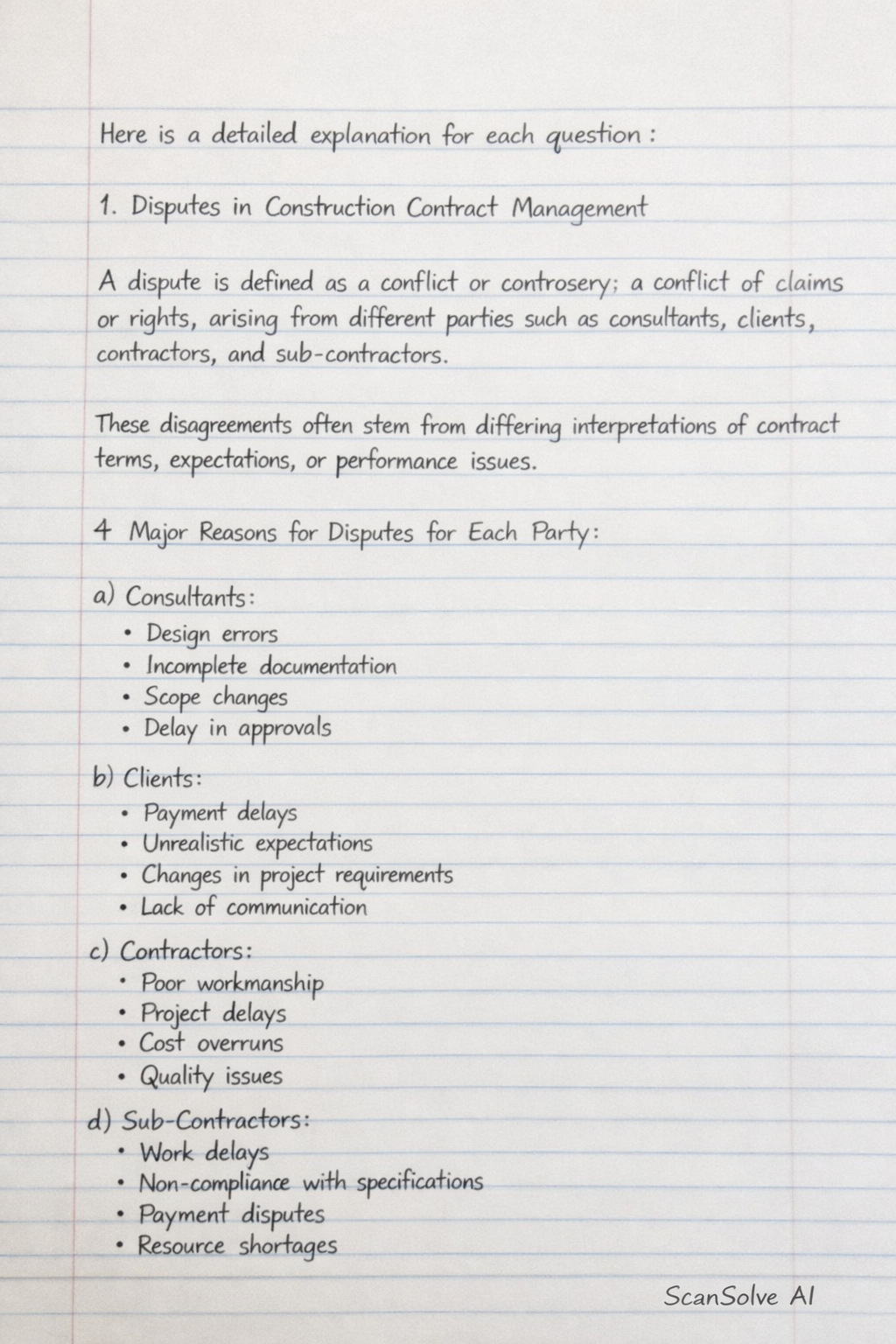
Here is a detailed explanation for each question:
1. Disputes in Construction Contract Management
A dispute is defined as a conflict or controversy; a conflict of claims or rights, arising from different parties such as consultants, clients, contractors, and sub-contractors. These disagreements often stem from differing interpretations of contract terms, expectations, or performance issues.
-
4 Major Reasons for Disputes for Each Party:
-
Consultants:
- Ambiguous Scope of Work: Disputes often arise when the consultant's responsibilities or the exact scope of their services are not clearly defined in the contract. This can lead to disagreements over what deliverables are expected or what constitutes additional work beyond the initial agreement.
- Errors or Omissions in Design: Mistakes, inconsistencies, or missing critical information in architectural designs, engineering drawings, or project specifications provided by the consultant can cause significant rework, delays, and increased costs during the construction phase, leading to contractor claims.
- Delayed Approvals/Decisions: Consultants are often responsible for reviewing contractor submissions, issuing approvals, or providing critical clarifications. Delays in these processes can halt construction progress, impact project schedules, and result in claims for extension of time or additional costs.
- Payment for Extra Services: Disagreements frequently occur regarding the scope and payment for services that the consultant deems "extra" or outside the original contract. If these variations are not properly documented, agreed upon, and priced, they can become a source of conflict.
-
Clients:
- Frequent Changes in Requirements: Clients often change their minds about the project's scope, design, or specifications after the contract has been awarded. These frequent variations can lead to significant cost overruns, project delays, and numerous claims from contractors for additional work and time.
- Delayed Payments: One of the most common causes of disputes is the client's failure to make timely payments to contractors or consultants as stipulated in the contract. This can severely impact the cash flow of the performing parties, potentially leading to work stoppages, demobilization, and legal action.
- Inaccurate or Incomplete Information: Providing incorrect, insufficient, or delayed critical information (e.g., site access, existing utility locations, necessary permits) required for the project's execution can cause significant disruptions, unforeseen conditions, and claims for delays and additional costs.
- Interference in Contractor's Work: Direct intervention by the client in the contractor's construction methods, site management, or selection of sub-contractors can disrupt workflow, create confusion over responsibilities, and lead to claims that the client is impeding the contractor's ability to perform.
-
Contractors:
- Delays in Project Completion: Contractors are often held accountable for completing projects within the agreed-upon schedule. Failure to meet milestones or the final completion date can result in liquidated damages, project extensions, and financial penalties, leading to disputes over responsibility for the delays.
- Poor Workmanship or Materials: Disputes arise when the quality of work performed or the materials used by the contractor do not meet the specified standards or are deemed defective. This can lead to demands for rework, rectification costs, and potential structural failures, incurring additional costs and time.
- Unjustified Claims for Extras: Contractors may submit claims for additional work or variations that are not properly substantiated, documented, or agreed upon by the client or consultant. These claims, if not resolved, can lead to payment disputes and protracted negotiations.
- Non-compliance with Contract Terms: Failure by the contractor to adhere to specific contract clauses, safety regulations, environmental standards, or local building codes can result in penalties, legal action, project suspension, or termination, all of which are significant sources of disputes.
-
Sub-contractors:
- Delayed Payments from Main Contractor: Sub-contractors frequently face disputes due to delayed payments from the main contractor for completed work. This impacts their cash flow, ability to pay their own suppliers and workers, and can lead to work stoppages or legal action against the main contractor.
- Scope of Work Discrepancies: Disagreements often occur between sub-contractors and the main contractor regarding the exact scope of work, responsibilities, or interpretation of drawings and specifications assigned to the sub-contractor, leading to claims for additional work.
- Lack of Resources/Instructions: Insufficient provision of materials, equipment, site access, or clear and timely instructions from the main contractor can hinder the sub-contractor's ability to perform their work efficiently, causing delays and claims for disruption.
- Sudden Changes in Schedule: Abrupt changes to the work schedule, sequencing, or terms by the main contractor can disrupt the sub-contractor's planning, resource allocation, and ability to meet their own commitments, leading to claims for inefficiency or additional costs.
-
2. Importance of Procurement in District Councils
-
a) Explain why you think procurements is of paramount importance in district councils in Tanzania: Procurement is of paramount importance in district councils in Tanzania because it serves as the primary mechanism for the acquisition of goods, services, and works necessary for local development and public service delivery. District councils manage public funds, which are often scarce, and procurement ensures their efficient, transparent, and accountable utilization. Through a well-managed procurement process, councils can obtain the best value for money, ensuring that essential projects like schools, health centers, roads, and water systems are constructed to the required quality standards, delivered on time, and within budget. Furthermore, robust procurement systems are crucial for combating corruption, preventing embezzlement, and minimizing the misuse of public resources, thereby fostering public trust and confidence in local government institutions and promoting sustainable development that directly benefits the community.
-
b) By giving an example, explain what will happen if the principles of procurements are not upheld in the procurement process in construction sector in your district? Example: Imagine a district council in your area decides to construct a new community health center to serve a growing population. If the fundamental principles of procurement, such as transparency, fairness, competition, and value for money, are not upheld—for instance, by awarding the construction tender to a contractor who lacks the necessary technical qualifications, financial capacity, or proven experience, perhaps due to favoritism, personal connections, or corrupt practices.
Consequences:
- Poor Project Quality: The health center might be constructed using substandard materials, poor workmanship, or inadequate design implementation. This could lead to a facility that is unsafe, structurally unsound, requires frequent and costly repairs shortly after completion, or fails to meet its intended purpose, ultimately endangering the health and safety of its users.
- Significant Project Delays: An unqualified or inefficient contractor may face numerous challenges, leading to prolonged construction periods, missed deadlines, and significant delays in the health center becoming operational. This deprives the community of essential healthcare services for an extended period, causing hardship and frustration.
- Exorbitant Cost Overruns: Due to poor planning, rework necessitated by defects, material failures, or the need to bring in other contractors to fix mistakes, the project's initial budget could be significantly exceeded. This leads to financial losses for the district, diverting scarce public funds from other critical development initiatives and potentially leaving other projects unfunded.
- Loss of Public Trust and Accountability: When procurement principles are violated, citizens lose faith in the district council's ability to manage public funds responsibly and deliver quality services. This erodes public confidence, fosters cynicism towards government institutions, and can lead to social unrest, protests, or demands for accountability from local leaders, damaging the council's reputation and legitimacy.
3. Functions of Three Members of the Tender Board
The Tender Board plays a critical role in ensuring fair, transparent, and efficient procurement processes. Here are four functions for each of its key members:
-
Chairperson of the Tender Board:
- To preside over all meetings of the Tender Board, ensuring that discussions are orderly, productive, and adhere to established procedures and legal frameworks.
- To ensure that all procurement laws, regulations, and guidelines are strictly followed throughout the tendering process, maintaining legality, fairness, and ethical conduct.
- To approve meeting agendas and ensure that all necessary documents and information are available to board members, enabling them to make informed and well-considered decisions.
- To sign official documents, including tender awards, minutes of meetings, and other formal communications, thereby validating the Board's decisions and ensuring their legal enforceability.
-
Secretary of the Tender Board:
- To prepare and circulate agendas, minutes, tender documents, and all necessary reports for Tender Board meetings in a timely and organized manner, ensuring all members are well-informed.
- To accurately record and maintain comprehensive minutes of all meetings, including decisions made, reasons for decisions, and any dissenting opinions, ensuring a clear and auditable trail of the process.
- To provide professional and technical advice to the Board on procurement matters, relevant legislation, and best practices, guiding decision-making to ensure compliance and efficiency.
- To ensure that decisions made by the Board are effectively communicated to relevant parties (e.g., bidders, procuring entity) and that their implementation is monitored to ensure adherence to the Board's directives.
-
Member of the Tender Board:
- To actively participate in all discussions, evaluations, and decision-making processes of the Board, contributing their expertise, insights, and critical analysis to ensure robust deliberations.
- To thoroughly review and critically evaluate all submitted tender documents, proposals, and evaluation reports to ensure compliance with specifications, assess technical and financial viability, and determine value for money.
- To offer objective opinions and professional advice based on their experience, technical knowledge, and understanding of procurement principles, helping the Board make sound and justifiable decisions.
- To ensure transparency, integrity, fairness, and impartiality are maintained throughout the entire tendering process, safeguarding against bias, conflicts of interest, or corruption, and upholding public trust.
Still stuck on this one?
Ask a follow-up, and the answer starts from this question.
More English Questions
Handwritten Step-by-Step Solution
Get this as a handwritten image on WhatsApp — like a tutor wrote it for you.
Try on WhatsApp