
We read your photo as:
Define folklore, myths, legends, and fables. Explain their significance and differentiate between them.
ScanSolve AI Answer
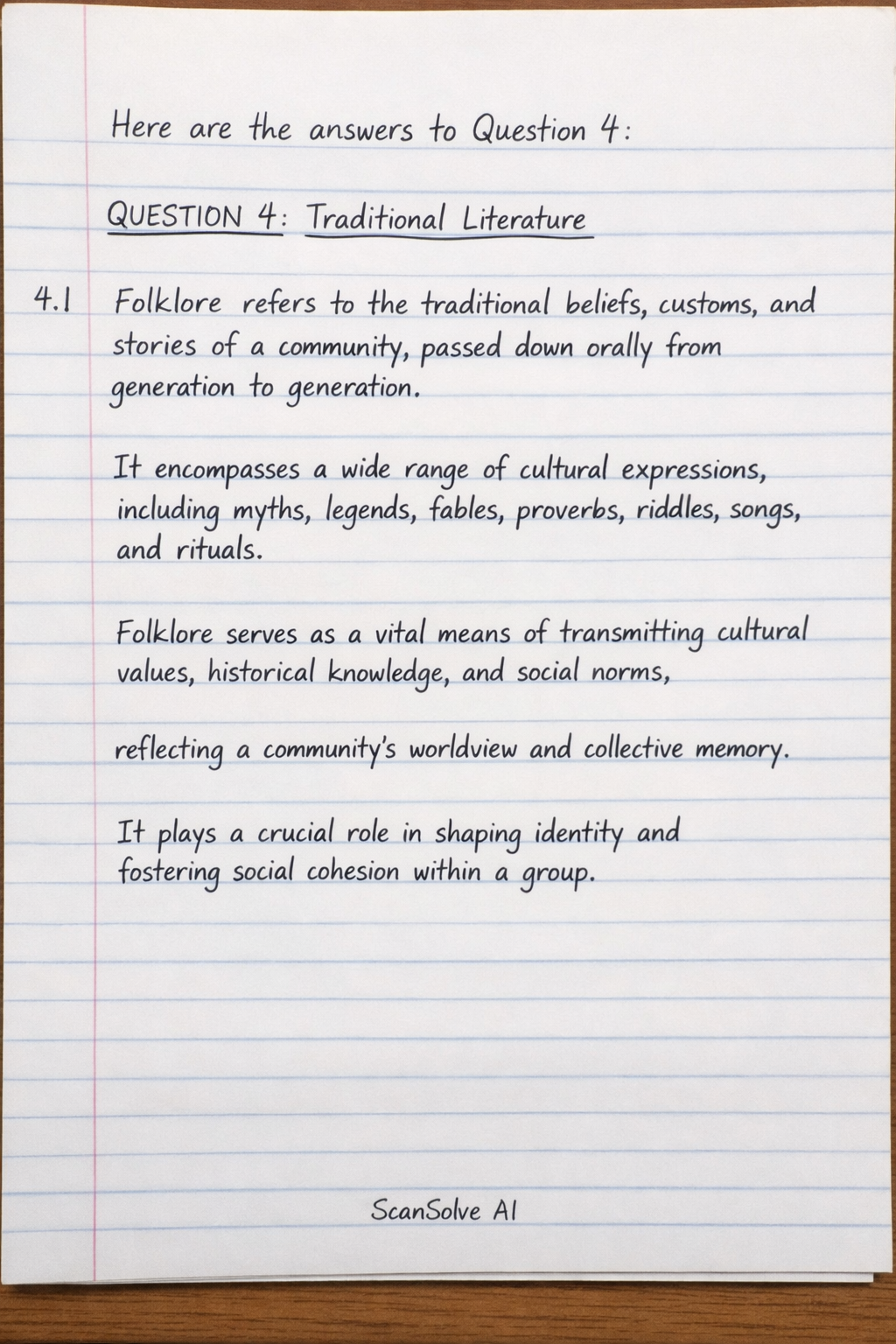
Here are the answers to Question 4:
QUESTION 4: Traditional Literature
4.1 Folklore refers to the traditional beliefs, customs, and stories of a community, passed down orally from generation to generation. It encompasses a wide range of cultural expressions, including myths, legends, fables, proverbs, riddles, songs, and rituals. Folklore serves as a vital means of transmitting cultural values, historical knowledge, and social norms, reflecting a community's worldview and collective memory. It plays a crucial role in shaping identity and fostering social cohesion within a group.
4.2
- Myths are sacred narratives that explain the origins of the world, natural phenomena, or human customs, often featuring deities or supernatural beings. They typically address fundamental questions about existence and provide a framework for understanding the universe.
- Legends are traditional stories about human heroes or historical events, often with a basis in fact but embellished over time. They are usually set in a specific time and place and are often believed to be true, even if they contain fantastical elements.
- Fables are short, fictional stories, often featuring anthropomorphic animals, plants, or inanimate objects, that convey a moral lesson or practical truth. They are primarily didactic, aiming to teach a principle of conduct or wisdom.
4.3
- Kaizer Chiefs: "Amakhosi Amahle" (The Beautiful Chiefs)
- Orlando Pirates: "Ezimnyama Ngenkani" (The Black Ones by Force)
- Mamelodi Sundowns: "Ka Bo Yellow" (It's Yellow)
4.4 Two types of "Stylised didactic prose" are proverbs and riddles.
-
1. Proverbs:
- These are short, pithy sayings that express a general truth or piece of advice. They often use metaphorical language to convey wisdom.
- Example (isiNdebele): "Induku enhle iganyulwa ezizweni."
- Meaning: A good stick is cut from foreign lands. (This proverb implies that good things or opportunities are often found far from home, or that one must seek beyond their immediate surroundings for success.)
-
2. Riddles:
- These are statements or questions phrased in a puzzling way, posed as a problem to be solved or guessed. They often rely on descriptive imagery and wordplay.
- Example (isiNdebele): "Ngilala ngivukela phezulu."
- Meaning: I sleep and wake up high.
- Answer: "Ukhuni" (Firewood, which is often stacked high and burns upwards).
Still stuck on this one?
Ask a follow-up, and the answer starts from this question.
More English Questions
Handwritten Step-by-Step Solution
Get this as a handwritten image on WhatsApp — like a tutor wrote it for you.
Try on WhatsApp