

This English question involves literary analysis, grammar, or writing skills. The detailed response below provides a well-structured answer with supporting evidence and clear explanations.
ScanSolve AI Answer
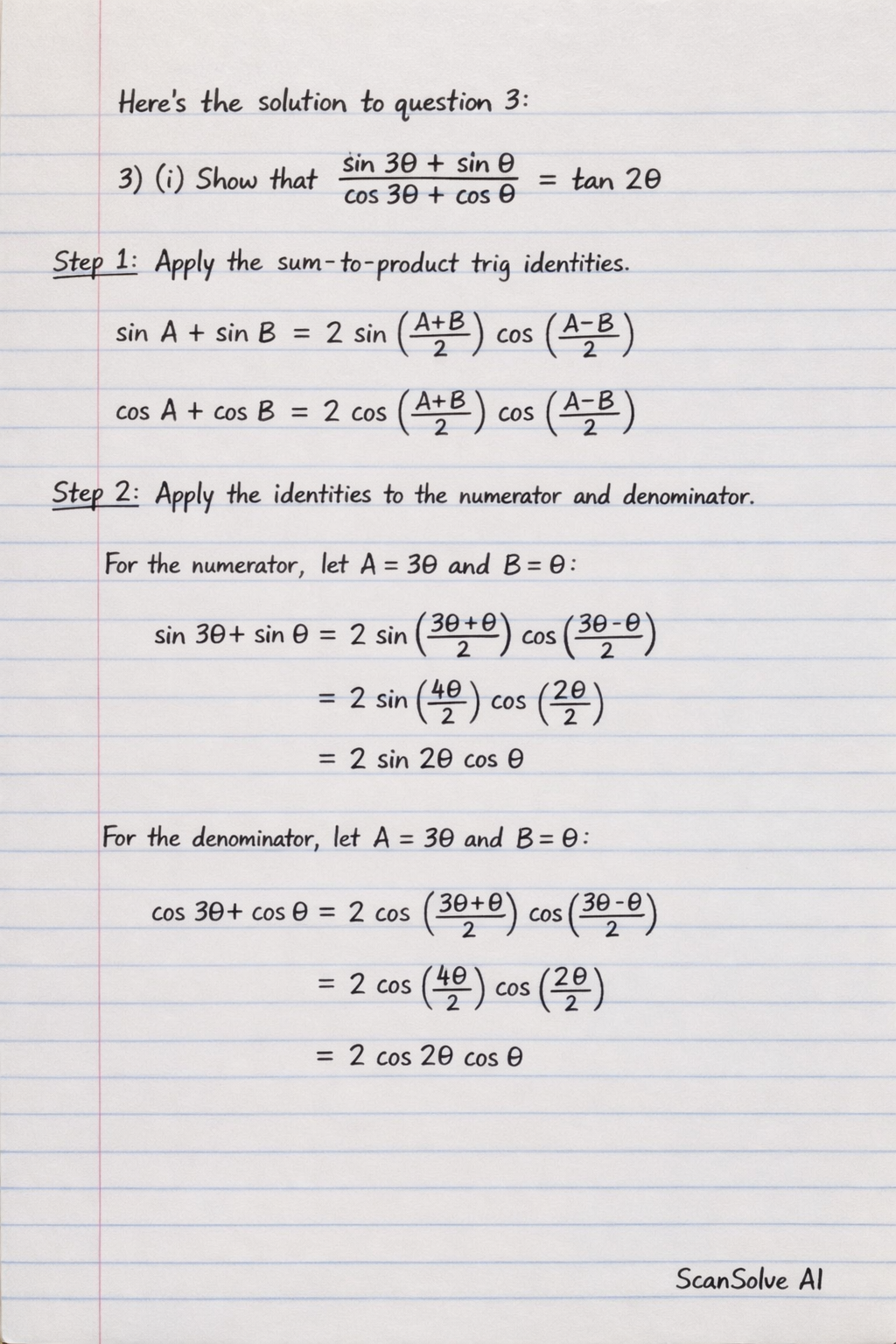
Here's the solution to question 3: 3) (i) Show that ( 3 + )/( 3 + ) = 2 Step 1: Apply the sum-to-product trigonometric identities. The identities are: A + B = 2 ((A+B)/(2)) ((A-B)/(2)) A + B = 2 ((A+B)/(2)) ((A-B)/(2)) Step 2: Apply the identities to the numerator and denominator. For the numerator, let A = 3 and B = : 3 + = 2 ((3+)/(2)) ((3-)/(2)) = 2 ((4)/(2)) ((2)/(2)) = 2 (2) () For the denominator, let A = 3 and B = : 3 + = 2 ((3+)/(2)) ((3-)/(2)) = 2 ((4)/(2)) ((2)/(2)) = 2 (2) () Step 3: Substitute the simplified expressions back into the original fraction. ( 3 + )/( 3 + ) = (2 (2) ())/(2 (2) ()) Step 4: Cancel common terms and simplify. Assuming () ≠ 0, we can cancel 2 () from the numerator and denominator: = ((2))/((2)) = (2) Thus, it is shown that ( 3 + )/( 3 + ) = 2. 3) (ii) Given that f(x) = x + sqrt(3) x a) Express f(x) in the form R (x - ), where R > 0 and 0 < < ()/(2). Step 1: Use the R-formula for a x + b x = R (x - ). Here, a=1 and b=sqrt(3). The formula states R = sqrt(a^2 + b^2) and = (b)/(a). Step 2: Calculate R. R = sqrt(1^2 + (3))^2 R = sqrt(1 + 3) R = sqrt(4) R = 2 Step 3: Calculate . = sqrt(3)1 = sqrt(3) Since a=1 and b=sqrt(3) are both positive, is in the first quadrant. = (sqrt(3)) = ()/(3) This value satisfies 0 < < ()/(2). Step 4: Write f(x) in the required form. f(x) = 2 (x - ()/(3)) b) Find the minimum value of (1)/(1+|f(x)|). Step 1: Determine the range of f(x). From part (a), f(x) = 2 (x - ()/(3)). The range of (x - ()/(3)) is [-1, 1]. Therefore, the range of f(x) is 2 × [-1, 1] = [-2, 2]. Step 2: Determine the maximum value of |f(x)|. The maximum value of |f(x)| occurs when f(x) = 2 or f(x) = -2. So, (|f(x)|) = |2| = 2. Step 3: Find the maximum value of the denominator 1+|f(x)|. To minimize the fraction (1)/(1+|f(x)|), we need to maximize its denominator. Maximum value of 1+|f(x)| = 1 + (|f(x)|) = 1 + 2 = 3. Step 4: Calculate the minimum value of the expression. The minimum value of (1)/(1+|f(x)|) is (1)/(maximum value of ) (1+|f(x)|). Minimum value = (1)/(3). The minimum value of (1)/(1+|f(x)|) is (1)/(3). c) Find the general solution of f(x) = sqrt(3). Step 1: Substitute the R-form of f(x) into the equation. 2 (x - ()/(3)) = sqrt(3) Step 2: Isolate the cosine term. (x - ()/(3)) = sqrt(3)2 Step 3: Find the principal value for the angle. The principal value for which = sqrt(3)2 is = ()/(6). Step 4: Write the general solution for the cosine equation. The general solution for = is = 2n ± , where n is an integer. So, x - ()/(3) = 2n ± ()/(6). Step 5: Solve for x in both cases. Case 1: x - ()/(3) = 2n + ()/(6) x = 2n + ()/(6) + ()/(3) x = 2n + ()/(6) + (2)/(6) x = 2n + (3)/(6) x = 2n + ()/(2) Case 2: x - ()/(3) = 2n - ()/(6) x = 2n - ()/(6) + ()/(3) x = 2n - ()/(6) + (2)/(6) x = 2n + ()/(6) The general solution is x = 2n + ()/(2) or x = 2n + ()/(6), where n Z. What's next?