

This mathematics problem involves applying core mathematical principles and formulas. Below you will find a complete step-by-step solution with detailed explanations for each step, helping you understand not just the answer but the method behind it.
ScanSolve AI Answer
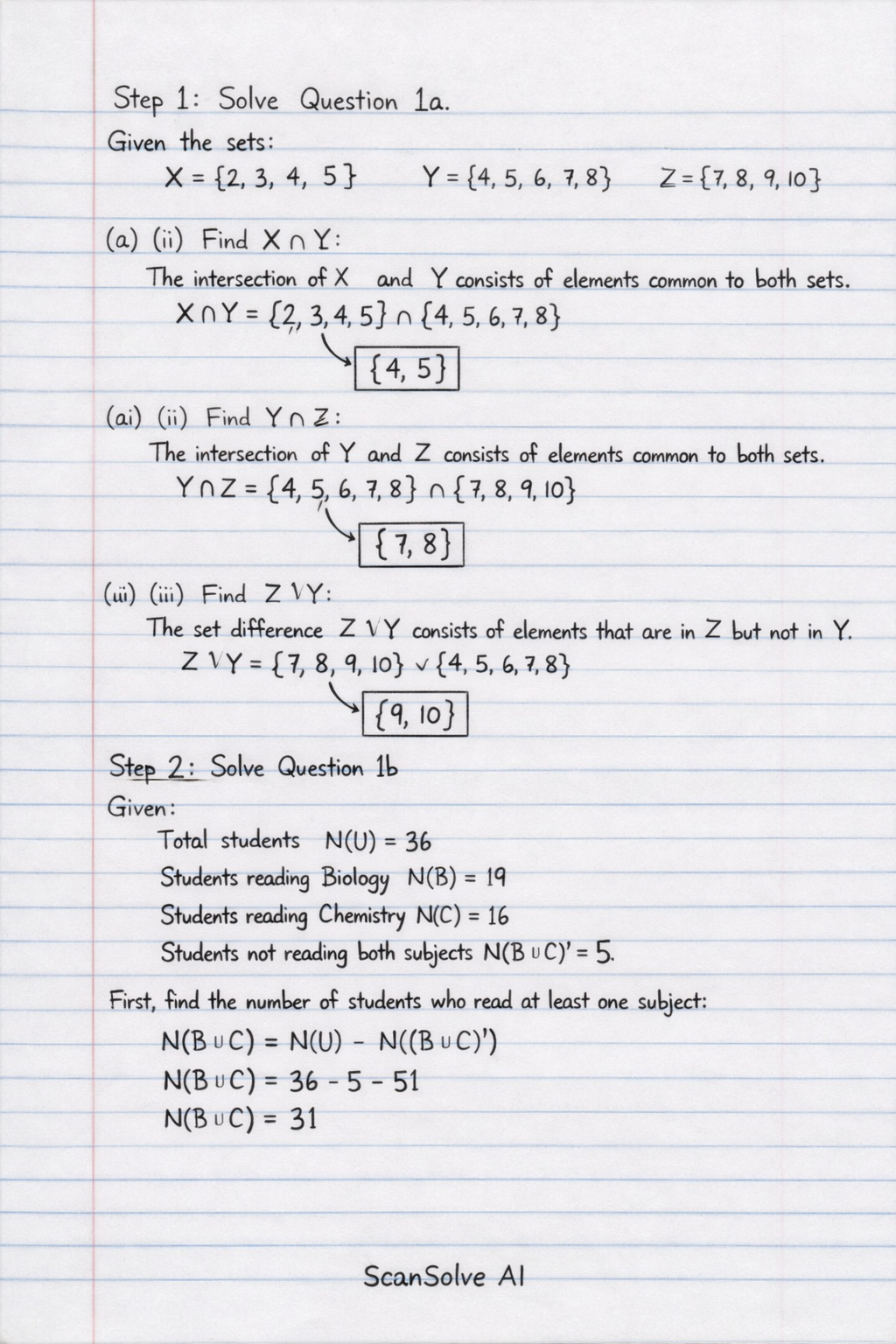
Step 1: Solve Question 1a. Given the sets: X = \2, 3, 4, 5\ Y = \4, 5, 6, 7, 8\ Z = \7, 8, 9, 10\ a) (i) Find X Y: The intersection of X and Y consists of elements common to both sets. X Y = \2, 3, 4, 5\ \4, 5, 6, 7, 8\ X Y = \4, 5\ a) (ii) Find Y Z: The intersection of Y and Z consists of elements common to both sets. Y Z = \4, 5, 6, 7, 8\ \7, 8, 9, 10\ Y Z = \7, 8\ a) (iii) Find Z Y: The set difference Z Y consists of elements that are in Z but not in Y. Z Y = \7, 8, 9, 10\ \4, 5, 6, 7, 8\ Z Y = \9, 10\ Step 2: Solve Question 1b. Given: Total students N(U) = 36 Students reading Biology N(B) = 19 Students reading Chemistry N(C) = 16 Students not reading both subjects N((B C)') = 5 First, find the number of students who read at least one subject: N(B C) = N(U) - N((B C)') N(B C) = 36 - 5 = 31 The formula for the union of two sets is N(B C) = N(B) + N(C) - N(B C). b) (i) Find how many students read both Biology and Chemistry: 31 = 19 + 16 - N(B C) 31 = 35 - N(B C) N(B C) = 35 - 31 N(B C) = 4 b) (ii) Find how many students read only Biology: Students who read only Biology are those in Biology but not in the intersection. N(only B) = N(B) - N(B C) N(only B) = 19 - 4 N(only B) = 15 b) (iii) Find how many students read only Chemistry: Students who read only Chemistry are those in Chemistry but not in the intersection. N(only C) = N(C) - N(B C) N(only C) = 16 - 4 N(only C) = 12 Venn Diagram Illustration: • Draw two overlapping circles. Label one "Biology" and the other "Chemistry". • The intersection (both B and C) contains 4 students. • The part of the Biology circle outside the intersection (only B) contains 15 students. • The part of the Chemistry circle outside the intersection (only C) contains 12 students. • The area outside both circles (neither B nor C) contains 5 students. • Total students: 15 + 4 + 12 + 5 = 36. Step 3: Solve Question 2 (Proof by Induction). Prove that 1^2 + 2^2 + 3^2 + + n^2 = (n(n+1)(2n+1))/(6). Base Case (n=1): LHS: 1^2 = 1 RHS: (1(1+1)(2 · 1+1))/(6) = (1 · 2 · 3)/(6) = (6)/(6) = 1 Since LHS = RHS, the statement is true for n=1. Inductive Hypothesis: Assume the statement is true for some positive integer k: 1^2 + 2^2 + 3^2 + + k^2 = (k(k+1)(2k+1))/(6) Inductive Step (n=k+1): We need to prove that the statement is true for n=k+1: 1^2 + 2^2 + 3^2 + + k^2 + (k+1)^2 = ((k+1)((k+1)+1)(2(k+1)+1))/(6) 1^2 + 2^2 + 3^2 + + k^2 + (k+1)^2 = ((k+1)(k+2)(2k+3))/(6) Start with the LHS: LHS = (1^2 + 2^2 + + k^2) + (k+1)^2 Using the inductive hypothesis: LHS = (k(k+1)(2k+1))/(6) + (k+1)^2 Factor out (k+1): LHS = (k+1) [ (k(2k+1))/(6) + (k+1) ] LHS = (k+1) [ 2k^2