
We read your photo as:
Given the vectors m = j + 2j and n = -3j + k. find: the angle between m and n, the projection of m on the n.
Mathematics
ScanSolve AI Answer
Answers
2 partsStep-by-step solution
5 stepsHere are the steps to solve the problem:
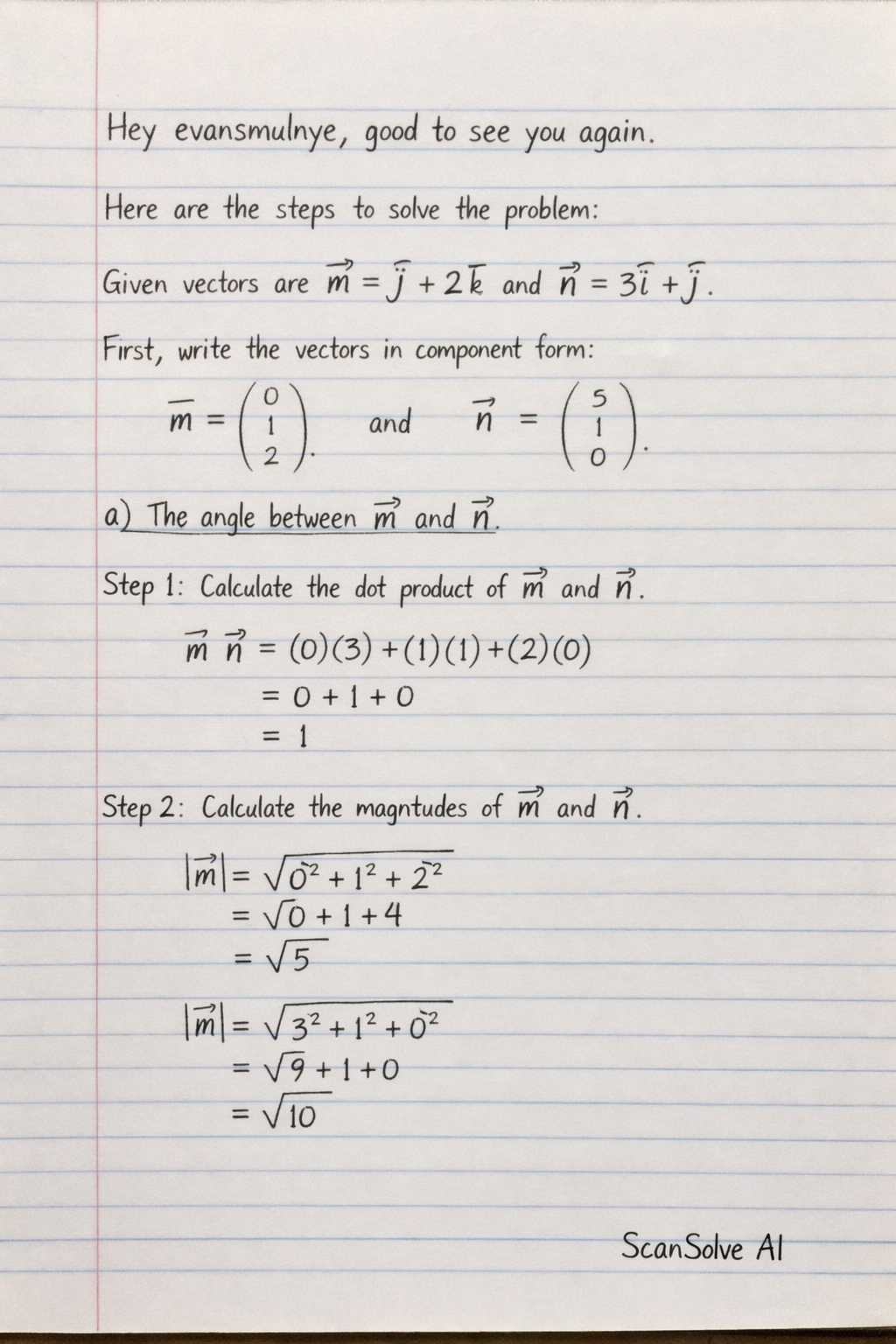
Given vectors are and .
First, write the vectors in component form:
Part a· 3 steps
The angle between and
Calculate the dot product of and .
Calculate the magnitudes of and .
Use the dot product formula for the angle between two vectors
.
To rationalize the denominator:
The angle between and is .
Part b
The projection of on
Use the formula for the vector projection of on
.
We already have and , so .Substitute the values into the projection formula.
The projection of on is .
Was this helpful?
Try one yourself
A new problem that tests the same skill.
Still stuck on this one?
Ask a follow-up, and the answer starts from this question.
Got a different question?Ask your own question
More Mathematics Questions
QGiven the vector m = 1+2j and n = 3j, find (i) The angle between m and n, (ii) The projection of m…QFind the value of m for which the vectors −2mi + 2j − 2k and 3i + 4mj + 3k perpendicular to each…QGiven vectors P = 3i − 2j − 4k and Q = ni + 2j − k, find the value of n if P and Q are…QCalculate the scalar projection of vector a = 2i + 3j − 2k onto vector b = i + 2j − 3k.QFind the sine of the angle between the vectors a = 3i − 2j + k and b = i + 2j − 3k
Browse by topic:Linear Algebra
Handwritten Step-by-Step Solution
Get this as a handwritten image on WhatsApp — like a tutor wrote it for you.
Try on WhatsApp