
I have an assignment so , This assignment requires you to analyse and apply the theory from the first six learning units of the module. It is divided into two main questions. Question 1 uses a case study to assess your ability to analyse a business situation. When formulating your answers, you will need to: • Conduct research beyond the textbook, using credible, referenced sources; however, the theoretical foundation for your answer must come from your prescribed textbook - marks will not be awarded if your answer contradicts the theory in your textbook; • Make sure to comply with the lIE referencing rubric, provided above. • Follow the marking rubrics to determine how marks will be awarded; Question 1 (Marks: 70) Review the following scenario, then answer the questions that follow. Zanele is a 35-year-old aspiring entrepreneur based in East London. After working in corporate administration for over a decade, she decided to follow her passion for hospitality and become a business owner. While researching different ways to enter the market, she learned that the owner of Daily Grind Café, a small coffee shop with a good reputation, was planning to emigrate and had listed the business for sale. Zanele had visited the café several times and always appreciated its relaxed atmosphere and menu, which offers a mix of traditional breakfast options, toasties, and locally roasted coffee. The café is located near office buildings, student accommodation, and a small hospital, and it receives a good flow of walk-in customers, especially during morning and lunchtime hours. These customers value convenience and affordable meals. While Zanele personally preferred a more suburban setting, she recognised the income potential of this busy, central location. Zanele arranged to meet the current owner, who was open and transparent about the business. He provided her with access to the financial statements from the past two years, a list of suppliers, a breakdown of monthly expenses, and information on the five staff members employed at the café. The owner explained that while the café's turnover had remained steady, it hadn't grown, as he had not invested in marketing or any upgrades in recent years. The café's equipment, including the coffee machine and kitchen appliances, was still functional but beginning to show signs of ageing. Zanele was intrigued by the opportunity but knew that buying an existing business came with both potential and risk. In terms of supplies, milk, bread, and coffee beans could be sourced from suppliers within a 5 km radius, offering competitive pricing and reliable delivery. Labour was also available locally, and the current staff members had experience in both barista and kitchen roles. However, the café had no dedicated parking, and public transport access was limited to daytime hours. Water and electricity were available, but occasional load shedding disrupted operations, and there was no backup power solution in place. The rent was reasonable for the area, but the space was small and offered little room for future expansion. The municipalitv hadrecently upgraded local pavements and signage. Zanele sees potential growth through a mobile ordering system and trending seasonal menu items, targeting busy professionals and students. The highly trained staff can help ensure service efficiency and consistency in quality. She hopes to stablish the café as a neighbourhood favourite where people can meet, study, or pop in for a takeaway. So long as no new competitors enter the area, the economy improves, and load shedding stops completely, she sees a bright future for this business. NOTE: In answering the questions below, consider the following: • Maintain a balance between theory and application, integrating the theory and application; • All theory must be referenced from the textbook first, and then only supplemented with other credible sources; Q.1.1 Create a checklist evaluating the location of the proposed business. The checklist should show which location factors are suitable and which are not, and which are not applicable. The evaluation should be concise and based on theory and the scenario. Marks(15) Q.1.2 Compare the advantages and disadvantages of buying an existing business, with application to the scenario. Based on your analysis, provide a recommendation as to whether Zanele should buy the business. Marks (15) Q.1.3 Create a diagram illustrating how businesses transform resources into products, with application to the scenario. Marks (20) Q. 1.4 Conduct a SWOT analysis for the business. Present your answer in a graphical format. Marks (20) Use this example below to Reference using the IIE Rosebank College in South Africa does use the "Introduction to Business Management" textbook, specifically the 12th edition, as part of their curriculum. This textbook, authored by Rudansky-Kloppers, Erasmus, and Strydom . This example text paraphrased: 2 or 3 authors 2 author's example • Strunk and White (2023) argue that overwriting should be avoided since it makes understanding and engaging with texts difficult for readers. • During the mid-nineties, research undertaken in Luton (Strunk and White, 2023) showed that overwriting should be avoided since it makes understanding and engaging with text difficult for readers. 3 author's example • Further research (Green, Harris and Dunne, 1969) showed that overwriting can be avoided if the correct Information is shared with readers. Reference list Strunk, W. and White, E.B., 2023. The elements of style, 4" ed. Massachusetts: Allan and Bacon.
English
ScanSolve AI Answer
The user provided examples of how to cite works with two or three authors in the IIE referencing style. I need to explain the rules for citing two or three authors based on the provided examples and general IIE referencing guidelines.
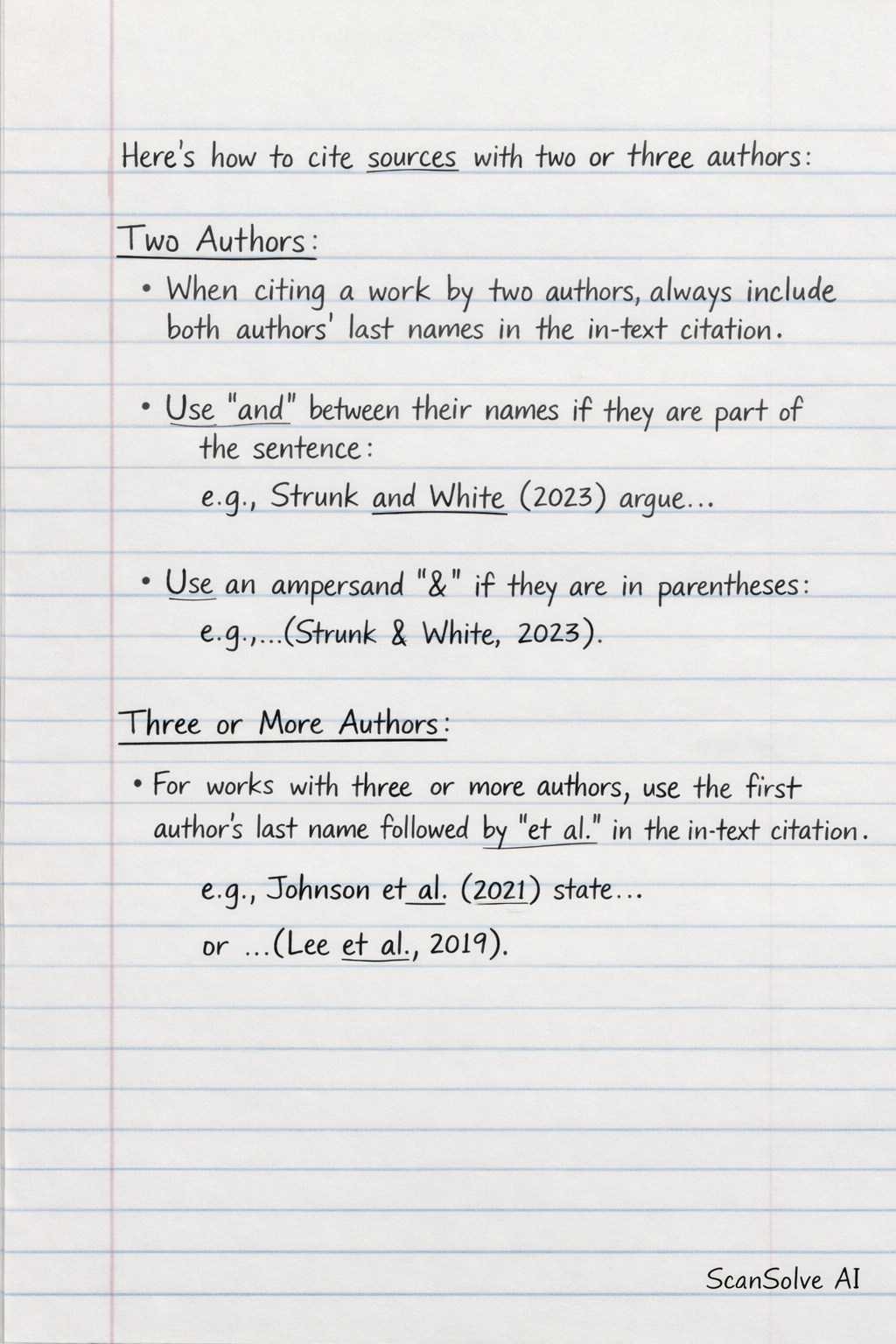
Here's how to cite sources with two or three authors:
- Two Authors: When citing a work by two authors, always include both authors' last names in the in-text citation. Use "and" between their names if they are part of the sentence (e.g., Strunk and White (2023) argue...), or use an ampersand "&" if they are in parentheses (e.g., ... (Strunk & White, 2023)).
- Three or More Authors: For works
Was this helpful?
Still stuck on this one?
Ask a follow-up, and the answer starts from this question.
Got a different question?Ask your own question
More English Questions
QHere is the outline of Section B: Practical Tasks Task 1: You are required to formulate a business…QGot you 👌 Here’s your full TAM2601 Assessment 2 / 2026 in a clean, ready-to-submit format. Just…QGot it – Ethics & Professionalism full 40/40 essay for Section C. Learn this structure and just swap…QWhat are the requirements for the Introduction section of an assignment about a business?QDefine corporate strategy and explain its scope. Discuss major growth strategies (mergers…
Handwritten Step-by-Step Solution
Get this as a handwritten image on WhatsApp — like a tutor wrote it for you.
Try on WhatsApp