
We read your photo as:
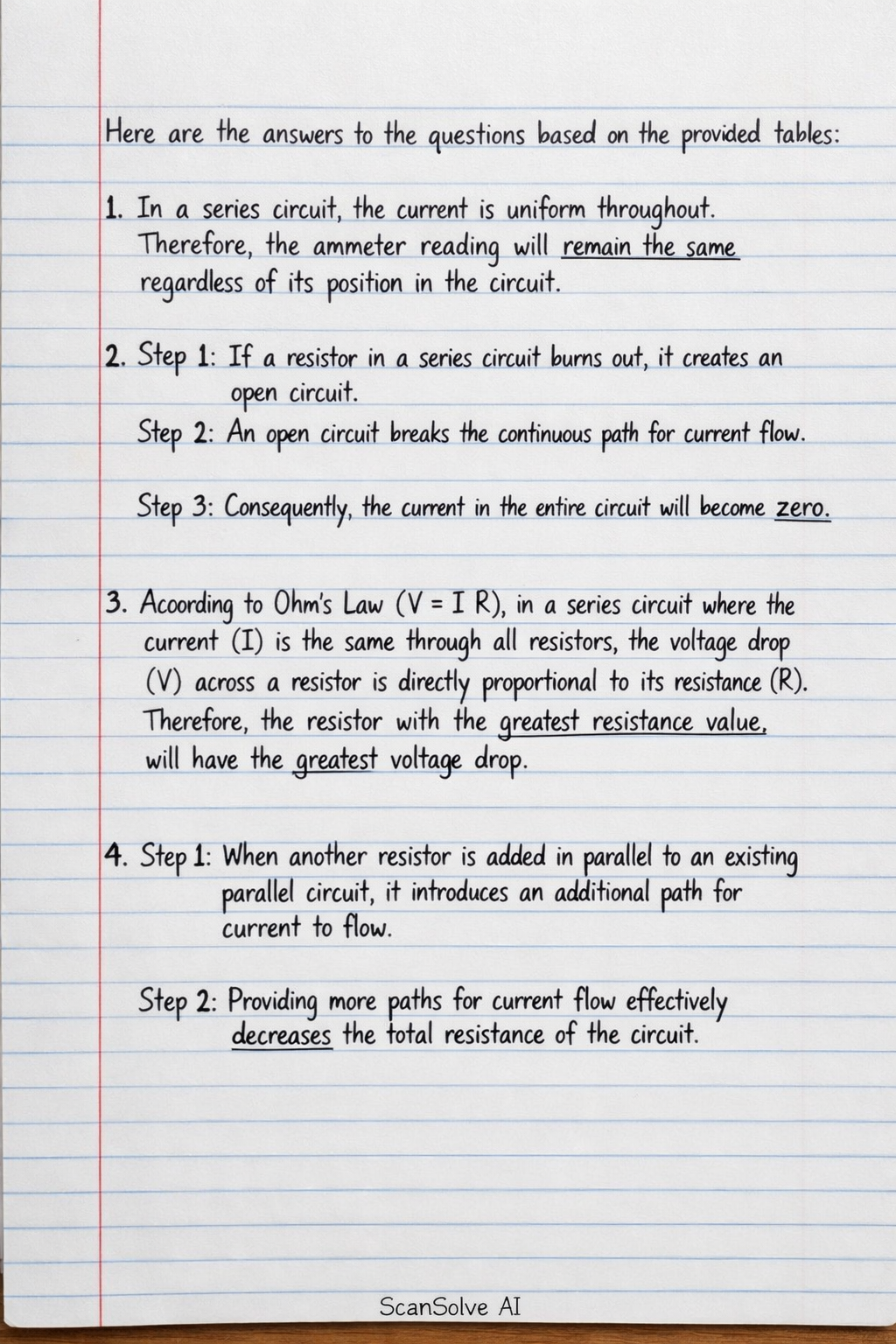
In a series circuit, the current is uniform throughout. Therefore, the ammeter reading will remain the same regardless of its position in the circuit.
ScanSolve AI Answer
Step-by-step solution
5 stepsHere are the answers to the questions based on the provided tables:
-
In a series circuit, the current is uniform throughout. Therefore, the ammeter reading will remain the same regardless of its position in the circuit.
-
Step 1: If a resistor in a series circuit burns out, it creates an open circuit.
An open circuit breaks the continuous path for current flow.
Consequently, the current in the entire circuit will become zero.
-
According to Ohm's Law (), in a series circuit where the current () is the same through all resistors, the voltage drop () across a resistor is directly proportional to its resistance (). Therefore, the resistor with the greatest resistance value will have the greatest voltage drop.
-
Step 1: When another resistor is added in parallel to an existing parallel circuit, it introduces an additional path for current to flow.
-
Providing more paths for current flow effectively decreases the total resistance of the circuit.
- Step 1: In a parallel circuit, each branch operates independently. The total current is the sum of the currents in each branch.
If one resistor is removed from a parallel circuit, that specific branch is eliminated.
The total current (ammeter reading) will decrease because there is one less path for current, but the current through the remaining resistors will not change.
-
The conclusion for experiment 1 (Series Circuit) is that the current is the same at all points in a series circuit, and the total voltage across the circuit is the sum of the individual voltage drops across each resistor.
-
The conclusion for experiment 2 (Parallel Circuit) is that the voltage across each branch is the same in a parallel circuit, and the total current flowing from the source is the sum of the currents flowing through each parallel branch.
-
Still stuck on this one?
Ask a follow-up, and the answer starts from this question.
More English Questions
Handwritten Step-by-Step Solution
Get this as a handwritten image on WhatsApp — like a tutor wrote it for you.
Try on WhatsApp