

This physics problem tests your understanding of fundamental physical laws and their applications. The step-by-step solution below breaks down the problem using relevant equations and physical reasoning.
ScanSolve AI Answer
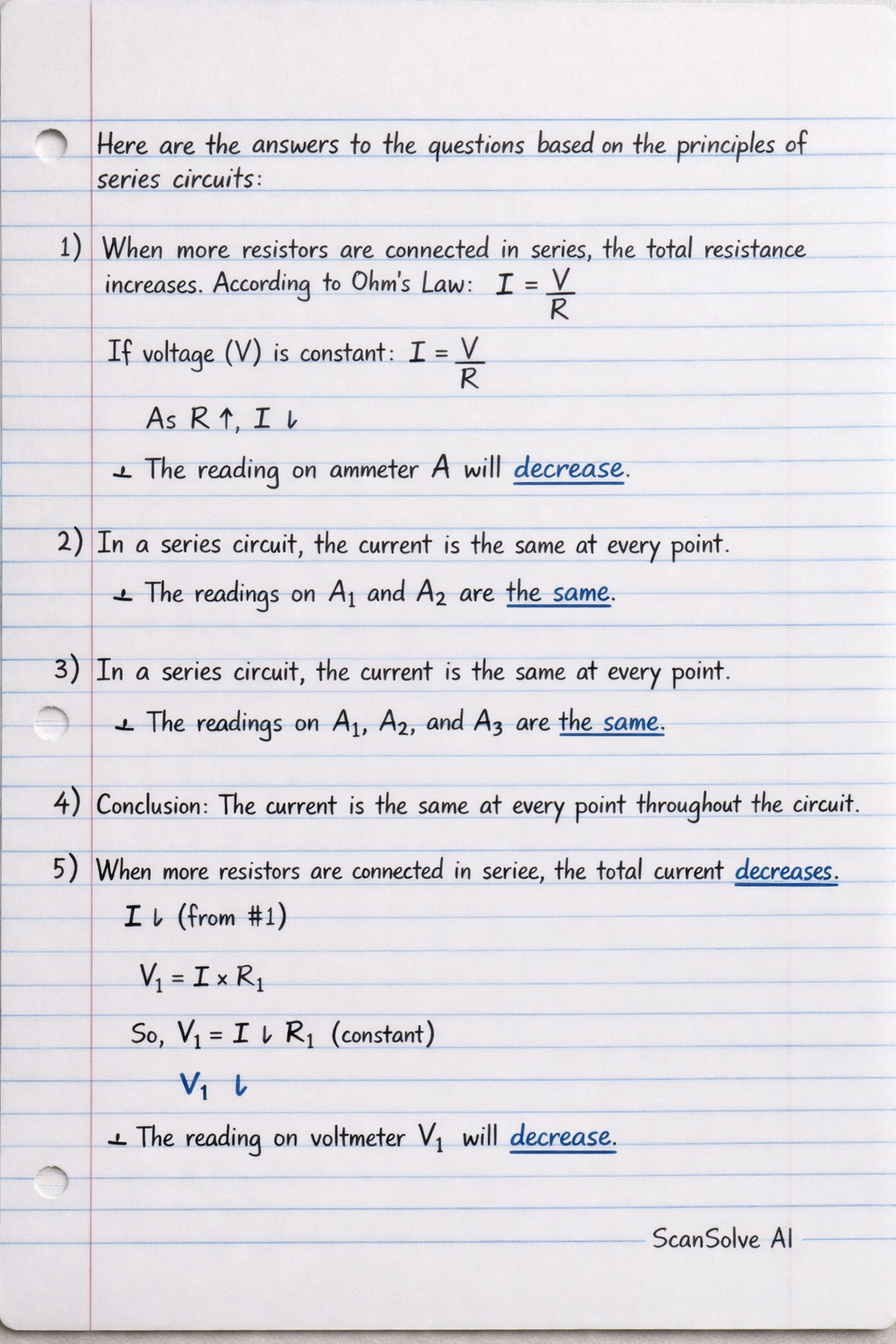
Here are the answers to the questions based on the principles of series circuits: 1. When more resistors are connected in series, the total resistance of the circuit increases. According to Ohm's Law (I = V/R), if the voltage source remains constant, the total current in the circuit will decrease. The reading on ammeter A will decrease. 2. In a series circuit, the current is the same at every point. The readings on A_1 and A_2 will be the same. 3. In a series circuit, the current is the same at every point. The readings on A_1, A_2, and A_3 will be the same. 4. The conclusion concerning the current in a series circuit is that the current is the same at every point throughout the circuit. 5. When more resistors are connected in series, the total current in the circuit decreases (as per question 1). Since V_1 measures the potential difference across a single resistor (V_1 = I × R_1), and the current I decreases while R_1 remains constant, V_1 will decrease. The reading on voltmeter V_1 will decrease. 6. In a series circuit, the sum of the potential differences across individual components equals the total potential difference across the series combination. The sum of V_1 and V_2 will be equal to the total potential difference across the two resistors. (A specific numerical value cannot be determined without experimental data). 7. The sum of V_1 and V_2 will be equal to the total potential difference across the series combination (e.g., the supply voltage if V_1 and V_2 cover the entire circuit). 8. In a series circuit, the sum of the potential differences across individual components equals the total potential difference across the series combination. The sum of V_1, V_2, and V_3 will be equal to the total potential difference across the three resistors. (A specific numerical value cannot be determined without experimental data). 9. The sum of V_1, V_2, and V_3 will be equal to the total potential difference across the series combination (e.g., the supply voltage if V_1, V_2, and V_3 cover the entire circuit). 10. The conclusion concerning the potential difference in a series circuit is that the total potential difference across the series combination is the sum of the potential differences across each individual resistor. CONCLUSION For resistors connected in series, the sum of the potential differences across the individual resistors is equal to the total potential difference across the series combination. Resistors connected in series are known as series circuit components. That's 2 down. 3 left today — send the next one.