
We read your photo as:
A group of learners perform an experiment to verify a gas law. The results of the experiment are shown in the graph of pressure vs the inverse of volume drawn below.
ScanSolve AI Answer
Answers
3 partsStep-by-step solution
6 stepsPart 5.1
The graph shows a direct proportionality between pressure () and the inverse of volume (). This relationship is described by Boyle's Law.
Part 5.2
An investigative question for this experiment could be:
"How does the pressure of a gas change as its volume is varied, while keeping the temperature and amount of gas constant?"
Part 5.3
The two variables that must be kept constant during the experiment to verify Boyle's Law are:
- The temperature of the gas.
- The amount (number of moles) of the gas.
Part 5.4
Locate the pressure value on the y-axis.
From the graph, when the pressure is , find the corresponding value on the x-axis.
Read the inverse of volume from the graph.
At , the value on the x-axis is .
So, .Calculate the volume.
The volume occupied by the gas is .
Part 5.5
Calculate the inverse of the given volume.
Given volume .
Determine the constant of proportionality (slope) from the graph.
The graph is a straight line passing through the origin. Using the point :
Calculate the pressure using the constant .
The pressure exerted by the gas is approximately .
Part 5.6
Two properties of an Ideal Gas are:
- The particles of an ideal gas have negligible volume.
- There are no intermolecular forces of attraction or repulsion between the particles of an ideal gas.
Try one yourself
A new problem that tests the same skill.
Still stuck on this one?
Ask a follow-up, and the answer starts from this question.
More Physics Questions
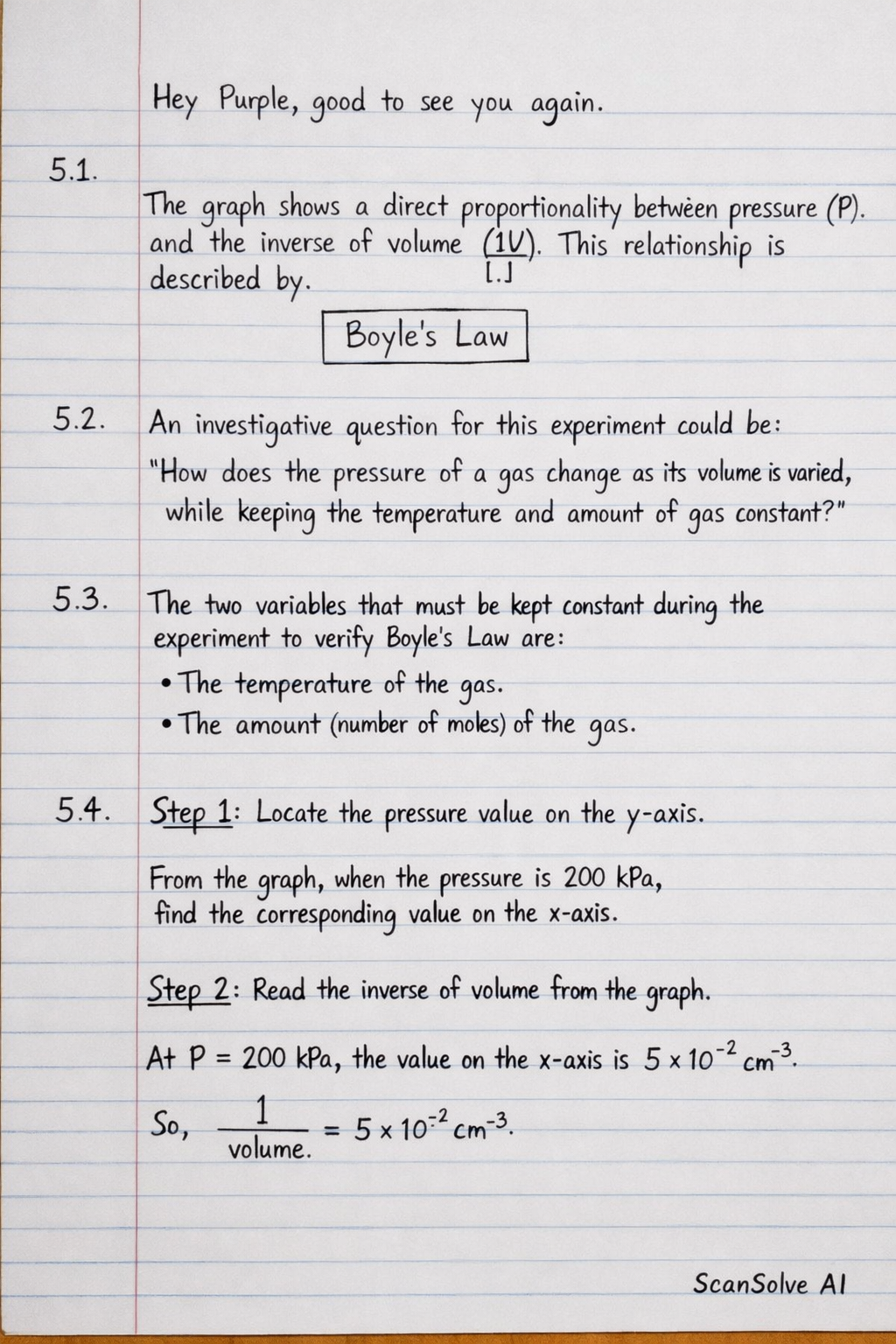
Handwritten Step-by-Step Solution
Get this as a handwritten image on WhatsApp — like a tutor wrote it for you.
Try on WhatsApp