
We read your photo as:
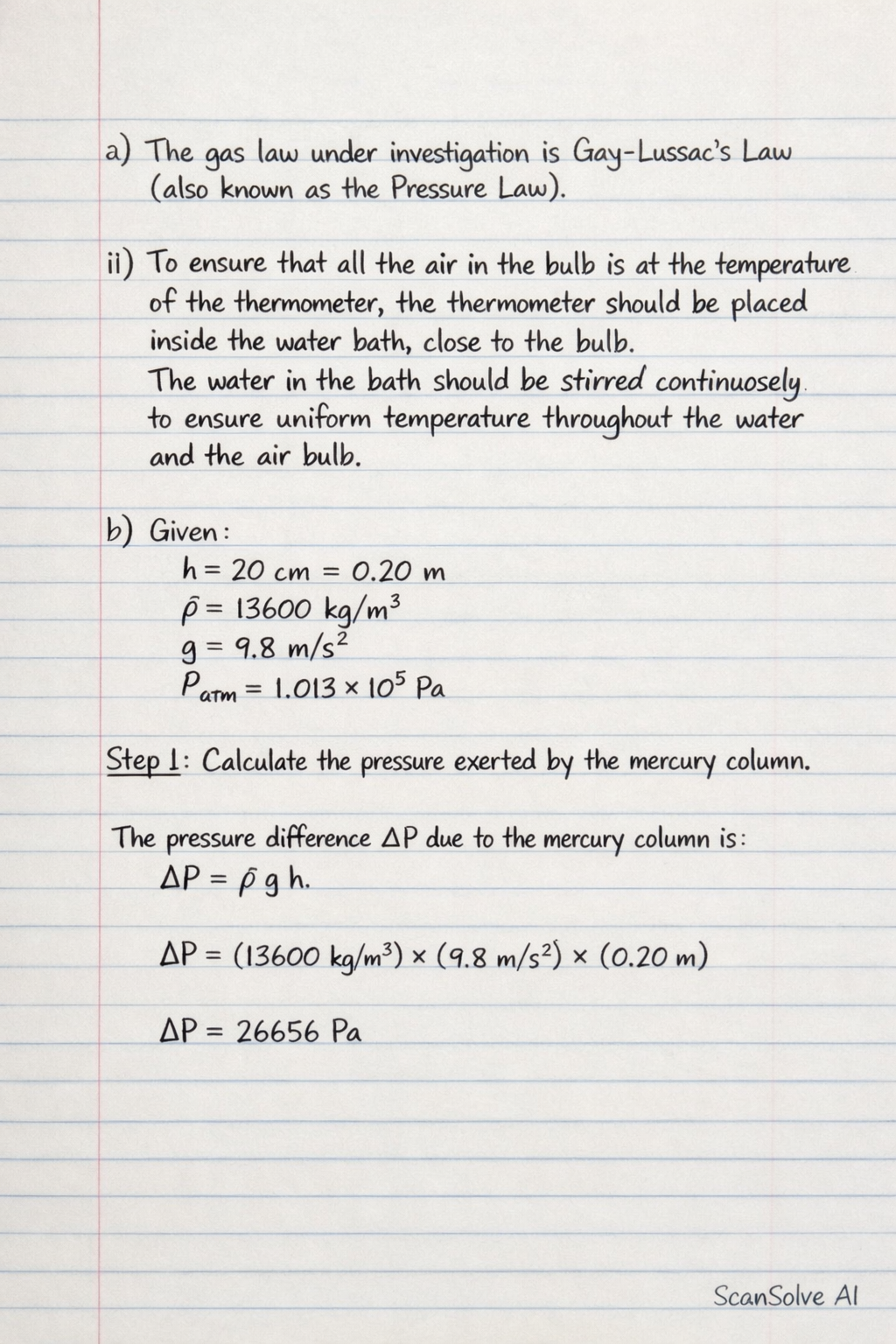
I) The gas law under investigation is Gay-Lussac's Law (also known as the Pressure Law).
ScanSolve AI Answer
Answer
Step-by-step solution
2 stepsPart a(i)
The gas law under investigation is Gay-Lussac's Law (also known as the Pressure Law).
ii) To ensure that all the air trapped in the bulb was at the temperature recorded by the thermometer, the thermometer should be placed inside the water bath, close to the bulb. Additionally, the water in the bath should be stirred continuously to ensure uniform temperature distribution throughout the water and the air bulb.
Part b
Given:
Height difference in mercury
Density of mercury
Acceleration due to gravity
Assume standard atmospheric pressure .
Calculate the pressure exerted by the mercury column.
The pressure difference due to the mercury column is given by the formula .
Determine the total pressure of the air trapped in the bulb.
From the diagram, the mercury level in the arm connected to the bulb is lower than the level in the arm open to the atmosphere. This indicates that the pressure of the air in the bulb is greater than the atmospheric pressure.
The total pressure of air trapped in the bulb is .
Part c
The graph of pressure versus temperature (in ) for a fixed mass of gas at constant volume (Gay-Lussac's Law) is a straight line with a positive slope. It does not pass through the origin because is not absolute zero. If extrapolated, the line would intersect the temperature axis at approximately .
\begin{tikzpicture}
\draw[->] (0,0) -- (5,0) node[below] {Temperature ($^\circ$C)};
\draw[->] (0,0) -- (0,4) node[left] {Pressure ($\text{N/m}^2$)};
\draw[thick, blue] (1,1) -- (4,3.5); % Example line segment
\end{tikzpicture}
(Note: The graph should be a straight line with a positive slope, starting from a point in the positive temperature range and extending upwards. It should not pass through the origin.)
Try one yourself
A new problem that tests the same skill.
Still stuck on this one?
Ask a follow-up, and the answer starts from this question.
More Physics Questions
Handwritten Step-by-Step Solution
Get this as a handwritten image on WhatsApp — like a tutor wrote it for you.
Try on WhatsApp