
We read your photo as:
The circuit shows two resistors, X and R, connected in parallel to a voltage source E. An ammeter measures the total current flowing from the source.
ScanSolve AI Answer
Answer
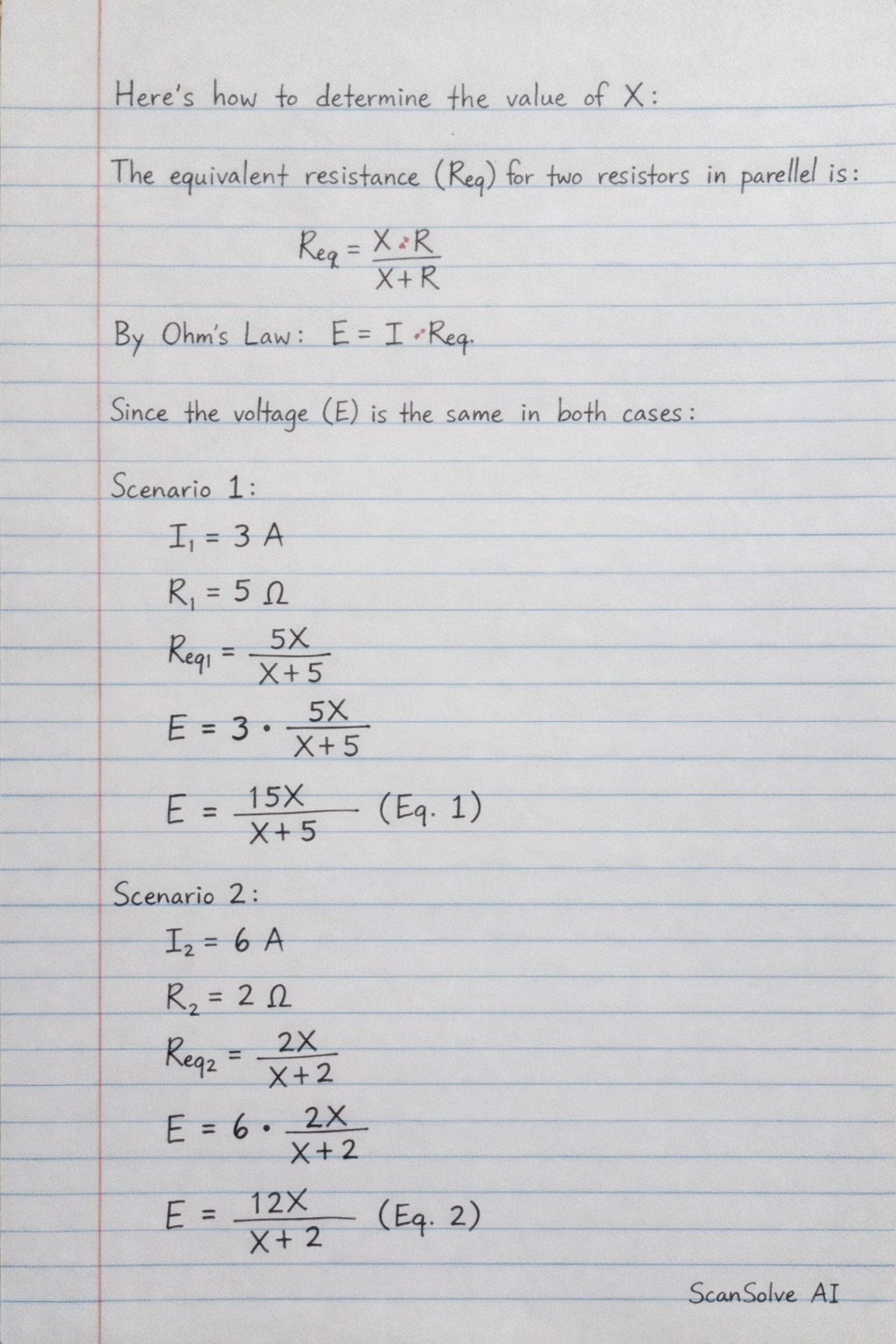
Here's how to determine the value of X:
The circuit shows two resistors, X and R, connected in parallel to a voltage source E. An ammeter measures the total current flowing from the source.
The equivalent resistance () for two resistors in parallel is given by:
According to Ohm's Law, the voltage (E) across the parallel combination is the total current (I) multiplied by the equivalent resistance:
Since the voltage source E is constant, we can set up equations for the two given scenarios.
-
Scenario 1:
- Current
- Resistance
- Equivalent resistance
- Voltage (Equation 1)
-
Scenario 2:
- Current
- Resistance
- Equivalent resistance
- Voltage (Equation 2)
Now, we equate Equation 1 and Equation 2 since E is constant:
Since X is a resistance, . We can divide both sides by X:
Cross-multiply to solve for X:
Subtract from both sides:
Subtract 30 from both sides:
Divide by 3:
The value of X is .
The final answer is .
Try one yourself
A new problem that tests the same skill.
Still stuck on this one?
Ask a follow-up, and the answer starts from this question.
More Physics Questions
Handwritten Step-by-Step Solution
Get this as a handwritten image on WhatsApp — like a tutor wrote it for you.
Try on WhatsApp