I want all the above solutions in English

English

ScanSolve AI Answer

Answers

2 parts
a

2x4+x2\frac{2x}{4 + x^2}

b

y=25x−25+ln⁡(5)y = \frac{2}{5}x - \frac{2}{5} + \ln(5)

y=−52x+52+ln⁡(5)y = -\frac{5}{2}x + \frac{5}{2} + \ln(5)

Step-by-step solution

7 steps

Here are the solutions for the questions from the image, in English.

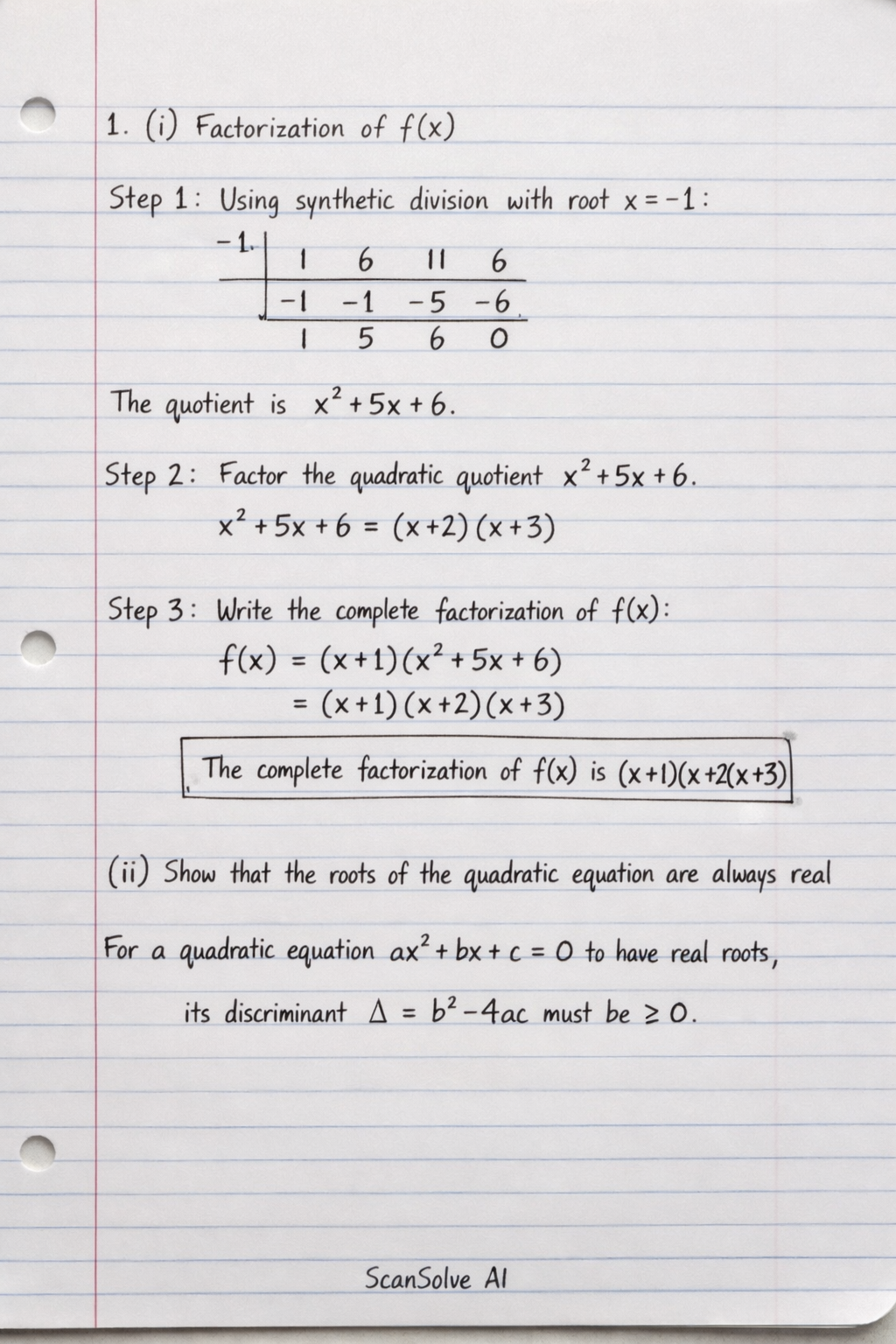
1. (i) Factorization of f(x)f(x)

Step 1: Given that (x+1)(x+1) is a factor of f(x)=x3+6x2+11x+6f(x) = x^3 + 6x^2 + 11x + 6, we perform polynomial division or synthetic division. Using synthetic division with the root x=−1x = -1:

−116116−1−5−61560\begin{array}{c|cccc} -1 & 1 & 6 & 11 & 6 \\ & & -1 & -5 & -6 \\ \hline & 1 & 5 & 6 & 0 \\ \end{array}

The quotient is x2+5x+6x^2 + 5x + 6.

Step 2: Factor the quadratic quotient x2+5x+6x^2 + 5x + 6.
We look for two numbers that sum to 5 and multiply to 6. These numbers are 2 and 3.

x2+5x+6=(x+2)(x+3)x^2 + 5x + 6 = (x+2)(x+3)

Step 3: Write the complete factorization of f(x)f(x).

f(x)=(x+1)(x2+5x+6)=(x+1)(x+2)(x+3)f(x) = (x+1)(x^2 + 5x + 6) = (x+1)(x+2)(x+3)

The complete factorization of f(x)f(x) is (x+1)(x+2)(x+3)\boxed{(x+1)(x+2)(x+3)}.

1. (ii) Show that the roots of the quadratic equation are always real

For a quadratic equation ax2+bx+c=0ax^2 + bx + c = 0 to have real roots, its discriminant Δ=b2−4ac\Delta = b^2 - 4ac must be greater than or equal to zero (Δ≥0\Delta \ge 0).

Step 1: Identify the coefficients a,b,ca, b, c from the equation 3x2+(−4−2λ)x+2λ=03x^2 + (-4 - 2\lambda)x + 2\lambda = 0.

a=3a = 3 b=(−4−2λ)b = (-4 - 2\lambda) c=2λc = 2\lambda

Step 2: Calculate the discriminant Δ\Delta.

Δ=b2−4ac\Delta = b^2 - 4ac Δ=(−4−2λ)2−4(3)(2λ)\Delta = (-4 - 2\lambda)^2 - 4(3)(2\lambda) Δ=(−(4+2λ))2−24λ\Delta = (-(4 + 2\lambda))^2 - 24\lambda Δ=(4+2λ)2−24λ\Delta = (4 + 2\lambda)^2 - 24\lambda Δ=(16+16λ+4λ2)−24λ\Delta = (16 + 16\lambda + 4\lambda^2) - 24\lambda Δ=4λ2−8λ+16\Delta = 4\lambda^2 - 8\lambda + 16

Step 3: Show that Δ≥0\Delta \ge 0.
Factor out 4 from the expression and complete the square for the quadratic term in λ\lambda:

Δ=4(λ2−2λ+4)\Delta = 4(\lambda^2 - 2\lambda + 4) Δ=4((λ2−2λ+1)+3)\Delta = 4((\lambda^2 - 2\lambda + 1) + 3) Δ=4((λ−1)2+3)\Delta = 4((\lambda - 1)^2 + 3)

Since (λ−1)2≥0(\lambda - 1)^2 \ge 0 for any real value of λ\lambda, it follows that (λ−1)2+3≥3(\lambda - 1)^2 + 3 \ge 3.
Therefore, Δ=4((λ−1)2+3)≥4(3)=12\Delta = 4((\lambda - 1)^2 + 3) \ge 4(3) = 12.
Since Δ≥12\Delta \ge 12, the discriminant is always positive, which means the roots of the quadratic equation are always real.

2. (i) Differentiation and equations of the tangent and normal

Part a· 2 steps

Find dydx\frac{dy}{dx} for y=ln⁡(4+x2)y = \ln(4 + x^2)

  1. Apply the chain rule.

    If y=ln⁡(u)y = \ln(u), then dydx=1ududx\frac{dy}{dx} = \frac{1}{u} \frac{du}{dx}.
    Here, u=4+x2u = 4 + x^2.
    The derivative of uu with respect to xx is dudx=ddx(4+x2)=2x\frac{du}{dx} = \frac{d}{dx}(4 + x^2) = 2x.

  2. Substitute uu and dudx\frac{du}{dx} into the chain rule formula.

    dydx=14+x2⋅(2x)\frac{dy}{dx} = \frac{1}{4 + x^2} \cdot (2x) dydx=2x4+x2\frac{dy}{dx} = \boxed{\frac{2x}{4 + x^2}}

Part b

y=25x−25+ln⁡(5)y = \frac{2}{5}x - \frac{2}{5} + \ln(5)

The equations of the tangent and normal to the curve y=ln⁡(4+x2)y = \ln(4 + x^2) at the point where x=1x = 1.

  1. Find the yy-coordinate of the point.

    Substitute x=1x=1 into the curve's equation:

    y=ln⁡(4+12)=ln⁡(4+1)=ln⁡(5)y = \ln(4 + 1^2) = \ln(4 + 1) = \ln(5)

    The point is (1,ln⁡(5))(1, \ln(5)).

  2. Find the gradient of the tangent at x=1x=1.

    Use the derivative dydx=2x4+x2\frac{dy}{dx} = \frac{2x}{4 + x^2} found in (a):

    mtangent=2(1)4+12=25m_{tangent} = \frac{2(1)}{4 + 1^2} = \frac{2}{5}
  3. Write the equation of the tangent.

    Use the point-slope form y−y1=m(x−x1)y - y_1 = m(x - x_1):

    y−ln⁡(5)=25(x−1)y - \ln(5) = \frac{2}{5}(x - 1) y=25x−25+ln⁡(5)y = \frac{2}{5}x - \frac{2}{5} + \ln(5)

    The equation of the tangent is y=25x−25+ln⁡(5)\boxed{y = \frac{2}{5}x - \frac{2}{5} + \ln(5)}.

  4. Find the gradient of the normal at x=1x=1.

    The gradient of the normal is the negative reciprocal of the tangent's gradient:

    mnormal=−1mtangent=−12/5=−52m_{normal} = -\frac{1}{m_{tangent}} = -\frac{1}{2/5} = -\frac{5}{2}
  5. Write the equation of the normal.

    Use the point-slope form y−y1=m(x−x1)y - y_1 = m(x - x_1):

    y−ln⁡(5)=−52(x−1)y - \ln(5) = -\frac{5}{2}(x - 1) y=−52x+52+ln⁡(5)y = -\frac{5}{2}x + \frac{5}{2} + \ln(5)

    The equation of the normal is y=−52x+52+ln⁡(5)\boxed{y = -\frac{5}{2}x + \frac{5}{2} + \ln(5)}.

    Dernière correction gratuite aujourd'hui — reviens demain, ou tape /upgrade pour l'illimité.

Was this helpful?

Still stuck on this one?

Ask a follow-up, and the answer starts from this question.

Got a different question?Ask your own question
Handwritten step-by-step solution preview

Handwritten Step-by-Step Solution

Get this as a handwritten image on WhatsApp — like a tutor wrote it for you.

Try on WhatsApp