

This English question involves literary analysis, grammar, or writing skills. The detailed response below provides a well-structured answer with supporting evidence and clear explanations.
ScanSolve AI Answer
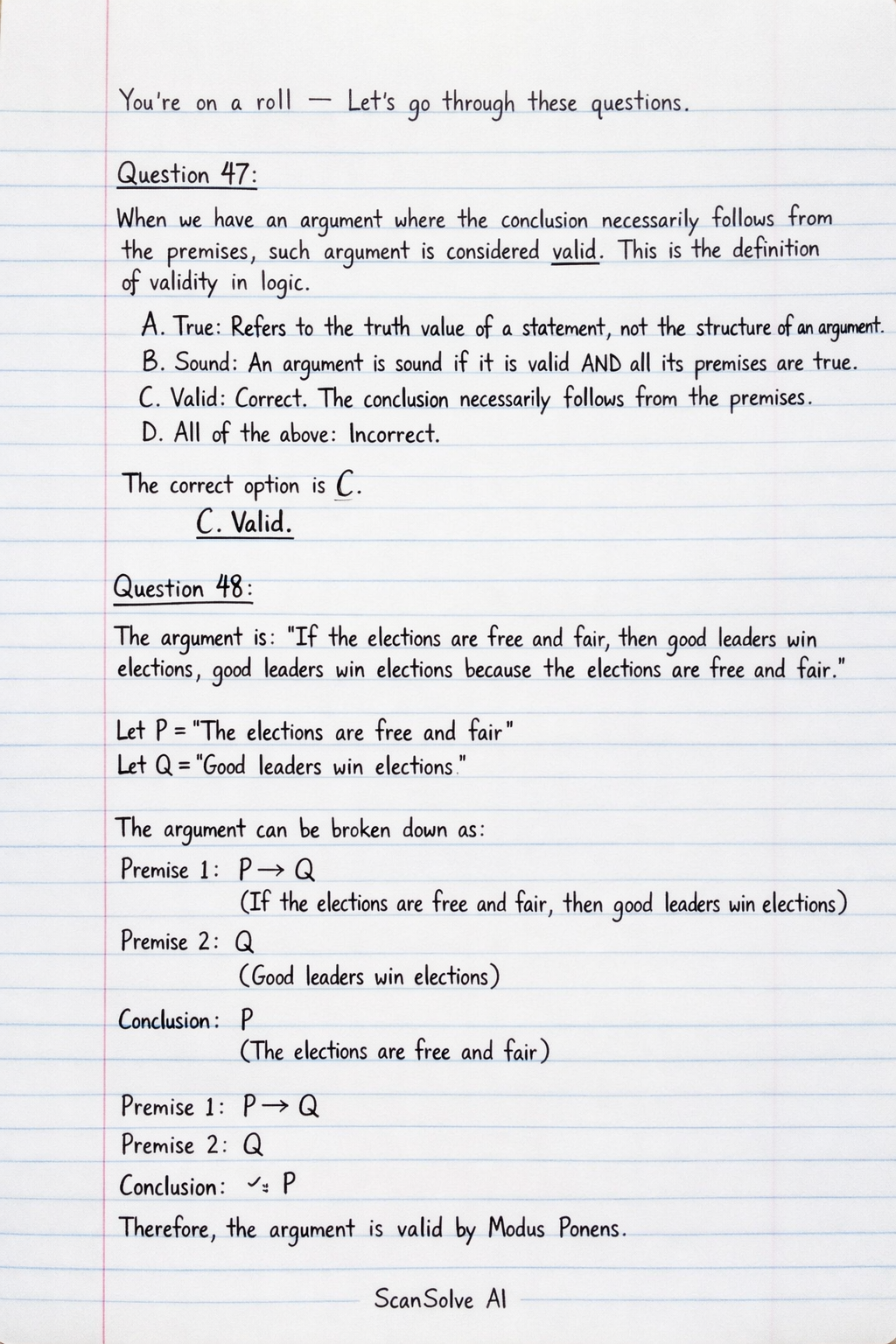
Let's go through these questions. Question 47: When we have an argument where the conclusion necessarily follows from the premises, such argument is considered valid. This is the definition of validity in logic. A. True: Refers to the truth value of a statement, not the structure of an argument. B. Sound: An argument is sound if it is valid AND all its premises are true. C. Valid: Correct. The conclusion necessarily follows from the premises. D. All of the above: Incorrect. The correct option is C. C. Valid Question 48: The argument is: "If the elections are free and fair then good leaders win elections, good leaders win elections because the elections are free and fair." Let P = "The elections are free and fair" Let Q = "Good leaders win elections" The argument can be broken down as: Premise 1: P → Q (If the elections are free and fair, then good leaders win elections) Premise 2: Q (Good leaders win elections) Conclusion: P (The elections are free and fair) This structure is an example of affirming the consequent, which is a logical fallacy. However, the question asks to identify the conclusion in this argument. The conclusion is the statement that is being asserted as a result of the premises. In the phrasing "good leaders win elections because the elections are free and fair," the "because" clause indicates the premise, and the statement before it is the conclusion being drawn. Let's re-evaluate the phrasing: "If the elections are free and fair then good leaders win elections, good leaders win elections because the elections are free and fair." The first part "If the elections are free and fair then good leaders win elections" is a conditional statement. The second part "good leaders win elections because the elections are free and fair" is a statement where "good leaders win elections" is presented as a conclusion, and "the elections are free and fair" is given as the reason (premise). So, the conclusion is "Good leaders win elections." A. If the elections are free and fair then good leaders win elections: This is a conditional premise. B. The elections are free and fair: This is a premise. C. Good leaders win elections: This is the statement being concluded. D. None of the above: Incorrect. The correct option is C. C. Good leaders win elections Question 49: The argument in which the conclusion always claims something more than what is necessarily implied by the premises is called Inductive. A. Deductive: In a deductive argument, the conclusion is necessarily implied by the premises. If the premises are true, the conclusion must* be true. B. Informal: Refers to fallacies that arise from the content or context of an argument, not its structure. C. Inductive: In an inductive argument, the conclusion goes beyond the information given in the premises, offering a probable, but not certain, claim. D. Syllogism: A type of deductive argument, typically with two premises and a conclusion. The correct option is C. C. Inductive Question 50: Identify the fallacy that is committed in the following argument. "Every footballer in Arsenal Football Club is skillful. Therefore Arsenal Football team is skillful." This argument incorrectly attributes a characteristic of the individual parts (each footballer) to the whole (the team). This is known as the Fallacy of Composition. A. Amphiboly: A fallacy of ambiguity where a sentence can be interpreted in multiple ways due to grammatical structure. B. Fallacy of accident: Applying a general rule to a specific case where the rule does not apply due to unusual circumstances. C. Composition: Correct. Inferring that because parts of a whole have a certain property, the whole must also have that property. D. Division: The opposite of composition; inferring that because the whole has a certain property, its parts must also have that property. The correct option is C. C. Composition What's next?