
We read your photo as:
Please identify the literary device in the example provided, explain why it is that device, discuss challenges in translating it, and list two of its functions. Also, indicate intonation in the follow
ScanSolve AI Answer
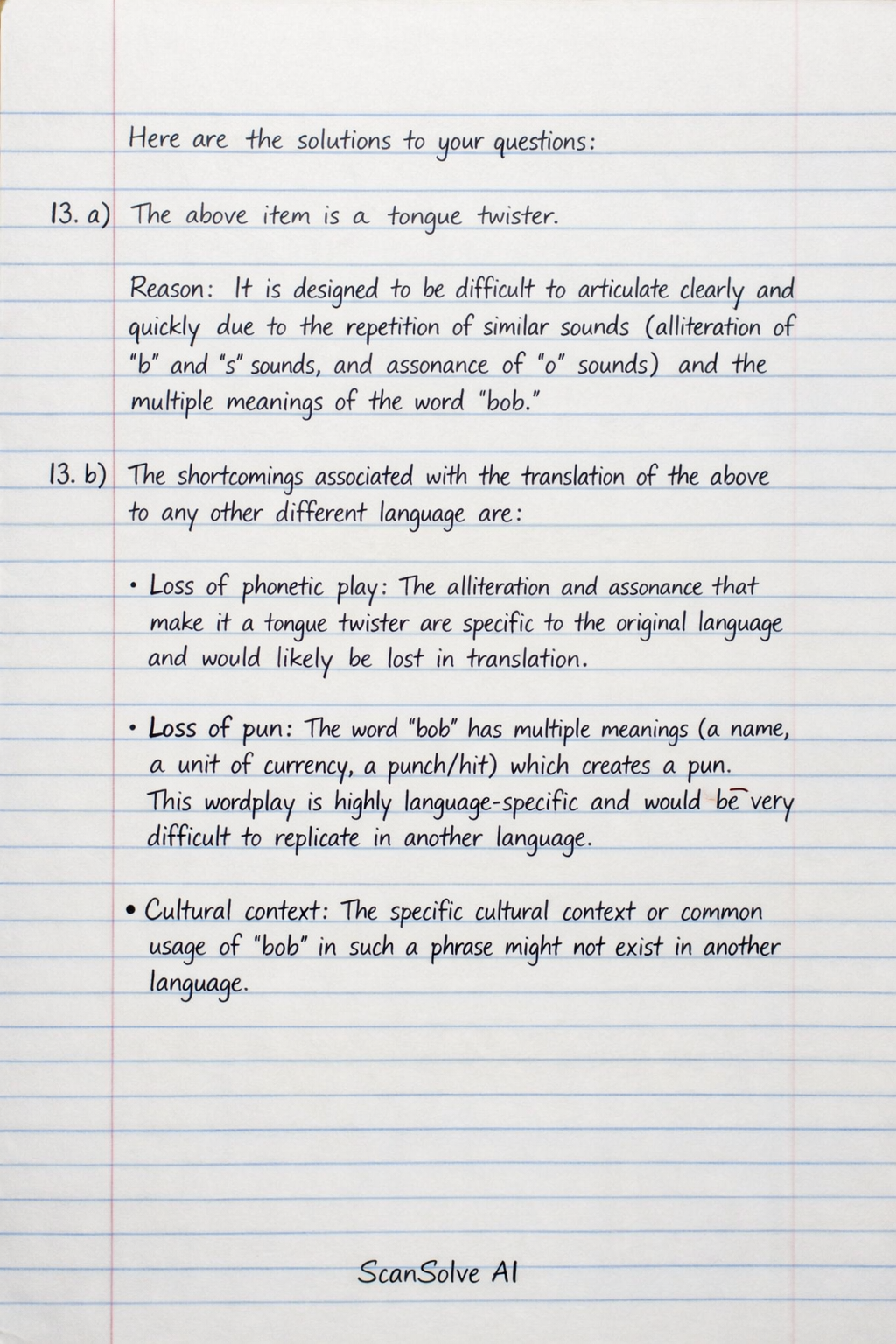
Here are the solutions to your questions:
13. a) The above item is a tongue twister.
Reason: It is designed to be difficult to articulate clearly and quickly due to the repetition of similar sounds (alliteration of 'b' and 's' sounds, and assonance of 'o' sounds) and the multiple meanings of the word "bob."
13. b) The shortcomings associated with the translation of the above to any other different language are:
- Loss of phonetic play: The alliteration and assonance that make it a tongue twister are specific to the original language and would likely be lost in translation.
- Loss of pun: The word "bob" has multiple meanings (a name, a unit of currency, a punch/hit) which creates a pun. This wordplay is highly language-specific and would be very difficult to replicate in another language.
- Cultural context: The specific cultural context or common usage of "bob" in such a phrase might not exist in another language.
13. c) Two functions of the above oral literature item are:
- To improve pronunciation and articulation: Practicing tongue twisters helps speakers to articulate sounds more clearly and quickly.
- For entertainment and amusement: They are often used as a fun linguistic challenge or game.
14. Indicate intonation in the following sentences. Write F and R against each sentence to represent falling and rising intonation respectively.
a) Who was shouting at the back of the classroom? F
b) Walk out! F
c) Is it raining? R
d) He's alive! F
15. a) To prepare for an oral report on the causes of poverty in my local area, I would:
- Conduct thorough research: Gather data, statistics, and local examples related to the causes of poverty in the specific area.
- Structure the report: Create a clear outline with an introduction, main points (causes), supporting evidence, and a conclusion.
- Practice the delivery: Rehearse the report multiple times to ensure fluency, proper timing, and confident presentation.
15. b) To present my report effectively, I would:
- Use clear and concise language: Avoid jargon and present information in an easy-to-understand manner for the audience.
- Incorporate visual aids: Use charts, graphs, or images to illustrate data and make complex information more accessible and engaging.
- Maintain an engaging delivery: Use vocal variety, eye contact, and appropriate gestures to keep the audience's attention and convey passion for the topic.
16. i) The above genre is a proverb.
16. ii) The genre is used in place of plain language because:
- It conveys wisdom concisely: Proverbs offer profound insights and advice in a memorable, short form.
- It is culturally rich: They often encapsulate cultural values, beliefs, and experiences, making them relatable and impactful.
- It is memorable: Their rhythmic or metaphorical nature makes them easier to remember and transmit across generations.
17. At the end of the performance of a narrative, five things that would tell that the audience has enjoyed the presentation are:
- Sustained applause or cheering.
- Laughter at appropriate moments throughout the narrative.
- Positive verbal feedback or comments from audience members.
- Audience members asking questions or engaging in discussion about the narrative.
- Audience members requesting an encore or another story.
18. To ensure that I get all the details from the public health officer about malaria, I would:
- Listen actively and attentively: Pay close attention to all the information being shared without interrupting.
- Take comprehensive notes: Write down key facts, figures, symptoms, treatments, and prevention methods.
- Prepare specific questions in advance: Have a list of questions ready to ask for clarification or more detail on specific aspects.
- Ask clarifying and follow-up questions: If something is unclear, politely ask for further explanation or examples.
- Request handouts or contact information: Ask if there are any brochures, websites, or contact details for further reference.
19. Five strategies I may employ to ensure an effective introduction of the speech are:
- Start with a compelling hook: Begin with an engaging anecdote, a surprising statistic, a rhetorical question, or a powerful quote to immediately capture the audience's attention.
- Clearly state the purpose/topic: Inform the audience what the speech will be about and why it is relevant to them.
- Establish credibility: Briefly mention my experience or position (as outgoing head girl) to show I am qualified to speak on the topic.
- Preview the main points: Give a brief overview of the key areas that will be covered in the speech, providing a roadmap for the audience.
- Connect with the audience: Acknowledge the occasion (prize-giving day) and the audience, making them feel included and valued.
Still stuck on this one?
Ask a follow-up, and the answer starts from this question.
More English Questions
Handwritten Step-by-Step Solution
Get this as a handwritten image on WhatsApp — like a tutor wrote it for you.
Try on WhatsApp