This mathematics problem involves applying core mathematical principles and formulas. Below you will find a complete step-by-step solution with detailed explanations for each step, helping you understand not just the answer but the method behind it.
ScanSolve AI Answer
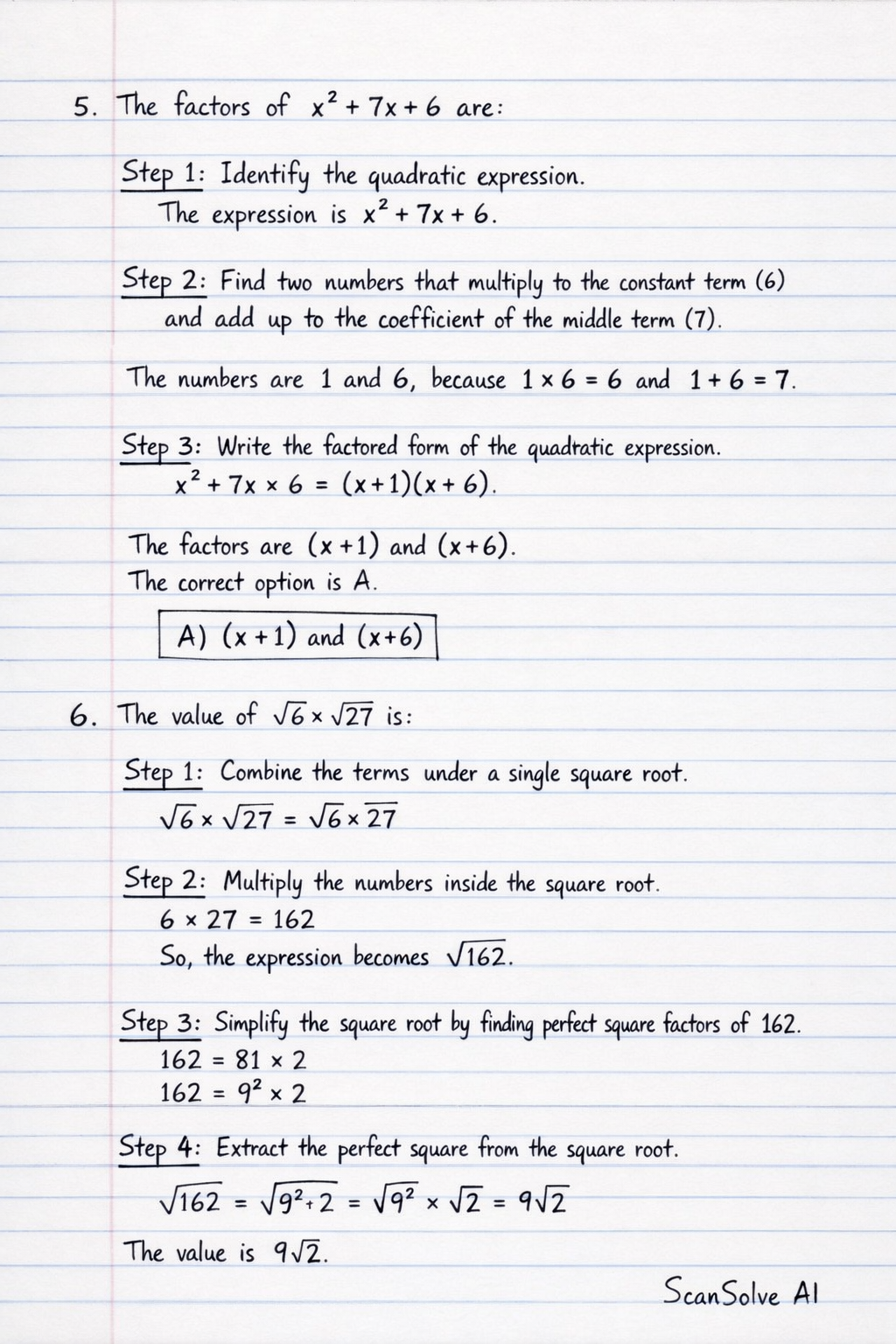
5. The factors of $x^2 + 7x + 6$ are:
Step 1: Identify the quadratic expression.
The expression is $x^2 + 7x + 6$.
Step 2: Find two numbers that multiply to the constant term (6) and add up to the coefficient of the middle term (7).
The numbers are 1 and 6, because $1 \times 6 = 6$ and $1 + 6 = 7$.
Step 3: Write the factored form of the quadratic expression.
$$x^2 + 7x + 6 = (x+1)(x+6)$$
The factors are $(x+1)$ and $(x+6)$.
The correct option is A.
$$\boxed{\text{A) } (x+1) \text{ and } (x+6)}$$
6. The value of $\sqrt{6} \times \sqrt{27}$ is:
Step 1: Combine the terms under a single square root.
$$\sqrt{6} \times \sqrt{27} = \sqrt{6 \times 27}$$
Step 2: Multiply the numbers inside the square root.
$$6 \times 27 = 162$$
So, the expression becomes $\sqrt{162}$.
Step 3: Simplify the square root by finding perfect square factors of 162.
$$162 = 81 \times 2$$
$$162 = 9^2 \times 2$$
Step 4: Extract the perfect square from the square root.
$$\sqrt{162} = \sqrt{9^2 \times 2} = \sqrt{9^2} \times \sqrt{2} = 9\sqrt{2}$$
The value is $9\sqrt{2}$.
The correct option is B.
$$\boxed{\text{B) } 9\sqrt{2}}$$
7. Observe the triangles, the correct statement among the following is:
Step 1: Analyze the given triangles $\triangle ABC$ and $\triangle QPR$.
In $\triangle ABC$:
Side $AB = 6$ cm
Side $BC = 4$ cm
Angle $\angle B = 90^\circ$ (indicated by the square symbol)
In $\triangle QPR$:
Side $QP = 6$ cm
Side $PR = 4$ cm
Angle $\angle P = 90^\circ$ (indicated by the square symbol)
Step 2: Compare corresponding sides and angles.
We have:
$AB = QP = 6$ cm
$\angle B = \angle P = 90^\circ$
$BC = PR = 4$ cm
Step 3: Apply the Side-Angle-Side (SAS) congruence criterion.
Since two sides and the included angle of $\triangle ABC$ are equal to two sides and the included angle of $\triangle QPR$, the triangles are congruent.
The correspondence of vertices is $A \leftrightarrow Q$, $B \leftrightarrow P$, $C \leftrightarrow R$.
Step 4: Write the congruence statement.
$$\triangle ABC \cong \triangle QPR$$
The correct option is A.
$$\boxed{\text{A) } \triangle ABC \cong \triangle QPR}$$
8. If one side of an isosceles triangle is 5 cm & its equal sides measure 3 cm each, then half of its perimeter is:
Step 1: Identify the lengths of the sides of the isosceles triangle.
The equal sides are 3 cm each. The third side is 5 cm.
So, the side lengths are 3 cm, 3 cm, and 5 cm.
Step 2: Calculate the perimeter of the triangle.
Perimeter $P = \text{sum of all sides}$
$$P = 3 \text{ cm} + 3 \text{ cm} + 5 \text{ cm}$$
$$P = 11 \text{ cm}$$
Step 3: Calculate half of the perimeter.
$$\text{Half of perimeter} = \frac{P}{2} = \frac{11 \text{ cm}}{2}$$
$$\text{Half of perimeter} = 5.5 \text{ cm}$$
The correct option is B.
$$\boxed{\text{B) } 5.5 \text{ cm}}$$
9. Two angles measure $(55^\circ + 3a)$ and $(115^\circ - 2a)$ if each angle is a supplement of the other, then calculate the value of "a".
Step 1: Understand the definition of supplementary angles.
If two angles are supplementary, their sum is $180^\circ$.
Step 2: Set up the equation using the given angle measures.
$$(55^\circ + 3a) + (115^\circ - 2a) = 180^\circ$$
Step 3: Combine like terms.
$$55^\circ + 115^\circ + 3a - 2a = 180^\circ$$
$$170^\circ + a = 180^\circ$$
Step 4: Solve for $a$.
$$a = 180^\circ - 170^\circ$$
$$a = 10^\circ$$
The value of $a$ is $10^\circ$.
$$\boxed{a = 10^\circ}$$
10. Write any two of Euclid's axioms.
Here are two of Euclid's axioms:
• Things which are equal to the same thing are equal to one another.
• The whole is greater than the part.
Q
The factors of x^2 + 7x + 6 are?
|Mathematics
The factors of x^2 + 7x + 6 are?
ScanSolve AI Answer
The factors of x2+7x+6 are:
Step 1: Identify the quadratic expression.
The expression is x2+7x+6.
Step 2: Find two numbers that multiply to the constant term (6) and add up to the coefficient of the middle term (7).
The numbers are 1 and 6, because 1×6=6 and 1+6=7.
Step 3: Write the factored form of the quadratic expression.
x2+7x+6=(x+1)(x+6)
The factors are (x+1) and (x+6).
The correct option is A.
A)(x+1)and(x+6)
The value of 6×27 is:
Step 1: Combine the terms under a single square root.
6×27=6×27
Step 2: Multiply the numbers inside the square root.
6×27=162
So, the expression becomes 162.
Step 3: Simplify the square root by finding perfect square factors of 162.
162=81×2162=92×2
Step 4: Extract the perfect square from the square root.
162=92×2=92×2=92
The value is 92.
The correct option is B.
B)92
Observe the triangles, the correct statement among the following is:
Step 1: Analyze the given triangles △ABC and △QPR.
In △ABC:
Side AB=6 cm
Side BC=4 cm
Angle ∠B=90∘ (indicated by the square symbol)
In △QPR:
Side QP=6 cm
Side PR=4 cm
Angle ∠P=90∘ (indicated by the square symbol)
Step 2: Compare corresponding sides and angles.
We have:
AB=QP=6 cm
∠B=∠P=90∘BC=PR=4 cm
Step 3: Apply the Side-Angle-Side (SAS) congruence criterion.
Since two sides and the included angle of △ABC are equal to two sides and the included angle of △QPR, the triangles are congruent.
The correspondence of vertices is A↔Q, B↔P, C↔R.
Step 4: Write the congruence statement.
△ABC≅△QPR
The correct option is A.
A)△ABC≅△QPR
If one side of an isosceles triangle is 5 cm & its equal sides measure 3 cm each, then half of its perimeter is:
Step 1: Identify the lengths of the sides of the isosceles triangle.
The equal sides are 3 cm each. The third side is 5 cm.
So, the side lengths are 3 cm, 3 cm, and 5 cm.
Step 2: Calculate the perimeter of the triangle.
Perimeter P=sum of all sidesP=3cm+3cm+5 cmP=11 cm
Step 3: Calculate half of the perimeter.
Half of perimeter=2P=211cmHalf of perimeter=5.5 cm
The correct option is B.
B)5.5cm
Two angles measure (55∘+3a) and (115∘−2a) if each angle is a supplement of the other, then calculate the value of "a".
Step 1: Understand the definition of supplementary angles.
If two angles are supplementary, their sum is 180∘.
Step 2: Set up the equation using the given angle measures.
(55∘+3a)+(115∘−2a)=180∘
Step 3: Combine like terms.
55∘+115∘+3a−2a=180∘170∘+a=180∘
Step 4: Solve for a.
a=180∘−170∘a=10∘
The value of a is 10∘.
a=10∘
Write any two of Euclid's axioms.
Here are two of Euclid's axioms:
• Things which are equal to the same thing are equal to one another.
• The whole is greater than the part.
Need help with your own homework?
Get instant step-by-step solutions to any question. Free to start.