

This English question involves literary analysis, grammar, or writing skills. The detailed response below provides a well-structured answer with supporting evidence and clear explanations.
ScanSolve AI Answer
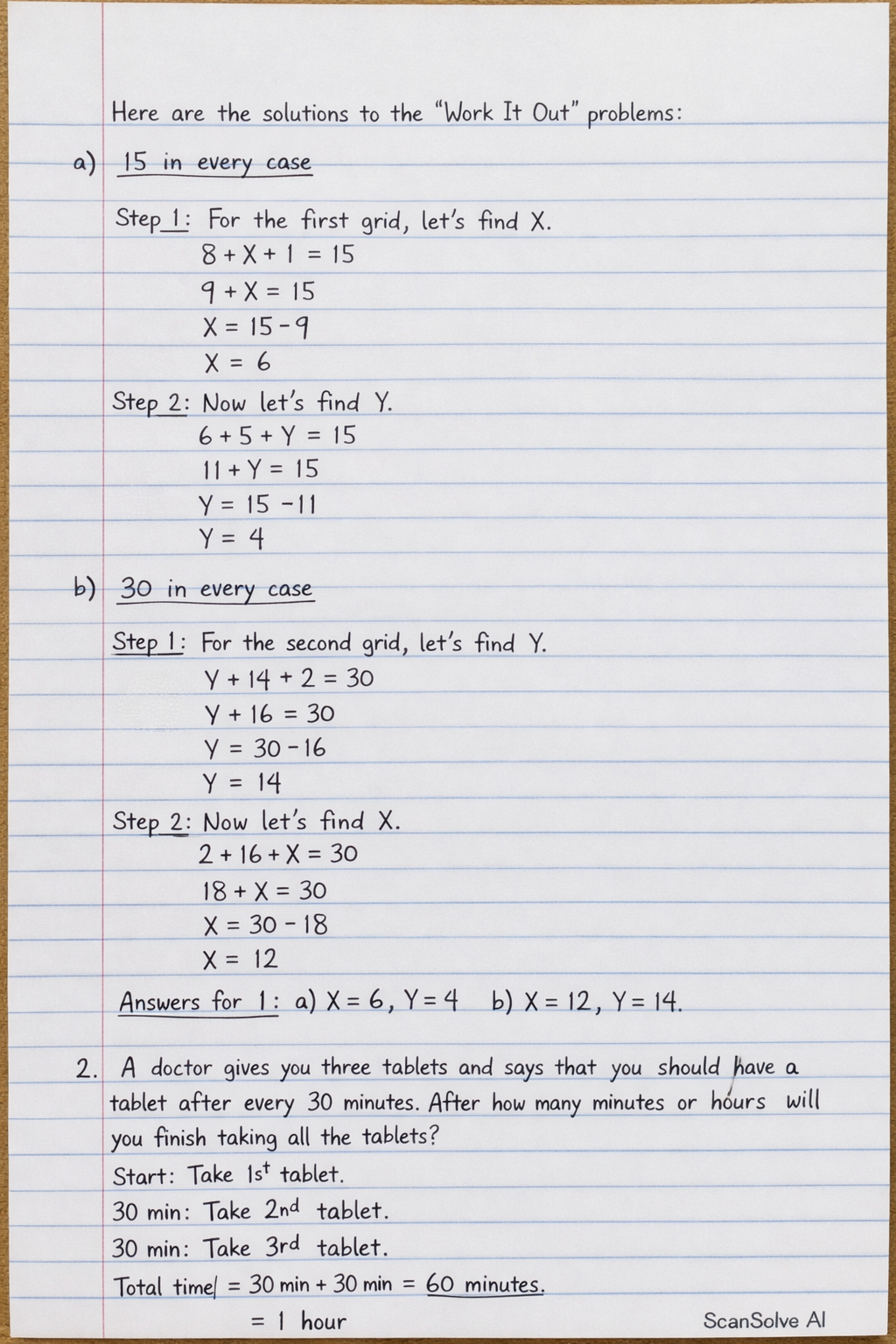
Here are the solutions to the "Work It Out" problems: 1. Find the values of X and Y in each of the grids below. The sum of any numbers in these grids vertically, horizontally, or diagonally, will be as follow: a) 15 in every case Step 1: For the first grid, let's find X. The sum of the first row is 8 + X + 1 = 15. 9 + X = 15 X = 15 - 9 X = 6 Step 2: Now let's find Y. The sum of the second column is X + 5 + Y = 15. Substitute X=6. 6 + 5 + Y = 15 11 + Y = 15 Y = 15 - 11 Y = 4 b) 30 in every case Step 1: For the second grid, let's find Y. The sum of the first row is Y + 14 + 2 = 30. Y + 16 = 30 Y = 30 - 16 Y = 14 Step 2: Now let's find X. The sum of the third column is 2 + 16 + X = 30. 18 + X = 30 X = 30 - 18 X = 12 Answers for 1: a) X=6, Y=4 b) X=12, Y=14 2. A doctor gives you three tablets and says that you should have a tablet after every 30 minutes. After how many minutes or hours will you finish taking all the tablets? Step 1: You take the first tablet at 0 minutes. Step 2: You take the second tablet after 30 minutes. Step 3: You take the third tablet after another 30 minutes. Total time taken = 30 minutes + 30 minutes = 60 minutes. Step 4: Convert minutes to hours. 60 minutes = 1 hour Answer for 2: You will finish taking all the tablets in 60 minutes or 1 hour. 3. How many 5s, immediately preceded by 4, are there in the following series of numbers? 6 4 8 7 3 4 5 6 7 4 5 3 4 5 4 5 7 2 4 5 4 5 3 5 Step 1: Look for the sequence "4 5" in the series. 6 4 8 7 3 4 5 6 7 4 5 3 4 5 4 5 7 2 4 5 4 5 3 5 Step 2: Count the occurrences. There are 6 instances where a 5 is immediately preceded by a 4. Answer for 3: There are 6 such 5s. 4. What are the next two numbers in this series? 1, 3, 7, 15, ... Step 1: Find the pattern by looking at the differences between consecutive numbers. 3 - 1 = 2 7 - 3 = 4 15 - 7 = 8 The differences are doubling: 2, 4, 8. Step 2: The next difference should be 8 × 2 = 16. The next number in the series is 15 + 16 = 31. Step 3: The next difference after that should be 16 × 2 = 32. The second next number in the series is 31 + 32 = 63. Answer for 4: The next two numbers are 31, 63. 5. What are the next two letters in this series? Z, V, R, N, ... Step 1: Determine the position of each letter in the alphabet (A=1, B=2, ..., Z=26). Z = 26 V = 22 R = 18 N = 14 Step 2: Find the pattern in the positions. 26 - 22 = 4 22 - 18 = 4 18 - 14 = 4 The pattern is subtracting 4 from the position of the previous letter. Step 3: Apply the pattern to find the next letter. The next position is 14 - 4 = 10. The 10th letter is J. Step 4: Apply the pattern again to find the second next letter. The next position is 10 - 4 = 6. The 6th letter is F. Answer for 5: The next two letters are J, F. 6. Complete each series given below: a) 25, 125, 625, ... Step 1: Identify the pattern. 25 = 5^2 125 = 5^3 625 = 5^4 This is a geometric progression where each term is multiplied by 5, or powers of 5. Step 2: The next term will be 5^5. 5^5 = 625 × 5 = 3125. Answer for 6a): The next number is 3125. b) A, C, E, 1, 3, 5, B, D, F, 2, 4, 6, G, I, K, 7, 9, 11, ... Step 1: Observe the structure of the series. It alternates between letters and numbers, in groups of three. Group 1: A, C, E (letters, skipping one) Group 2: 1, 3, 5 (odd numbers) Group 3: B, D, F (letters, skipping one) Group 4: 2, 4, 6 (even numbers) Group 5: G, I, K (letters, skipping one) Group 6: 7, 9, 11 (odd numbers) Step 2: Identify the next group type and its starting point. The pattern of starting letters is A, B, G. This doesn't seem to follow a simple alphabetical sequence. Let's look at the type of group: (letters), (odd numbers), (letters), (even numbers), (letters), (odd numbers). The next group should be (letters). Step 3: Let's look at the starting letter of each letter group: A, B, G. A (1st letter) B (2nd letter) G (7th letter) This pattern is not straightforward. Let's re-examine the structure. It seems like the series is structured as: (Letters: A, C, E) -> (Numbers: 1, 3, 5) (Letters: B, D, F) -> (Numbers: 2, 4, 6) (Letters: G, I, K) -> (Numbers: 7, 9, 11) The letters in each group are consecutive letters from the alphabet, skipping one (e.g., A, C, E; B, D, F; G, I, K). The numbers in each group are consecutive odd or even numbers. Let's look at the first letter of each letter group: A, B, G. A is 1st. B is 2nd. G is 7th. This is not a simple progression. Let's consider the last letter of each letter group: E, F, K. E (5th) F (6th) K (11th) This also doesn't show a clear pattern. Let's look at the first number of each number group: 1, 2, 7. 1 2 7 This also doesn't show a clear pattern. Given the structure, it's likely that the pattern is based on the type of group and the sequence within that type. The sequence of letter groups is (A,C,E), (B,D,F), (G,I,K). The sequence of number groups is (1,3,5), (2,4,6), (7,9,11). Let's look at the first element of each group: A (1st letter) 1 (1st number) B (2nd letter) 2 (2nd number) G (7th letter) 7 (7th number) This suggests that the next group should start with the 8th letter (H) and then the 8th number. However, the pattern of A, B, G for letters and 1, 2, 7 for numbers is not a simple arithmetic progression. A to B is +1. B to G is +5. 1 to 2 is +1. 2 to 7 is +5. So the next jump should be +1. If the pattern is +1, +5, +1, +5... Then the next letter group should start with G+1 = H. And the next number group should start with 7+1 = 8. So the next letter group would be H, J, L (skipping one letter). And the next number group would be 8, 10, 12 (consecutive even numbers, as the previous number group was odd, then even, then odd, so next should be even). Answer for 6b): The next elements are H, J, L, 8, 10, 12. c) (Image of triangles) Step 1: Observe the first triangle. It's a red triangle pointing up, with a blue triangle inside pointing down. Step 2: Observe the second triangle. It's a blue triangle pointing up, with a red triangle inside pointing down. Step 3: Observe the third shape. It's an outline of a triangle pointing up, with an outline of a circle inside. The pattern seems to be: 1. Solid triangle (red outer, blue inner) 2. Solid triangle (blue outer, red inner) 3. Outline triangle (outer), outline circle (inner) This pattern is not a simple repetition or transformation of the first two. It introduces a new element (circle) and changes from solid to outline. If we assume a repeating pattern of colors and shapes, the third image breaks it. However, if we consider the sequence of shapes: 1. Triangle with inverted triangle inside. 2. Triangle with inverted triangle inside. 3. Triangle with circle inside. The question asks to "complete each series". This implies finding the next element. Given the first two are solid triangles with inverted triangles inside (just colors swapped), and the third is an outline triangle with an outline circle inside, it's hard to predict the next element without more context or a clearer pattern. Let's assume the pattern is about the outer shape and inner shape. 1. Outer: Triangle, Inner: Inverted Triangle 2. Outer: Triangle, Inner: Inverted Triangle 3. Outer: Triangle, Inner: Circle If the outer shape remains a triangle, and the inner shape changes, the next inner shape could be a square, or it could revert to an inverted triangle with different colors/fill. Given the ambiguity, let's consider the simplest interpretation: the third image is a new type of element in the series. If the series is meant to be a sequence of transformations, the third image is a departure. Let's assume the pattern is: 1. Red outer, blue inner, inverted triangle. 2. Blue outer, red inner, inverted triangle. 3. Outline triangle, outline circle. If the pattern is about alternating colors and then introducing a new shape, the next shape might be an outline square with an outline circle, or it might revert to a solid shape. Without a clearer pattern, it's difficult to definitively complete this series. However, if we assume a simple rotation or color change, the third image doesn't fit. If the third image is a new type of element, then the series might be: (Solid, inverted triangle, color swap) -> (Outline, circle) -> (Next outline shape, next inner shape). Let's consider the possibility that the third image is a transition or a different type of element. If the series is about alternating between two types of elements, then the next one should be similar to the first two, but with a new color combination or orientation. However, the third image is an outline and has a circle. Given the context of other questions being logical sequences, this one is tricky. If we assume the series is about adding elements or changing elements: 1. Triangle with inverted triangle. 2. Triangle with inverted triangle (colors swapped). 3. Triangle with circle. Perhaps the next one would be a triangle with a square, or a square with a circle. Let's assume the outer shape remains a triangle. The inner shape changed from an inverted triangle to a circle. What's next? A square? Let's consider the possibility that the third image is a new type of element, and the series is about types of elements. Type 1: Solid, inverted triangle inside. Type 2: Outline, circle inside. If this is the case, the next element could be a solid square with an inverted square inside, or an outline square with a circle inside. Given the lack of a clear pattern, and the introduction of a new shape (circle) and style (outline), it's hard to give a definitive answer. However, if we must provide something, let's assume the outer shape remains a triangle, and the inner shape progresses. Inner shapes: Inverted Triangle, Inverted Triangle, Circle. This doesn't show a clear progression. Let's consider the possibility that the series is about alternating between solid and outline, and between inverted triangle and circle. 1. Solid, inverted triangle. 2. Solid, inverted triangle (colors swapped). 3. Outline, circle. If the pattern is (solid, solid, outline), then the next could be solid. If the pattern is (inverted triangle, inverted triangle, circle), then the next could be an inverted triangle or another shape. This question is highly ambiguous. Without further clarification or examples of similar series, any answer would be speculative. However, if forced to choose a pattern, let's assume the outer shape remains a triangle, and the inner shape progresses. Inner shapes: inverted triangle, inverted triangle, circle. Perhaps the next inner shape is a square. And the style (solid/outline) might alternate. So, if the third is outline, the fourth could be solid. Let's assume the simplest progression for the inner shape: inverted triangle -> circle -> square. And the outer shape remains a triangle. And the style alternates: solid -> solid -> outline -> solid. So, the next shape would be a solid triangle with a solid square inside. The colors would be speculative. Given the ambiguity, I will state that the pattern is unclear for a definitive answer. However, if we assume a progression of inner shapes and alternating styles: The series shows: 1. Solid triangle, inverted triangle inside (red/blue). 2. Solid triangle, inverted triangle inside (blue/red). 3. Outline triangle, outline circle inside. A possible continuation could be: 4. Solid triangle, solid square inside (with some color combination, e.g., red outer, blue inner). Answer for 6c): Due to ambiguity, a definitive answer is difficult. A possible continuation, assuming the outer shape remains a triangle, the inner shape progresses (inverted triangle -> circle -> square), and the style alternates (solid -> solid -> outline -> solid), would be: A solid triangle with a solid square inside. d) (Image of letter grids) Step 1: Observe the first grid. A B Z Y Step 2: Observe the second grid. Y Z B A Step 3: Observe the third grid. B A Y Z Step 4: Analyze the transformation from grid 1 to grid 2. The letters A and B moved from the top row to the bottom row, and their order swapped (A B -> B A). The letters Z and Y moved from the bottom row to the top row, and their order swapped (Z Y -> Y Z). Essentially, the rows swapped positions, and the letters within each row swapped positions. (Top row becomes bottom row, reversed. Bottom row becomes top row, reversed.) Step 5: Analyze the transformation from grid 2 to grid 3. Grid 2: Y Z B A Grid 3: B A Y Z Here, the top row (Y Z) moved to the bottom. The bottom row (B A) moved to the top. The letters within the rows did not swap positions. This is a simple row swap. Step 6: Determine the pattern. Transformation 1 (Grid 1 to Grid 2): Rows swap AND letters within rows swap. Transformation 2 (Grid 2 to Grid 3): Rows swap ONLY. If the pattern alternates between these two transformations, the next transformation (Grid 3 to Grid 4) should be Transformation 1 (Rows swap AND letters within rows swap). Step 7: Apply Transformation 1 to Grid 3. Grid 3: B A Y Z Swap rows: Y Z B A Swap letters within rows: Z Y A B Answer for 6d): The next grid is: Z & Y \\ A & B You're almost done! Send me the last one 📸