We read your photo as:

Item four but use English

English

ScanSolve AI Answer

Answers

2 parts
a

7 m/s2 (upwards)7 \text{ m/s}^2 \text{ (upwards)}

4.2 m/s2 (downwards)4.2 \text{ m/s}^2 \text{ (downwards)}

1.4 m/s2 (upwards)1.4 \text{ m/s}^2 \text{ (upwards)}

b

33.6 N33.6 \text{ N}

Step-by-step solution

5 steps

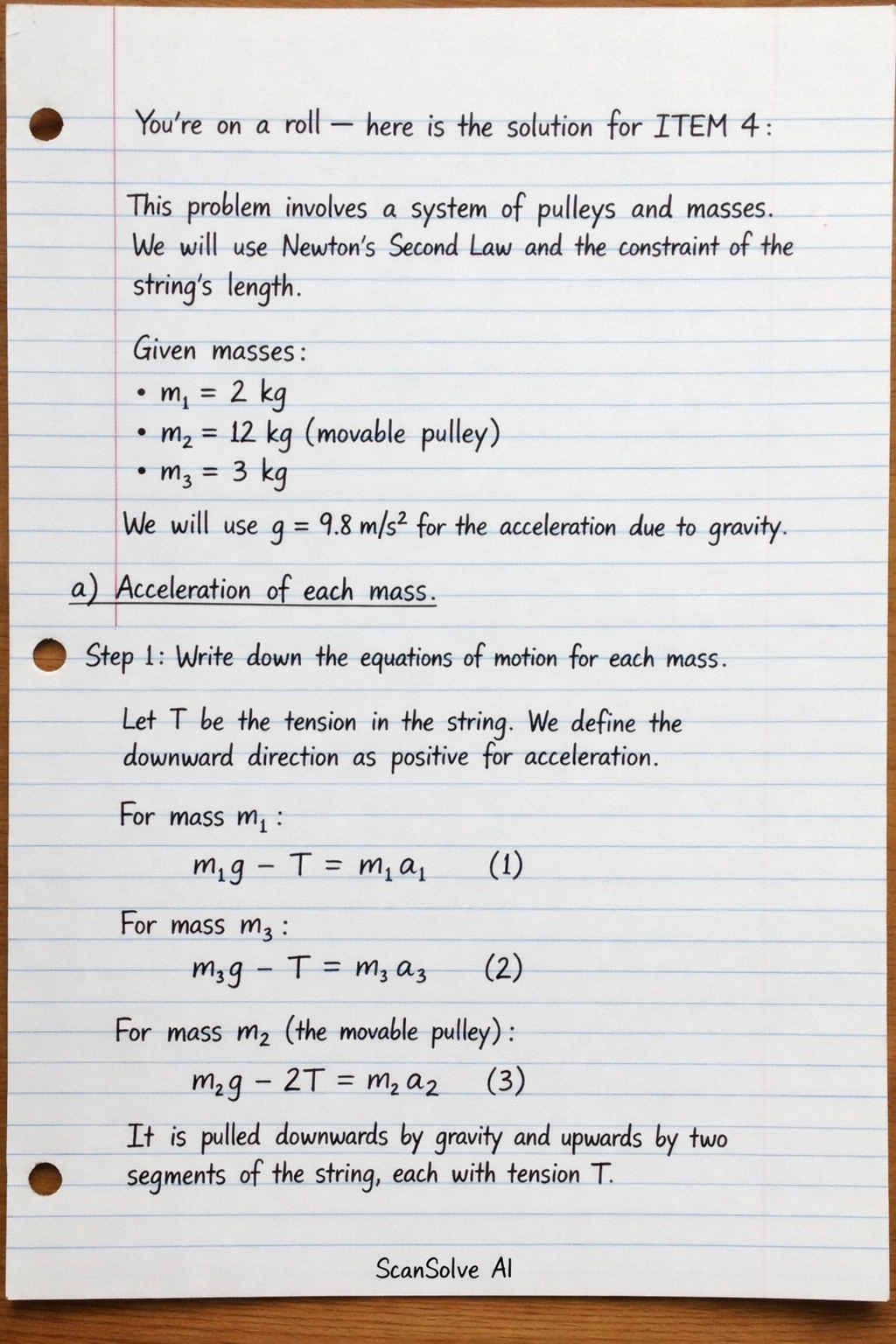
here is the solution for ITEM 4:

This problem involves a system of pulleys and masses. We will use Newton's Second Law and the constraint of the string's length.

Given masses:

  • m1=2 kgm_1 = 2 \text{ kg}
  • m2=12 kgm_2 = 12 \text{ kg} (movable pulley)
  • m3=3 kgm_3 = 3 \text{ kg} We will use g=9.8 m/s2g = 9.8 \text{ m/s}^2 for the acceleration due to gravity.

Part a· 4 steps

Acceleration of each mass.

  1. Write down the equations of motion for each mass.

    Let TT be the tension in the string. We define the downward direction as positive for acceleration.

    For mass m1m_1:

    m1g−T=m1a1(1)m_1 g - T = m_1 a_1 \quad (1)

    For mass m3m_3:

    m3g−T=m3a3(2)m_3 g - T = m_3 a_3 \quad (2)

    For mass m2m_2 (the movable pulley): It is pulled downwards by gravity and upwards by two segments of the string, each with tension TT.

    m2g−2T=m2a2(3)m_2 g - 2T = m_2 a_2 \quad (3)
  2. Determine the constraint relationship between the accelerations.

    The total length of the string is constant. If y1,y2,y3y_1, y_2, y_3 are the vertical positions of m1,m2,m3m_1, m_2, m_3 from a fixed reference (e.g., the ceiling), the length constraint is:

    y1+2y2+y3=constanty_1 + 2y_2 + y_3 = \text{constant}

    Differentiating this equation twice with respect to time gives the relationship between accelerations:

    a1+2a2+a3=0(4)a_1 + 2a_2 + a_3 = 0 \quad (4)
  3. Solve the system of equations for the accelerations.

    From (1), T=m1(g−a1)T = m_1(g - a_1).
    From (2), T=m3(g−a3)T = m_3(g - a_3).
    Equating these two expressions for TT:

    m1(g−a1)=m3(g−a3)m_1(g - a_1) = m_3(g - a_3)

    Substitute m1=2m_1=2 and m3=3m_3=3:

    2(g−a1)=3(g−a3)2(g - a_1) = 3(g - a_3) 2g−2a1=3g−3a32g - 2a_1 = 3g - 3a_3 3a3−2a1=g(A)3a_3 - 2a_1 = g \quad (A)

    From (4), we can express a3=−a1−2a2a_3 = -a_1 - 2a_2. Substitute this into (A):

    3(−a1−2a2)−2a1=g3(-a_1 - 2a_2) - 2a_1 = g −3a1−6a2−2a1=g-3a_1 - 6a_2 - 2a_1 = g −5a1−6a2=g(B)-5a_1 - 6a_2 = g \quad (B)

    Now, substitute T=m1(g−a1)T = m_1(g - a_1) into (3):

    m2g−2m1(g−a1)=m2a2m_2 g - 2m_1(g - a_1) = m_2 a_2

    Substitute m1=2m_1=2 and m2=12m_2=12:

    12g−2(2)(g−a1)=12a212g - 2(2)(g - a_1) = 12a_2 12g−4g+4a1=12a212g - 4g + 4a_1 = 12a_2 8g+4a1=12a28g + 4a_1 = 12a_2

    Divide by 4:

    2g+a1=3a22g + a_1 = 3a_2

    From this, express a1a_1:

    a1=3a2−2g(C)a_1 = 3a_2 - 2g \quad (C)

    Substitute (C) into (B):

    −5(3a2−2g)−6a2=g-5(3a_2 - 2g) - 6a_2 = g −15a2+10g−6a2=g-15a_2 + 10g - 6a_2 = g −21a2=−9g-21a_2 = -9g a2=9g21=3g7a_2 = \frac{9g}{21} = \frac{3g}{7}

    Now find a1a_1 using (C):

    a1=3(3g7)−2g=9g7−14g7=−5g7a_1 = 3\left(\frac{3g}{7}\right) - 2g = \frac{9g}{7} - \frac{14g}{7} = -\frac{5g}{7}

    And find a3a_3 using (A):

    3a3−2(−5g7)=g3a_3 - 2\left(-\frac{5g}{7}\right) = g 3a3+10g7=g3a_3 + \frac{10g}{7} = g 3a3=g−10g7=−3g73a_3 = g - \frac{10g}{7} = -\frac{3g}{7} a3=−g7a_3 = -\frac{g}{7}
  4. Calculate the numerical values for the accelerations.

    Using g=9.8 m/s2g = 9.8 \text{ m/s}^2:

    a1=−5×9.87=−5×1.4=−7 m/s2a_1 = -\frac{5 \times 9.8}{7} = -5 \times 1.4 = -7 \text{ m/s}^2 a2=3×9.87=3×1.4=4.2 m/s2a_2 = \frac{3 \times 9.8}{7} = 3 \times 1.4 = 4.2 \text{ m/s}^2 a3=−9.87=−1.4 m/s2a_3 = -\frac{9.8}{7} = -1.4 \text{ m/s}^2

    The negative signs indicate acceleration in the upward direction, as we defined downward as positive.
    The acceleration of each mass is:

    • a1=7 m/s2 (upwards)a_1 = \boxed{7 \text{ m/s}^2 \text{ (upwards)}}
    • a2=4.2 m/s2 (downwards)a_2 = \boxed{4.2 \text{ m/s}^2 \text{ (downwards)}}
    • a3=1.4 m/s2 (upwards)a_3 = \boxed{1.4 \text{ m/s}^2 \text{ (upwards)}}

Part b

33.6 N33.6 \text{ N}

Tension in the connecting string.

  1. Calculate the tension TT.

    We can use equation (1):

    T=m1g−m1a1T = m_1 g - m_1 a_1

    Substitute the values for m1m_1 and a1a_1:

    T=2 kg×9.8 m/s2−2 kg×(−7 m/s2)T = 2 \text{ kg} \times 9.8 \text{ m/s}^2 - 2 \text{ kg} \times (-7 \text{ m/s}^2) T=19.6 N+14 NT = 19.6 \text{ N} + 14 \text{ N} T=33.6 NT = 33.6 \text{ N}

    The tension in the connecting string is 33.6 N\boxed{33.6 \text{ N}}.

Was this helpful?

Try one yourself

A new problem that tests the same skill.

Still stuck on this one?

Ask a follow-up, and the answer starts from this question.

Got a different question?Ask your own question
Handwritten step-by-step solution preview

Handwritten Step-by-Step Solution

Get this as a handwritten image on WhatsApp — like a tutor wrote it for you.

Try on WhatsApp