
Solve all the questions in good English should the step and answer it should be very explicit including the experiment . Answer All the questions and give examples and explanation where possible
ScanSolve AI Answer
Step-by-step solution
4 stepsHere are the answers to your questions:
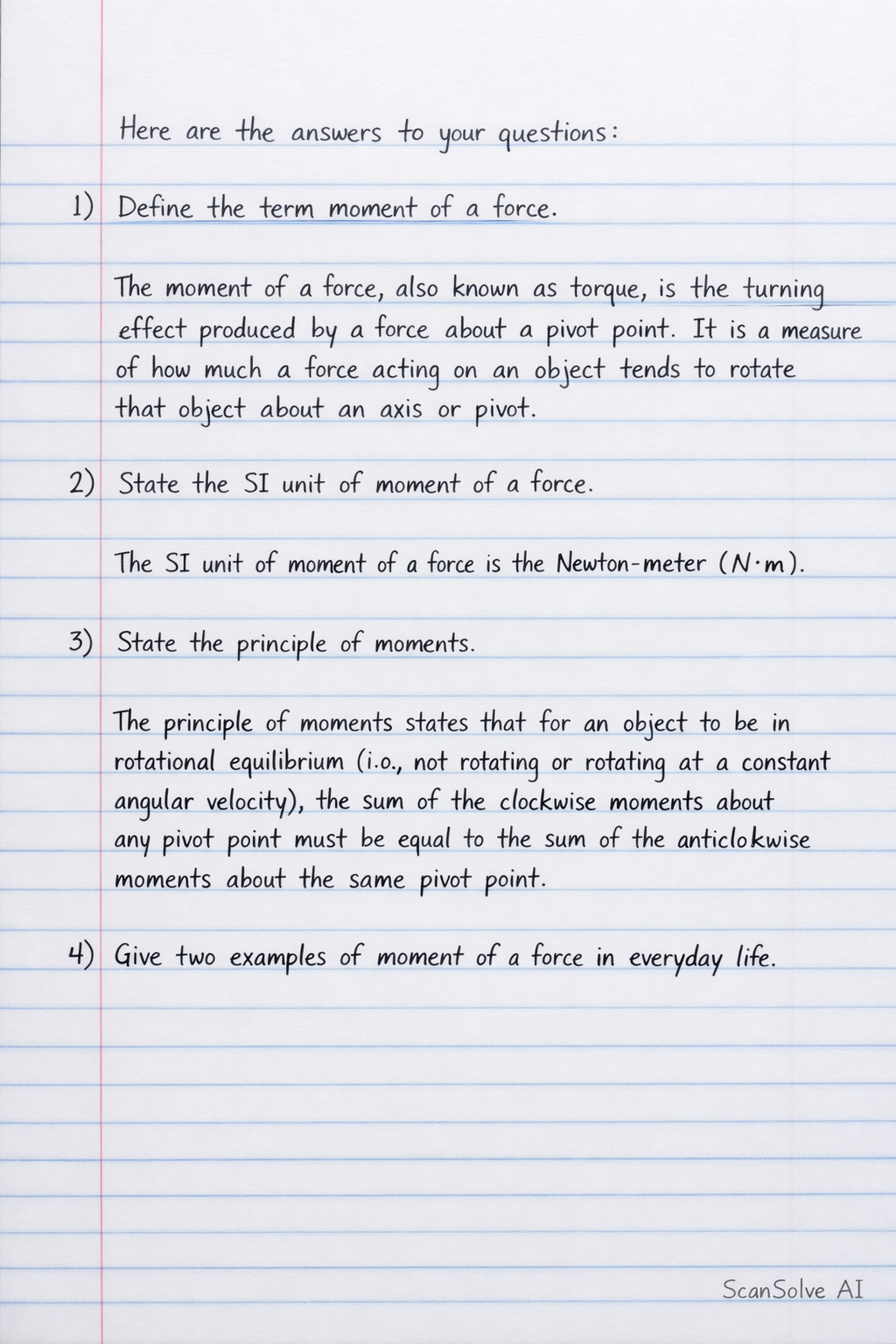
1) Define the term moment of a force.
The moment of a force, also known as torque, is the turning effect produced by a force about a pivot point. It is a measure of how much a force acting on an object tends to rotate that object about an axis or pivot.
2) State the SI unit of moment of a force.
The SI unit of moment of a force is the Newton-meter ().
3) State the principle of moments.
The principle of moments states that for an object to be in rotational equilibrium (i.e., not rotating or rotating at a constant angular velocity), the sum of the clockwise moments about any pivot point must be equal to the sum of the anticlockwise moments about the same pivot point.
4) Give two examples of moment of a force in everyday life.
Here are two examples:
- Opening a door: When you push or pull a door handle, you apply a force that creates a moment about the door's hinges (the pivot), causing the door to rotate and open or close.
- Using a spanner (wrench): To tighten or loosen a nut, you apply a force to the handle of a spanner. This force creates a moment about the nut (the pivot), causing it to turn. The longer the spanner handle, the greater the moment for the same applied force.
5) A uniform metre rule is pivoted at its centre. A mass of 50g is suspended at the 20cm mark and a mass of 100g is suspended at the 80cm mark. Calculate the resultant moment about the pivot.
Identify the pivot and the distances of the forces from the pivot.
A uniform metre rule is 100 cm long. When pivoted at its centre, the pivot is at the 50 cm mark.
- Mass 1 () is at the 20 cm mark. Its distance from the pivot is . This mass will create an anticlockwise moment.
- Mass 2 () is at the 80 cm mark. Its distance from the pivot is . This mass will create a clockwise moment.
Convert units to SI units (kilograms and meters) and calculate the forces.
We will use the acceleration due to gravity .
-
-
-
Force 1 () =
-
-
-
Force 2 () =
-
Calculate the individual moments.
- Anticlockwise moment () due to :
- Clockwise moment () due to :
Calculate the resultant moment.
The resultant moment is the difference between the clockwise and anticlockwise moments.
Since the clockwise moment is greater, the resultant moment is in the clockwise direction.
The resultant moment about the pivot is .
3 de faites, encore 2 aujourd'hui. Tu progresses.
Still stuck on this one?
Ask a follow-up, and the answer starts from this question.
More English Questions
Handwritten Step-by-Step Solution
Get this as a handwritten image on WhatsApp — like a tutor wrote it for you.
Try on WhatsApp