
This English question involves literary analysis, grammar, or writing skills. The detailed response below provides a well-structured answer with supporting evidence and clear explanations.
ScanSolve AI Answer
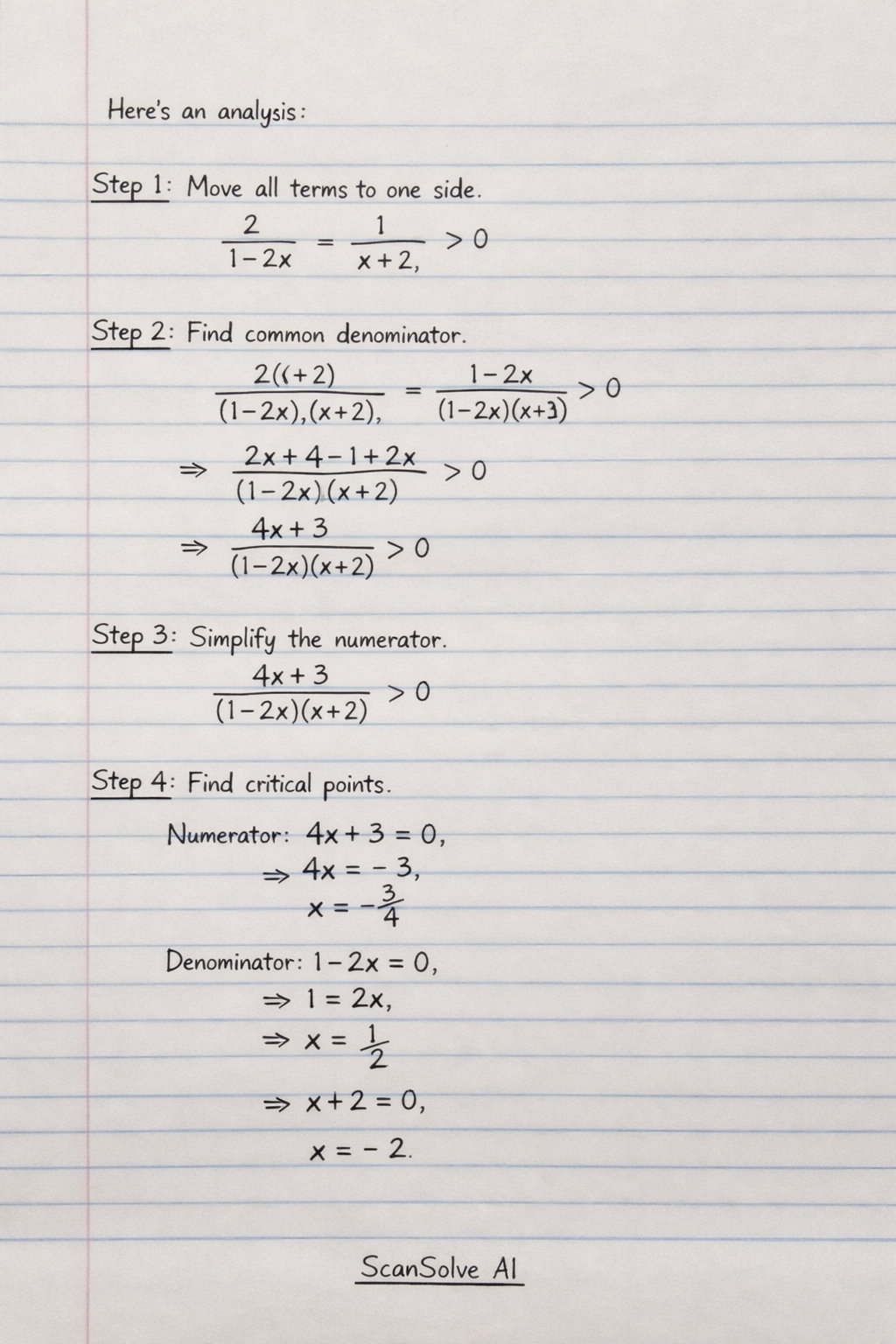
Here's a complete step-by-step solution for the inequality: Step 1: Move all terms to one side to compare the expression with zero. (2)/(1-2x) > (1)/(x+2) Subtract (1)/(x+2) from both sides: (2)/(1-2x) - (1)/(x+2) > 0 Step 2: Find a common denominator and combine the fractions. The common denominator is (1-2x)(x+2). (2(x+2))/((1-2x)(x+2)) - (1(1-2x))/((1-2x)(x+2)) > 0 Combine the numerators: (2(x+2) - (1-2x))/((1-2x)(x+2)) > 0 Step 3: Simplify the numerator. (2x + 4 - 1 + 2x)/((1-2x)(x+2)) > 0 (4x + 3)/((1-2x)(x+2)) > 0 Step 4: Identify the critical points by setting the numerator and each factor of the denominator to zero. These points indicate where the expression might change sign. • Numerator: 4x + 3 = 0 4x = -3 x = -(3)/(4) • Denominator: 1 - 2x = 0 1 = 2x x = (1)/(2) x + 2 = 0 x = -2 The critical points, in ascending order, are x = -2, x = -(3)/(4), and x = (1)/(2). These points divide the number line into four intervals: (-, -2), (-2, -(3)/(4)), (-(3)/(4), (1)/(2)), and ((1)/(2), ). Step 5: Test a value from each interval in the simplified inequality (4x+3)/((1-2x)(x+2)) > 0 to determine the sign of the expression. • Interval 1: (-, -2) Test x = -3: (4(-3)+3)/((1-2(-3))(-3+2)) = (-9)/((7)(-1)) = (-9)/(-7) = (9)/(7). Since (9)/(7) > 0, this interval is part of the solution. • Interval 2: (-2, -(3)/(4)) Test x = -1: (4(-1)+3)/((1-2(-1))(-1+2)) = (-1)/((3)(1)) = -(1)/(3). Since -(1)/(3) 0, this interval is not part of the solution. • Interval 3: (-(3)/(4), (1)/(2)) Test x = 0: (4(0)+3)/((1-2(0))(0+2)) = (3)/((1)(2)) = (3)/(2). Since (3)/(2) > 0, this interval is part of the solution. • Interval 4: ((1)/(2), ) Test x = 1: (4(1)+3)/((1-2(1))(1+2)) = (7)/((-1)(3)) = -(7)/(3). Since -(7)/(3) 0, this interval is not part of the solution. Step 6: Combine the intervals where the inequality is satisfied. The solution is the union of the intervals (-, -2) and (-(3)/(4), (1)/(2)). The solution set is (-, -2) (-(3)/(4), (1)/(2)).