
Please do question no. 6 to 13 in English language..
ScanSolve AI Answer
Answers
7 partsStep-by-step solution
27 stepsHere are the solutions to questions 6 to 13 in English:
Part 6
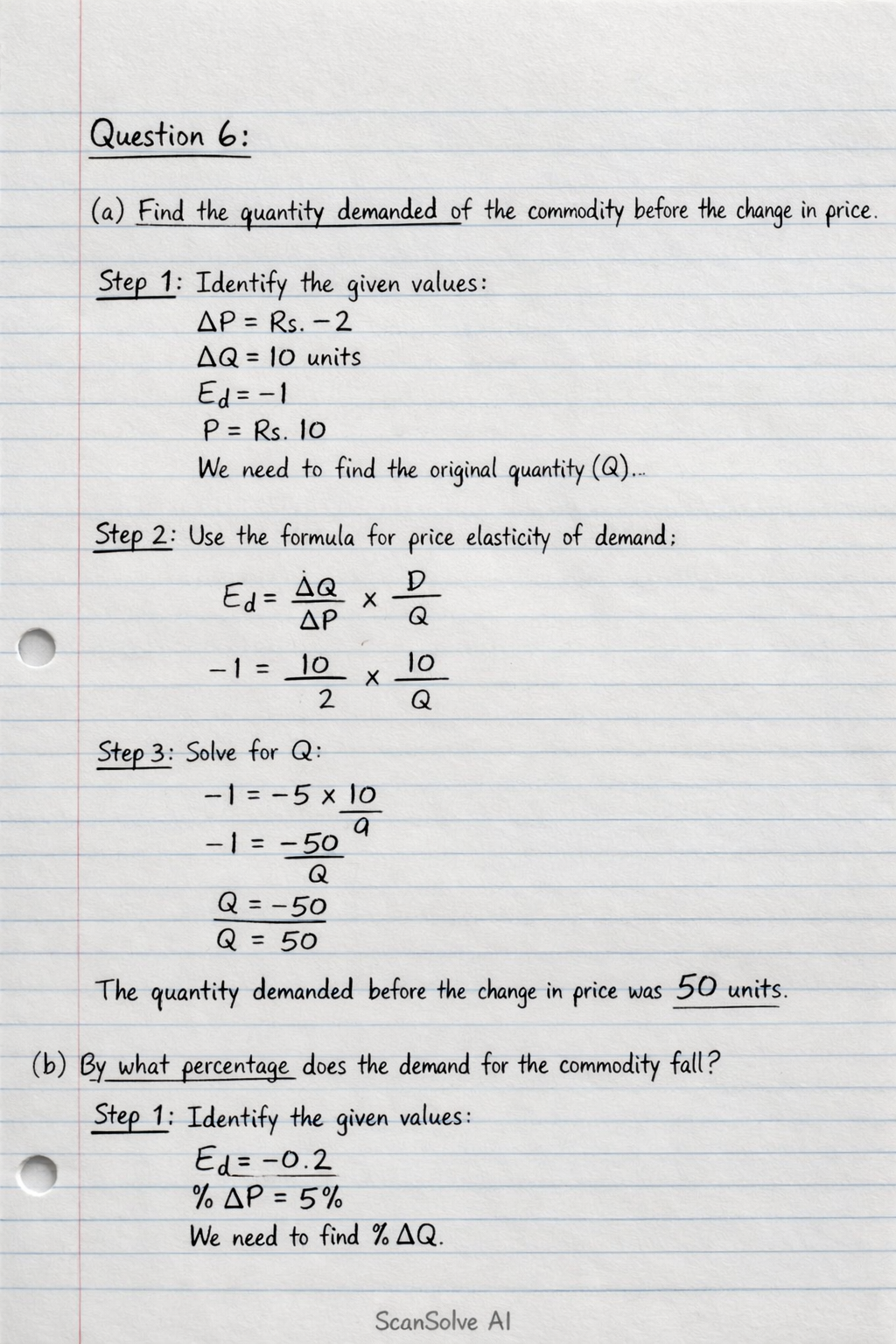
Part a· 3 steps
Find the quantity demanded of the commodity before the change in price.
Identify the given values.
Change in price () = Rs.
Change in quantity demanded () = 10 units
Price elasticity of demand () =
Original price () = Rs. 10
We need to find the original quantity ().Use the formula for price elasticity of demand
Substitute the given values:Solve for .
The quantity demanded before the change in price was 50 units.
Part b· 3 steps
By what percentage does the demand for the commodity fall?
Identify the given values.
Price elasticity of demand () =
Percentage increase in price () =
We need to find the percentage change in quantity demanded ().Use the formula for price elasticity of demand
Substitute the given values:Solve for .
The demand for the commodity falls by 1%.
Part 7-2.5
If the price of a commodity falls from Rs. 10 to Rs. 8 and its demand rises from 20 units to 30 units, calculate the price elasticity of demand.
Identify the initial and final values.
Initial Price () = Rs. 10
Final Price () = Rs. 8
Initial Quantity () = 20 units
Final Quantity () = 30 unitsCalculate the change in price () and change in quantity ().
Apply the price elasticity of demand formula.
The price elasticity of demand is .
Part 8-2.5
When the price of a commodity is Rs. 5 per unit, its demand is 100 units. When the price falls to Rs. 4 per unit, demand expands to 150 units. Calculate the price elasticity of demand.
Identify the initial and final values.
Initial Price () = Rs. 5
Final Price () = Rs. 4
Initial Quantity () = 100 units
Final Quantity () = 150 unitsCalculate the change in price () and change in quantity ().
Apply the price elasticity of demand formula.
The price elasticity of demand is .
Part 9-1
When the price of a commodity is Rs. 10 per unit, its demand is 100 units. When the price falls to Rs. 8 per unit, demand expands to 120 units. Calculate the price elasticity of demand.
Identify the initial and final values.
Initial Price () = Rs. 10
Final Price () = Rs. 8
Initial Quantity () = 100 units
Final Quantity () = 120 unitsCalculate the change in price () and change in quantity ().
Apply the price elasticity of demand formula.
The price elasticity of demand is .
Part 10-1
When the price of a commodity is Rs. 10 per unit, its demand is 100 units. When the price rises to Rs. 12 per unit, demand contracts to 80 units. Calculate the price elasticity of demand.
Identify the initial and final values.
Initial Price () = Rs. 10
Final Price () = Rs. 12
Initial Quantity () = 100 units
Final Quantity () = 80 unitsCalculate the change in price () and change in quantity ().
Apply the price elasticity of demand formula.
The price elasticity of demand is .
Part 11-2.5
When the price of a commodity is Rs. 10 per unit, its demand is 100 units. When the price falls to Rs. 8 per unit, demand expands to 150 units. Calculate the price elasticity of demand.
Identify the initial and final values.
Initial Price () = Rs. 10
Final Price () = Rs. 8
Initial Quantity () = 100 units
Final Quantity () = 150 unitsCalculate the change in price () and change in quantity ().
Apply the price elasticity of demand formula.
The price elasticity of demand is .
Part 12-1
When the price of a commodity is Rs. 10 per unit, its demand is 100 units. When the price falls to Rs. 8 per unit, demand expands to 120 units. Calculate the price elasticity of demand.
Identify the initial and final values.
Initial Price () = Rs. 10
Final Price () = Rs. 8
Initial Quantity () = 100 units
Final Quantity () = 120 unitsCalculate the change in price () and change in quantity ().
Apply the price elasticity of demand formula.
The price elasticity of demand is .
Part 13-1
When the price of a commodity is Rs. 10 per unit, its demand is 100 units. When the price rises to Rs. 12 per unit, demand contracts to 80 units. Calculate the price elasticity of demand.
Identify the initial and final values.
Initial Price () = Rs. 10
Final Price () = Rs. 12
Initial Quantity () = 100 units
Final Quantity () = 80 unitsCalculate the change in price () and change in quantity ().
Apply the price elasticity of demand formula.
The price elasticity of demand is .
Try one yourself
A new problem that tests the same skill.
Still stuck on this one?
Ask a follow-up, and the answer starts from this question.
More English Questions
Handwritten Step-by-Step Solution
Get this as a handwritten image on WhatsApp — like a tutor wrote it for you.
Try on WhatsApp