
We read your photo as:
Read the second poem "Kuna watu vitokoko" and answer the following questions. Specifically, explain six things the poet refuses to kiss in the first poem "Nakataa Kuubusu".
ScanSolve AI Answer
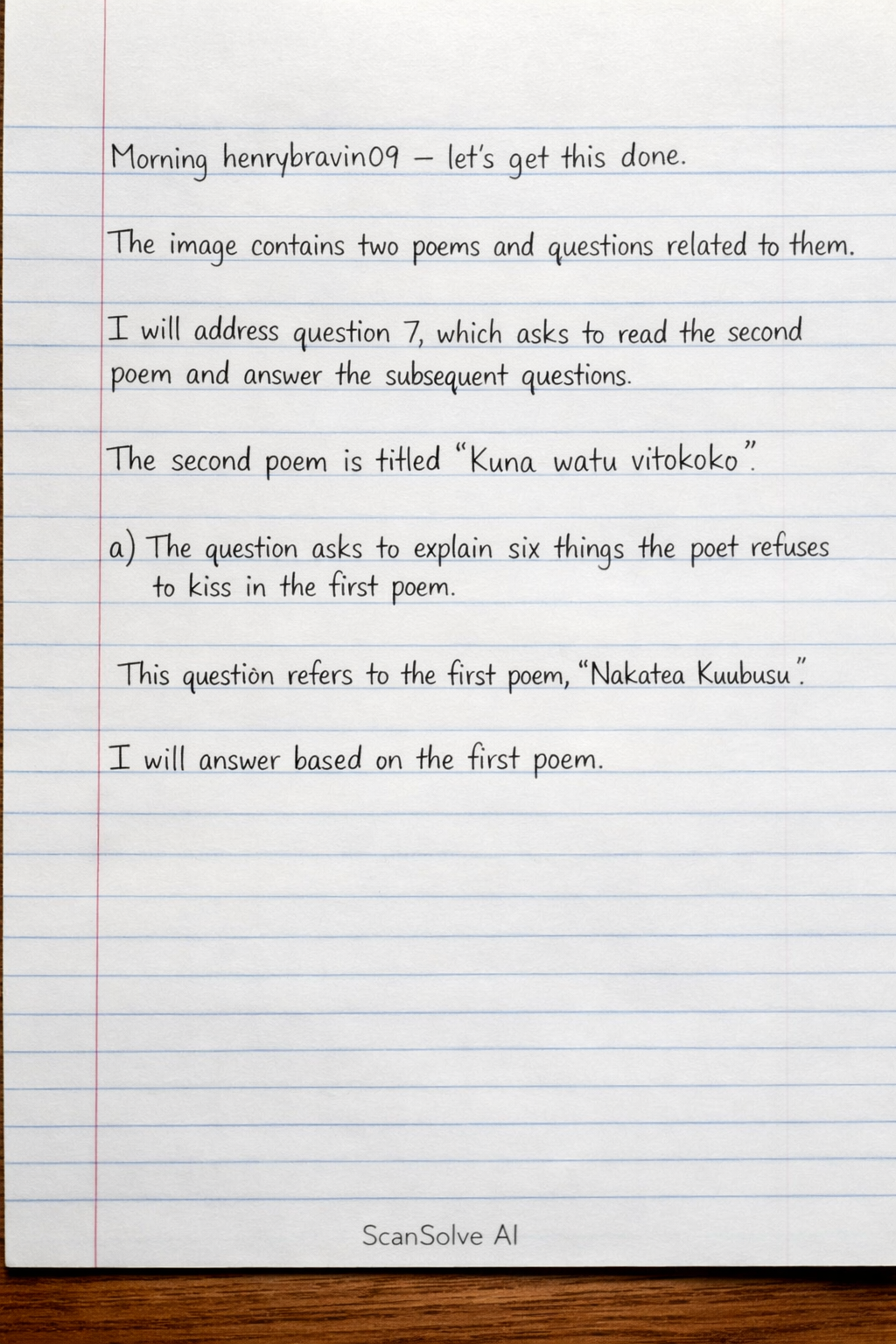
The image contains two poems and questions related to them. I will address question 7, which asks to read the second poem and answer the subsequent questions.
The second poem is titled "Kuna watu vitokoko".
a) The question asks to explain six things the poet refuses to kiss in the first poem. This question refers to the first poem, "Nakataa Kuubusu". I will answer based on the first poem.
The poet refuses to kiss:
- Kuwa mtumwa siwezi, kumilikiwa haramu (Being a slave, being owned illegally)
- Ni aila kuihizi, kuchochea uhasimu (A family that incites hatred, stirs animosity)
- Watanguliza vizazi, matakwa yao nakimu (Those who prioritize generations, their desires are oppressive)
- Mkono sitoubusi, ningashindwa kuukata! (A hand I won't kiss, even if I fail to cut it!)
- Sitobusu hakika, pengine nitaung'ata (I will not kiss for sure, maybe I will bite it)
- Pindi nitapoudaka, wa mja asotakata (When I catch it, from a person who is not pure)
- Ukemi utasikika, adhabu ni ya mkata (The cry will be heard, the punishment is severe)
- Mkono sitoubusi, ningashindwa kuukata! (A hand I won't kiss, even if I fail to cut it!)
The six things the poet refuses to kiss are:
- Utumwa (Slavery)
- Kumilikiwa haramu (Illegal ownership)
- Aila inayochochea uhasimu (A family that incites animosity)
- Watu wanaotanguliza vizazi na matakwa yao ya ukandamizaji (People who prioritize generations and their oppressive desires)
- Mkono wa mtu asiye safi (The hand of an impure person)
- Mkono unaoleta adhabu kali (A hand that brings severe punishment)
b) The question asks to identify the poet's attitude in the first poem.
The poet's attitude is one of defiance, rebellion, and unwillingness to submit to oppression or injustice. He strongly rejects anything that compromises his freedom and dignity.
c) The question asks to explain the importance of freedom and the poetic device used in the first poem.
The importance of freedom is highlighted as a fundamental human right that the poet is willing to fight for, even to the point of biting the hand that seeks to oppress him. The poetic device used is kinaya (irony) or taswira (imagery) through the repeated phrase "Mkono sitoubusi, ningashindwa kuukata!" which emphasizes his strong refusal and determination.
d) The question asks to explain two types of repetition (urudiaji) found in the first poem.
Two types of repetition are:
- Urudiaji wa maneno (Repetition of words): The phrase "Mkono sitoubusi, ningashindwa kuukata!" is repeated, emphasizing the poet's unwavering stance.
- Urudiaji wa sauti (Repetition of sound/rhyme): The poem uses urari wa vina (end rhyme) where lines within stanzas often rhyme, for example, "-hiz_i_", "-sim_u_", "-zim_u_", "-kat_a_".
e) The question asks to explain the structure of the first poem.
The poem is structured in mashairi (quatrains or four-line stanzas). Each stanza has a consistent rhyme scheme, typically AABB or ABAB, and a regular meter, characteristic of traditional Swahili poetry.
f) The question asks to write the third stanza of the first poem in prose.
The third stanza is:
"Sitobusu hakika, pengine nitaung'ata
Pindi nitapoudaka, wa mja asotakata
Ukemi utasikika, adhabu ni ya mkata
Mkono sitoubusi, ningashindwa kuukata!"
In prose, this means:
"I will certainly not kiss it; perhaps I will bite it when I catch it from an impure person. A cry will be heard, and the punishment will be severe. I will not kiss that hand, even if I fail to cut it off."
Still stuck on this one?
Ask a follow-up, and the answer starts from this question.
More English Questions
Handwritten Step-by-Step Solution
Get this as a handwritten image on WhatsApp — like a tutor wrote it for you.
Try on WhatsApp