ScanSolve logoScanSolve
Toggle sidebar
  • Homework
  • Tutor
  • Humanizer
  • AI Detector
  • Questions
  • Blog
  • History
  • Mobile App

  • Homework
  • Tutor
  • Humanizer
  • AI Detector

  • Questions
  • Math homework helpMath
    Physics homework helpPhysics
    Chemistry homework helpChemistry
    Biology homework helpBiology
    Computer Science homework helpComputer Science
    History homework helpHistory
    More homework helpMore
  • Blog
  • History

  • Mobile App
ScanSolvePLUS
  • Unlimited answers
  • ScanSolve AI Pro
Start Free Trial →
Try on WhatsApp
English: SECTION A: William Shakespeare: Macbeth — Step-by-Step Solution | ScanSolve
Home > English Homework Help > Solution

SECTION A: William Shakespeare: Macbeth

Asked on March 28, 2026|English

This English question involves literary analysis, grammar, or writing skills. The detailed response below provides a well-structured answer with supporting evidence and clear explanations.

ScanSolve AI AnswerAnswered on March 28, 2026
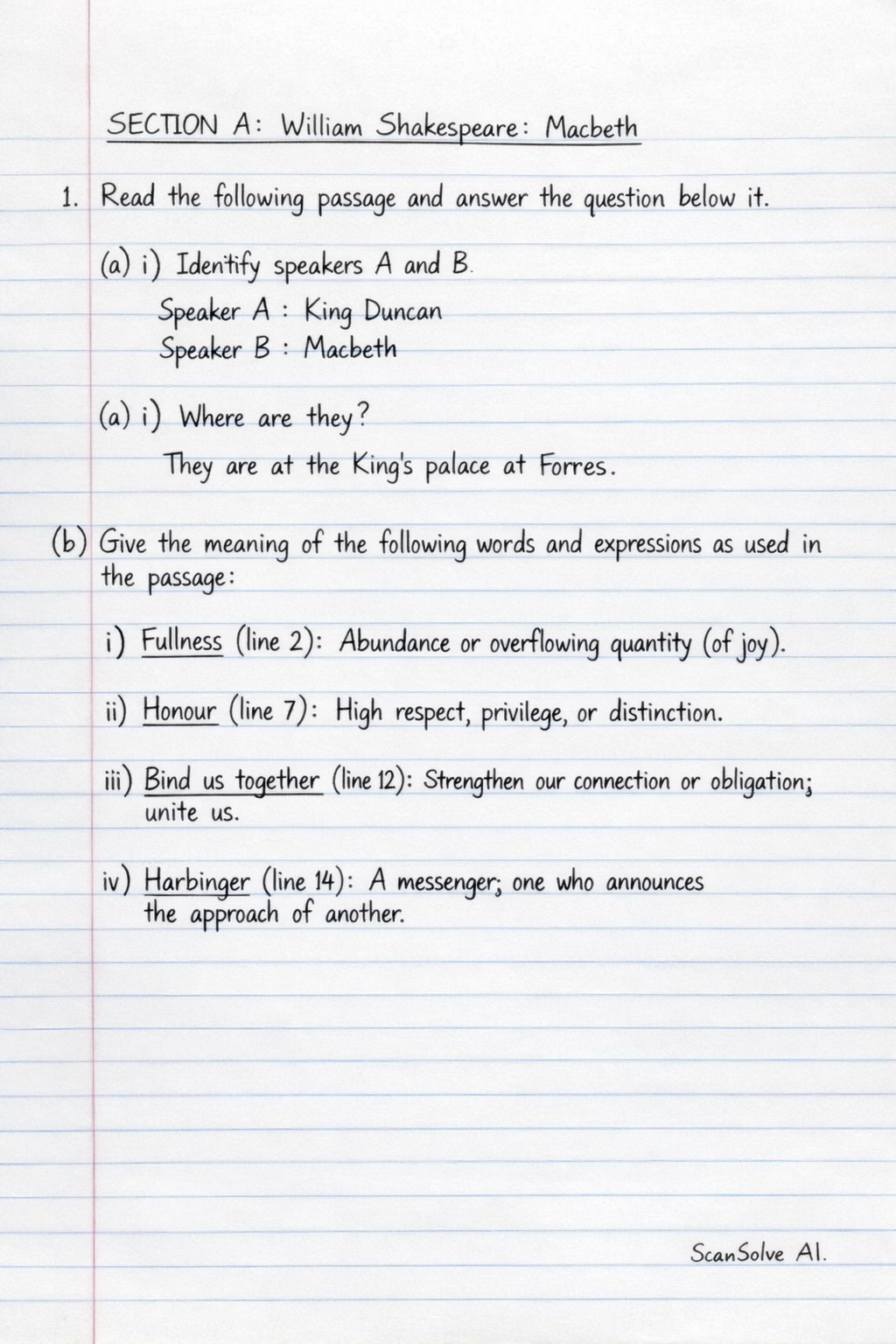
SECTION A: William Shakespeare: Macbeth 1. Read the following passage and answer the question below it. a) i) Identify speakers A and B Speaker A: King Duncan* Speaker B: Macbeth* a) ii) Where are they? They are at the King's palace at Forres. b) Give the meaning of the following words and expressions as used in the passage: i) Fullness (line 2): Abundance or overflowing quantity (of joy).* ii) Honour (line 7): High respect, privilege, or distinction.* iii) Bind us together (line 12): Strengthen our connection or obligation; unite us.* iv) Harbinger (line 14): A messenger; one who announces the approach of another.* c) Pick out two figures of speech from the extract above and state their effectiveness. 1. Figure of Speech: Simile* Example: "But signs of nobleness, like stars*, shall shine On all deservers." (lines 9-10) Effectiveness: The comparison of honours to stars emphasizes their brightness, visibility, and the idea that they are numerous and divinely bestowed, highlighting King Duncan's generosity and the worthiness of those he rewards. 2. Figure of Speech: Metaphor* Example: "I'll be myself the harbinger*..." (line 14) Effectiveness: Macbeth metaphorically calls himself a messenger, indicating his eagerness and loyalty to serve the King by going ahead to prepare for his arrival. It also subtly hints at his ambition and desire to be seen as a loyal subject. d) Bring out any two aspects of speaker A's character. 1. Generous and Benevolent*: King Duncan is shown to be generous as he bestows honours upon his loyal subjects ("signs of nobleness, like stars, shall shine On all deservers") and plans to visit Macbeth's castle, showing great favour. 2. Trusting and Naïve*: Duncan demonstrates a trusting nature by completely believing in Macbeth's loyalty and planning to stay at his castle, unaware of the treacherous thoughts Macbeth harbors. e) Give an account of what happens before the scene from the passage above is taken. Before this scene (Act 1, Scene 4), Macbeth and Banquo encounter the Three Witches on a desolate heath. The Witches deliver three prophecies to Macbeth: that he is the Thane of Glamis (which he already is), that he will be the Thane of Cawdor, and that he will eventually become king. They also prophesy that Banquo's descendants will be kings. Immediately after the Witches vanish, Ross and Angus arrive to inform Macbeth that King Duncan has bestowed upon him the title of Thane of Cawdor, confirming the second prophecy. This news deeply affects Macbeth, sparking ambitious thoughts and leading him to contemplate regicide to fulfill the third prophecy. 2. Read the following passage and answer the questions below it. The questions for this passage are not visible in the provided image.

Related English Questions

  • 9. With the aid of "The Concubine" by Elechi Amadi, here are five ideas communicated in the novel and their relevance to...
  • Your poem must only have 3 stanzas**.
  • A noun is a word that names a person, place, thing, or idea. For example, teacher, city, book, and happiness are all nou...
  • 1. (a) Seven literary forms used in the writing of the Bible are:
  • I snaped and send a reading passage with multiple Choice questions and you didn't solve it . Why ?
  • The question is incomplete. Please provide the full question or the rest of the sentence for "Bhola Grandpa was returnin...
See all English questions

This step-by-step solution was generated by ScanSolve AI. Need help with more english problems? Browse English solutions or ask your own question.

Home›English Homework Help›SECTION A: William Shakespeare: Macbeth
Q

SECTION A: William Shakespeare: Macbeth

March 28, 2026|English
SECTION A: William Shakespeare: Macbeth

SECTION A: William Shakespeare: Macbeth

ScanSolve AI

ScanSolve AI Answer

Answered on March 28, 2026

SECTION A: William Shakespeare: Macbeth

1. Read the following passage and answer the question below it.

a) i) Identify speakers A and B

  • Speaker A: King Duncan
  • Speaker B: Macbeth

a) ii) Where are they? They are at the King's palace at Forres.

b) Give the meaning of the following words and expressions as used in the passage:

  • i) Fullness (line 2): Abundance or overflowing quantity (of joy).
  • ii) Honour (line 7): High respect, privilege, or distinction.
  • iii) Bind us together (line 12): Strengthen our connection or obligation; unite us.
  • iv) Harbinger (line 14): A messenger; one who announces the approach of another.

c) Pick out two figures of speech from the extract above and state their effectiveness.

    1. Figure of Speech: Simile
    • Example: "But signs of nobleness, like stars, shall shine On all deservers." (lines 9-10)
    • Effectiveness: The comparison of honours to stars emphasizes their brightness, visibility, and the idea that they are numerous and divinely bestowed, highlighting King Duncan's generosity and the worthiness of those he rewards.
    1. Figure of Speech: Metaphor
    • Example: "I'll be myself the harbinger..." (line 14)
    • Effectiveness: Macbeth metaphorically calls himself a messenger, indicating his eagerness and loyalty to serve the King by going ahead to prepare for his arrival. It also subtly hints at his ambition and desire to be seen as a loyal subject.

d) Bring out any two aspects of speaker A's character.

    1. Generous and Benevolent: King Duncan is shown to be generous as he bestows honours upon his loyal subjects ("signs of nobleness, like stars, shall shine On all deservers") and plans to visit Macbeth's castle, showing great favour.
    1. Trusting and Naïve: Duncan demonstrates a trusting nature by completely believing in Macbeth's loyalty and planning to stay at his castle, unaware of the treacherous thoughts Macbeth harbors.

e) Give an account of what happens before the scene from the passage above is taken. Before this scene (Act 1, Scene 4), Macbeth and Banquo encounter the Three Witches on a desolate heath. The Witches deliver three prophecies to Macbeth: that he is the Thane of Glamis (which he already is), that he will be the Thane of Cawdor, and that he will eventually become king. They also prophesy that Banquo's descendants will be kings. Immediately after the Witches vanish, Ross and Angus arrive to inform Macbeth that King Duncan has bestowed upon him the title of Thane of Cawdor, confirming the second prophecy. This news deeply affects Macbeth, sparking ambitious thoughts and leading him to contemplate regicide to fulfill the third prophecy.

2. Read the following passage and answer the questions below it. The questions for this passage are not visible in the provided image.

Need help with your own homework?

Get instant step-by-step solutions to any question. Free to start.

Ask Your Question
Handwritten step-by-step solution

Handwritten Step-by-Step Solution

Get this solution as a handwritten image on WhatsApp — just like a tutor wrote it for you.

Try on WhatsApp

More English Questions

9. With the aid of "The Concubine" by Elechi Amadi, here are five ideas communicated in the novel an…Your poem must only have 3 stanzas**.A noun is a word that names a person, place, thing, or idea. For example, teacher, city, book, and h…1. (a) Seven literary forms used in the writing of the Bible are:I snaped and send a reading passage with multiple Choice questions and you didn't solve it . Why ?The question is incomplete. Please provide the full question or the rest of the sentence for "Bhola…
See all Englishquestions →