
Can you send me in English please step by step
ScanSolve AI Answer
Answer
Step-by-step solution
4 stepsSimplify the circuit using source transformation.
First, convert the current source on the left with its parallel resistor into an equivalent voltage source.
The voltage source value will be .
Since the current source points downwards, the positive terminal of the voltage source will be at the bottom (towards ground), and the negative terminal will be towards node . So, it contributes to node . This source will be in series with the resistor.Similarly, convert the current source on the right with its parallel resistor into an equivalent voltage source.
The voltage source value will be .
Since the current source points upwards, the positive terminal of the voltage source will be towards node , and the negative terminal will be at the bottom (towards ground). So, it contributes to node . This source will be in series with the resistor.The circuit now looks like this, with two main nodes and (assuming the bottom wire is ground ):
- From node to ground: A resistor in parallel with a series combination of a resistor and a voltage source.
- From node to ground: A resistor in parallel with a series combination of a resistor and a voltage source.
- Between nodes and : A resistor (through which flows), and a series combination of a resistor and a voltage source. The source has its positive terminal towards (through the resistor) and its negative terminal towards .
Apply Kirchhoff's Current Law (KCL) at nodes and using nodal analysis.
KCL at node (sum of currents leaving the node is zero):
Multiply the equation by 42 (the least common multiple of ) to eliminate fractions:
KCL at node (sum of currents leaving the node is zero):
Multiply the equation by 84 (the least common multiple of ) to eliminate fractions:
Solve the system of equations A and B.
From Equation A: .
Substitute the expression for into Equation B:
To combine the terms with , find a common denominator:
Now, calculate :
We can simplify and by noting that .
Calculate the current through the resistor.
The current flows from node to node .
The current is .
Try one yourself
A new problem that tests the same skill.
Still stuck on this one?
Ask a follow-up, and the answer starts from this question.
More English Questions
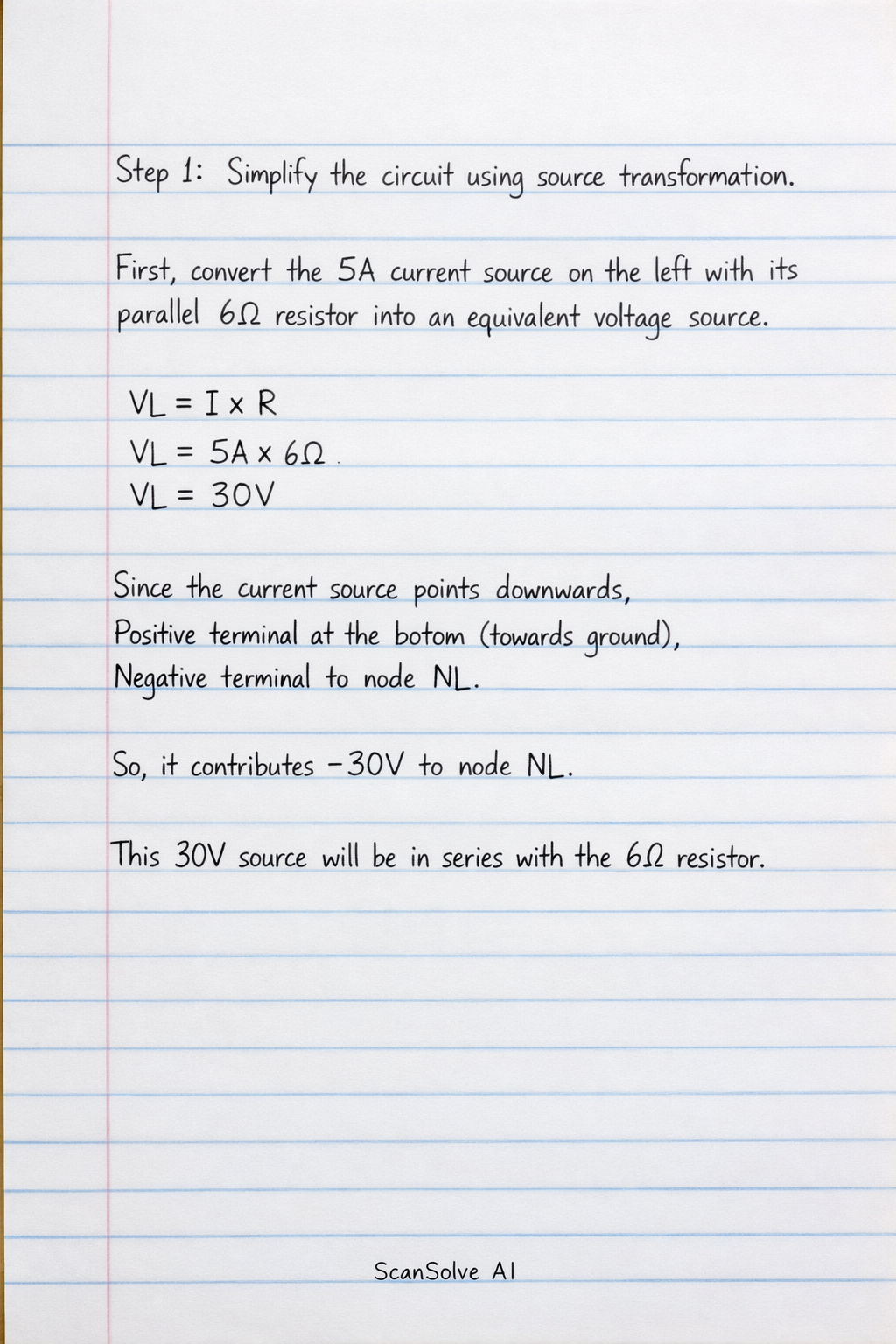
Handwritten Step-by-Step Solution
Get this as a handwritten image on WhatsApp — like a tutor wrote it for you.
Try on WhatsApp