
Talk in english plz
ScanSolve AI Answer
Step-by-step solution
7 stepsOkay, I can switch to English for you. Here are the solutions to your questions in English:
1. An atom of element E has a mass number of 31 and 16 neutrons.
a) Write the electron arrangement of the atom.
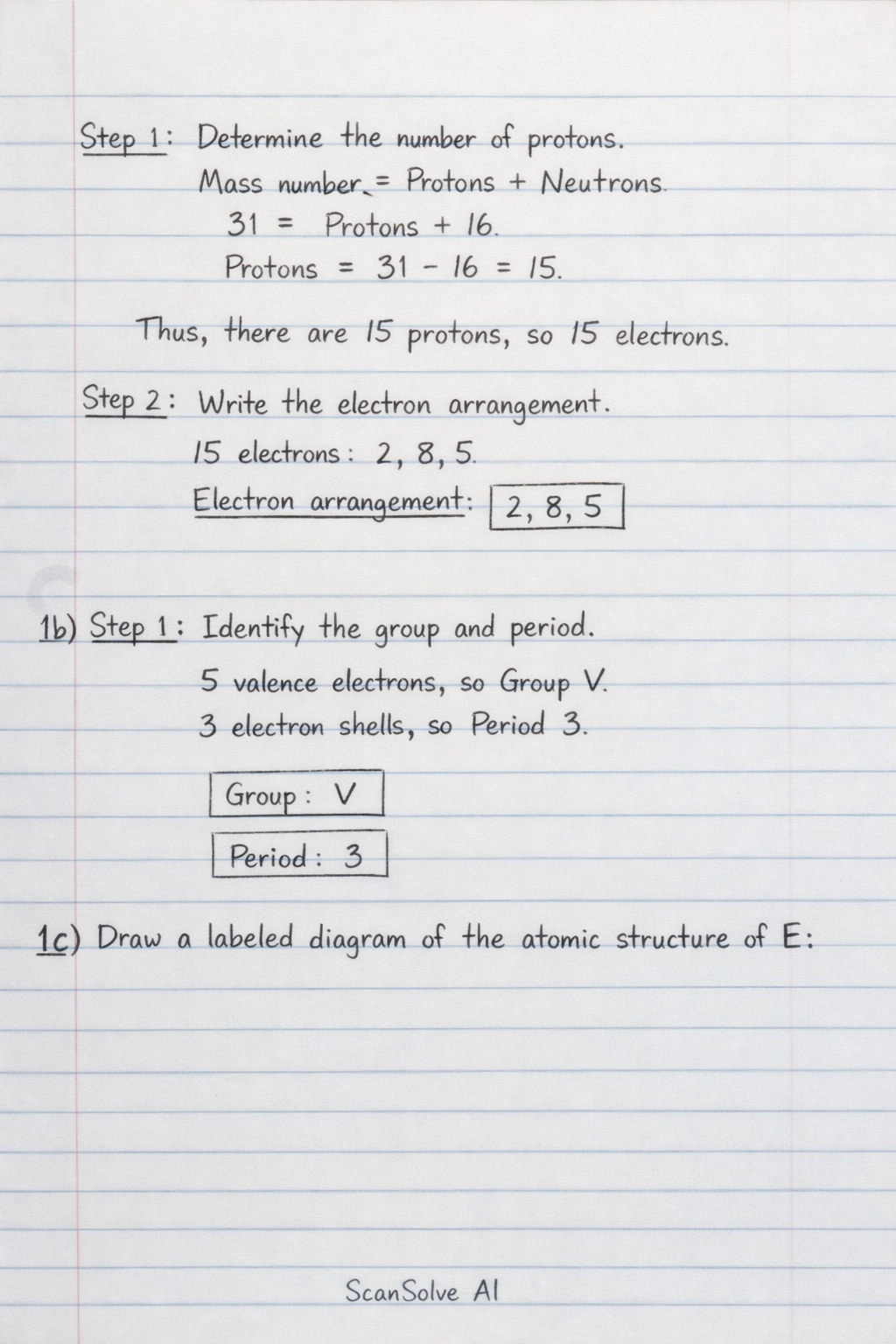
Determine the number of protons.
Mass number = Number of protons + Number of neutrons
For a neutral atom, the number of electrons is equal to the number of protons, so there are 15 electrons.
Write the electron arrangement.
The electron arrangement for 15 electrons is 2, 8, 5.
Electron arrangement:b) State the group and period to which element E belongs.
Identify the group and period.
The number of valence electrons (electrons in the outermost shell) is 5, so the element is in Group V (or 15).
The number of electron shells is 3, so the element is in Period 3.
Group:
Period:c) Draw a labeled diagram showing the atomic structure of E.
Describe the atomic structure.
Your diagram should show a nucleus containing 15 protons and 16 neutrons. It should also show three electron shells with 2 electrons in the first shell, 8 electrons in the second shell, and 5 electrons in the third (outermost) shell.
2. The diagram below shows an arrangement that can be used to react magnesium ribbon with steam.
a) Write a balanced chemical equation for the reaction that produces hydrogen gas.
Write and balance the equation.
Magnesium (Mg) reacts with steam (H₂O(g)) to produce magnesium oxide (MgO) and hydrogen gas (H₂).
b) Explain the precaution that should be observed at the end of the experiment before heating is stopped.
Explain the precaution.
To prevent water from being sucked back into the hot boiling tube (suck-back), which could cause it to crack, the delivery tube must be removed from the water trough before the heating is stopped.
Precaution:c) Explain the industrial use of the product formed in the boiling tube at the end of the experiment.
Explain the industrial use.
The product formed in the boiling tube is magnesium oxide (MgO).
Industrial use:
Still stuck on this one?
Ask a follow-up, and the answer starts from this question.
More English Questions
Handwritten Step-by-Step Solution
Get this as a handwritten image on WhatsApp — like a tutor wrote it for you.
Try on WhatsApp