
We read your photo as:
Write in english please
ScanSolve AI Answer
Step-by-step solution
26 stepsHere are the solutions to your questions:
32. Prove that is irrational.
Assume, for the sake of contradiction, that is a rational number.
If is rational, then it can be written in the form , where and are coprime integers and .
Rearrange the equation to isolate .
Analyze the result.
Since and are integers and , the ratio is a rational number. This implies that is a rational number.
State the contradiction and conclusion.
However, it is a known fact that is an irrational number. This contradicts our initial assumption. Therefore, our assumption that is rational must be false.
Hence, is irrational.33. Find the nature of the roots of the quadratic equation .
Identify the coefficients from the quadratic equation .
For , we have , , and .
Calculate the discriminant .
Determine the nature of the roots based on the value of .
Since , the roots are real and distinct.
The nature of the roots is real and distinct.34. Find a quadratic polynomial whose sum and product of zeroes are and respectively.
Identify the sum of zeroes () and product of zeroes ().
Given sum of zeroes, .
Given product of zeroes, .Use the general form of a quadratic polynomial
.
Substitute the values of and :Choose a suitable value for to simplify the polynomial (e.g., to clear fractions).
Let .
A quadratic polynomial is .
35. Evaluate: .
Substitute the value of .
We know that .
Simplify the expression.
Rationalize the denominator.
Alternatively, recognize the identity .
Here , so the expression is .
The value is .36. Prove that: .
Start with the Left Hand Side (LHS) and express and in terms of and .
Combine the terms in the second parenthesis.
Multiply the terms.
Use the trigonometric identity , which implies .
Conclude that LHS = RHS.
Since LHS = 1 and RHS = 1, the identity is proven.
37. A box contains 90 discs which are numbered from 1 to 90. If one disc is drawn at random from the box. Find the probability that it bears a perfect square number.
Determine the total number of possible outcomes.
Total number of discs = 90.
Identify the perfect square numbers between 1 and 90.
Perfect squares are numbers obtained by squaring an integer.
(This is greater than 90, so it's not included).
The perfect square numbers are .Count the number of favorable outcomes.
Number of perfect square numbers = 9.
Calculate the probability.
Probability (Perfect Square) =
The probability that the disc bears a perfect square number is .
38. E and F are points on the sides PQ and PR respectively of a . If PE = 4cm, EQ = 4.5cm, PF = 8cm and RF = 9cm. State whether EF || QR.
Calculate the ratio of the segments on side PQ.
Calculate the ratio of the segments on side PR.
Compare the two ratios.
We have and .
Since , the line segment EF divides the sides PQ and PR in the same ratio.Apply the Converse of Basic Proportionality Theorem (BPT).
According to the Converse of BPT, if a line divides any two sides of a triangle in the same ratio, then the line is parallel to the third side.
Therefore, EF || QR.
Still stuck on this one?
Ask a follow-up, and the answer starts from this question.
More English Questions
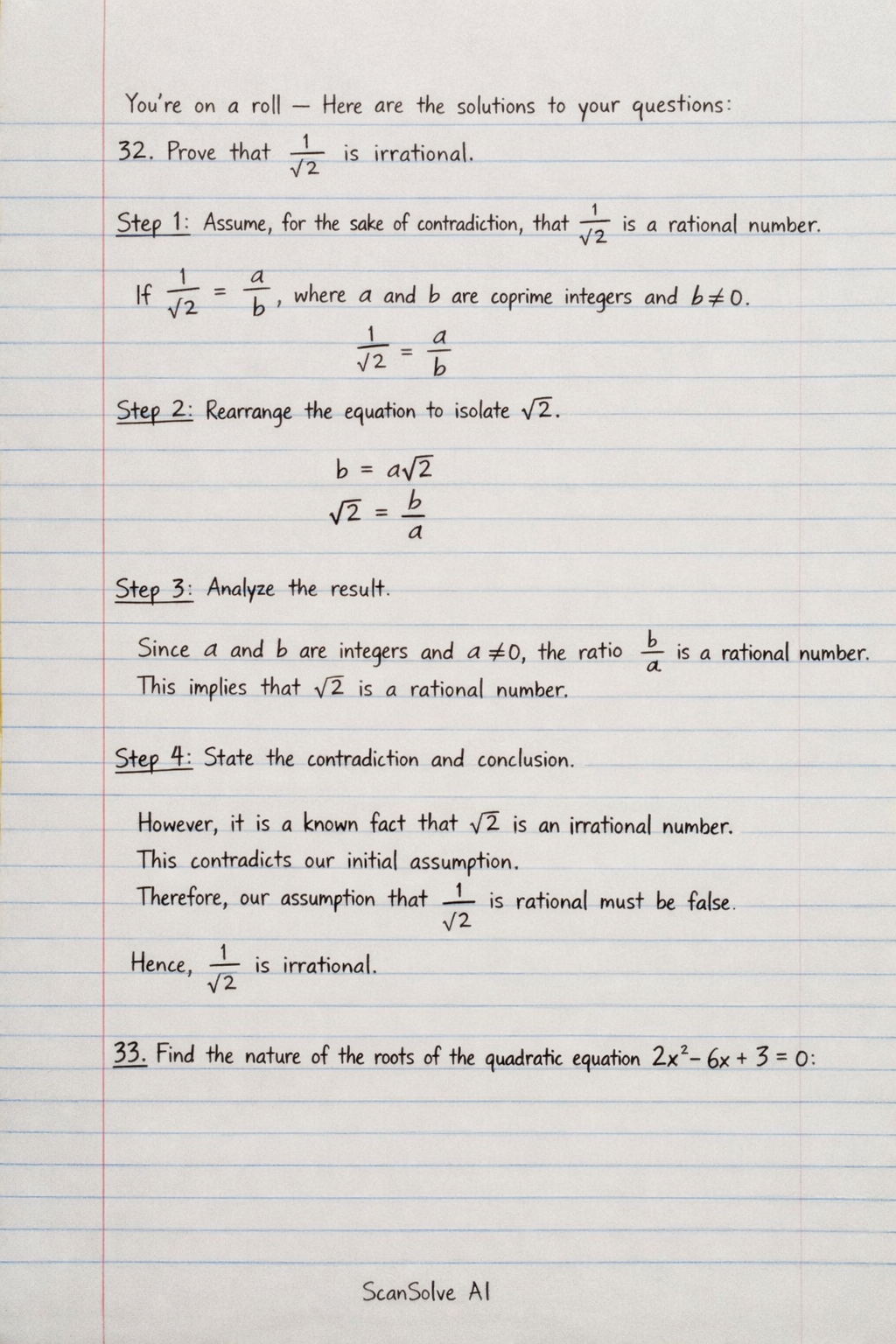
Handwritten Step-by-Step Solution
Get this as a handwritten image on WhatsApp — like a tutor wrote it for you.
Try on WhatsApp