Use English in the math assignment

English

ScanSolve AI Answer

Answer

15∘15^\circ

Step-by-step solution

6 steps

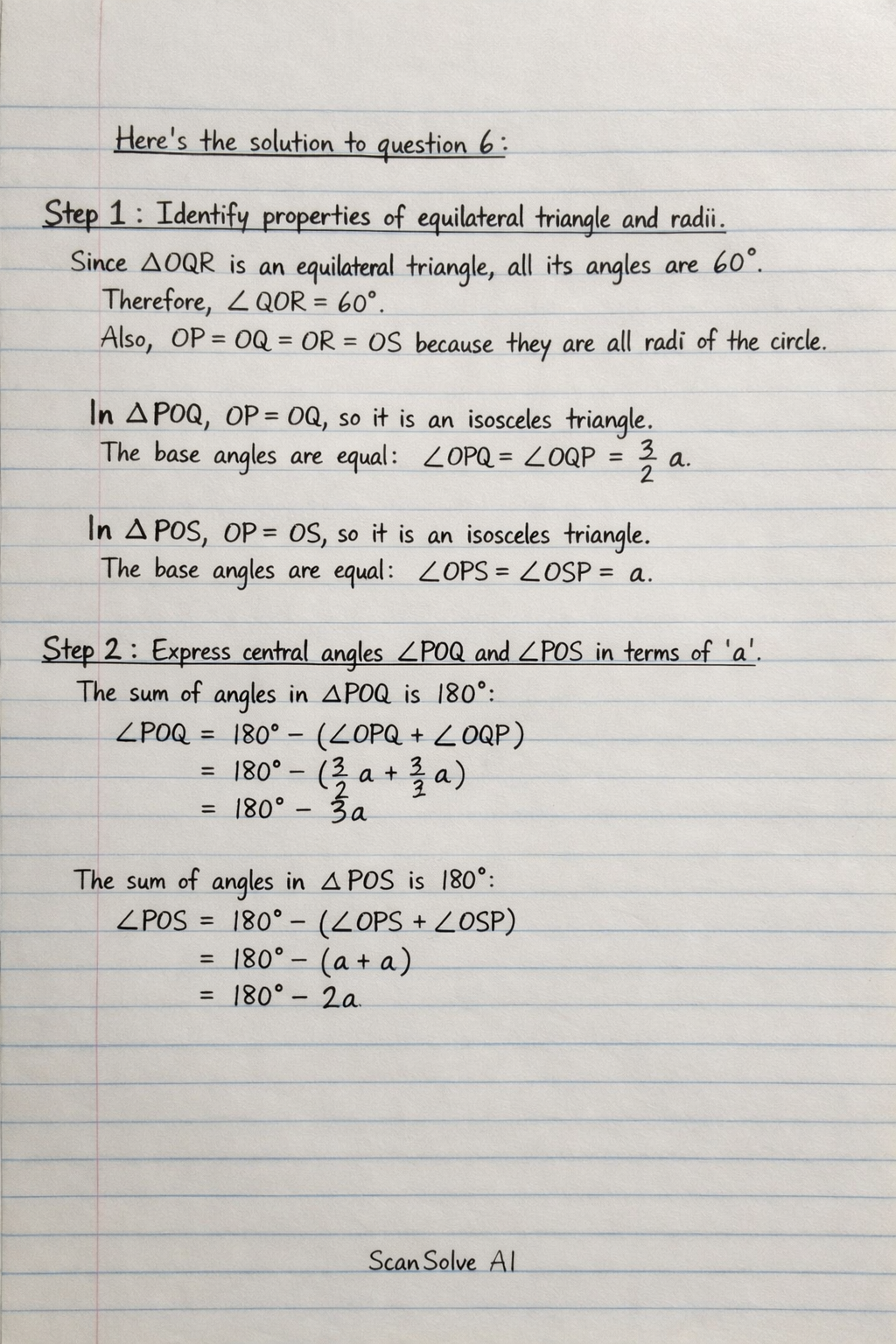
Here's the solution to question 6:

  1. Identify properties of equilateral triangle and radii.

    Since △OQR\triangle OQR is an equilateral triangle, all its angles are 60∘60^\circ. Therefore, ∠QOR=60∘\angle QOR = 60^\circ.
    Also, OP = OQ = OR = OS because they are all radii of the circle.
    In △POQ\triangle POQ, OP = OQ, so it is an isosceles triangle. The base angles are equal: ∠OPQ=∠OQP=32a\angle OPQ = \angle OQP = \frac{3}{2}a.
    In △POS\triangle POS, OP = OS, so it is an isosceles triangle. The base angles are equal: ∠OPS=∠OSP=a\angle OPS = \angle OSP = a.

  2. Express central angles ∠POQ\angle POQ and ∠POS\angle POS in terms of 'a'.

    The sum of angles in △POQ\triangle POQ is 180∘180^\circ:

    ∠POQ=180∘−(∠OPQ+∠OQP)=180∘−(32a+32a)=180∘−3a\angle POQ = 180^\circ - (\angle OPQ + \angle OQP) = 180^\circ - \left(\frac{3}{2}a + \frac{3}{2}a\right) = 180^\circ - 3a

    The sum of angles in △POS\triangle POS is 180∘180^\circ:

    ∠POS=180∘−(∠OPS+∠OSP)=180∘−(a+a)=180∘−2a\angle POS = 180^\circ - (\angle OPS + \angle OSP) = 180^\circ - (a + a) = 180^\circ - 2a
  3. Use the sum of angles around the center O to find ∠ROS\angle ROS in terms of 'a'.

    The sum of angles around the center O is 360∘360^\circ:

    ∠POQ+∠QOR+∠ROS+∠POS=360∘\angle POQ + \angle QOR + \angle ROS + \angle POS = 360^\circ

    Substitute the expressions from Step 1 and Step 2:

    (180∘−3a)+60∘+∠ROS+(180∘−2a)=360∘(180^\circ - 3a) + 60^\circ + \angle ROS + (180^\circ - 2a) = 360^\circ 420∘−5a+∠ROS=360∘420^\circ - 5a + \angle ROS = 360^\circ ∠ROS=360∘−420∘+5a=5a−60∘\angle ROS = 360^\circ - 420^\circ + 5a = 5a - 60^\circ
  4. Find ∠ORS\angle ORS and ∠PSR\angle PSR in terms of 'a'.

    In △ROS\triangle ROS, OR = OS (radii), so it is an isosceles triangle.

    ∠ORS=∠OSR=180∘−∠ROS2\angle ORS = \angle OSR = \frac{180^\circ - \angle ROS}{2}

    Substitute the expression for ∠ROS\angle ROS from Step 3:

    ∠ORS=180∘−(5a−60∘)2=180∘−5a+60∘2=240∘−5a2=120∘−52a\angle ORS = \frac{180^\circ - (5a - 60^\circ)}{2} = \frac{180^\circ - 5a + 60^\circ}{2} = \frac{240^\circ - 5a}{2} = 120^\circ - \frac{5}{2}a

    Now, find ∠PSR\angle PSR. From Step 1, ∠OSP=a\angle OSP = a.

    ∠PSR=∠OSP+∠OSR=a+(120∘−52a)=120∘−32a\angle PSR = \angle OSP + \angle OSR = a + \left(120^\circ - \frac{5}{2}a\right) = 120^\circ - \frac{3}{2}a
  5. Apply the parallel lines property (RO || SP).

    Since RO || SP, and RS is a transversal, the consecutive interior angles ∠ORS\angle ORS and ∠PSR\angle PSR sum to 180∘180^\circ.

    ∠ORS+∠PSR=180∘\angle ORS + \angle PSR = 180^\circ

    Substitute the expressions from Step 4:

    (120∘−52a)+(120∘−32a)=180∘\left(120^\circ - \frac{5}{2}a\right) + \left(120^\circ - \frac{3}{2}a\right) = 180^\circ 240∘−82a=180∘240^\circ - \frac{8}{2}a = 180^\circ 240∘−4a=180∘240^\circ - 4a = 180^\circ
  6. Solve for 'a'.

    240∘−180∘=4a240^\circ - 180^\circ = 4a 60∘=4a60^\circ = 4a a=60∘4a = \frac{60^\circ}{4} a=15∘a = \boxed{15^\circ}
Was this helpful?

Try one yourself

A new problem that tests the same skill.

Still stuck on this one?

Ask a follow-up, and the answer starts from this question.

Got a different question?Ask your own question
Handwritten step-by-step solution preview

Handwritten Step-by-Step Solution

Get this as a handwritten image on WhatsApp — like a tutor wrote it for you.

Try on WhatsApp