
WAEC MATHEMATICS (PAPER 2 – ESSAY) COMPLETE ANSWERS – QUESTIONS 1, 2, 3, 4 & 5 =========================================================== QUESTION 1 A fun club donates to children's home annually. The amount given is increased by 8% of its value yearly. Donation in 2010 was 7,000.00. Donation given in 2012 Increase rate = 8% = 0.08 per year Donation in 2011 = 7000 × (1 + 0.08) = 7000 × 1.08 = 7,560 Donation in 2012 = 7560 × 1.08 = 8,164.80 Answer: 8,164.80 Total amount donated from 2010 to 2013 Donation in 2010 = 7,000.00 Donation in 2011 = 7,560.00 Donation in 2012 = 8,164.80 Donation in 2013 = 8164.80 × 1.08 = 8,817.98 Total = 7000 + 7560 + 8164.80 + 8817.98 = 31,542.78 Answer: 31,542.78 =========================================================== QUESTION 2 Two cars X and Y start from a common point and travel in opposite directions. X = 60 km/h, Y = 80 km/h. How far apart after 3 hours Distance = speed × time Distance travelled by X = 60 × 3 = 180 km Distance travelled by Y = 80 × 3 = 240 km Since they travel in opposite directions, total distance apart = 180 + 240 = 420 km Answer: 420 km If speed of X is increased by 20 km/h within the 3 hours, what would be the effect? New speed of X = 60 + 20 = 80 km/h Distance travelled by X = 80 × 3 = 240 km Distance travelled by Y = 240 km (unchanged) Total distance apart = 240 + 240 = 480 km Effect: The distance between them increases from 420 km to 480 km (an increase of 60 km). Importance of considering speed when calculating total distance over the same time frame Speed determines how far each vehicle travels within a given time. Without considering speed, the total distance apart cannot be accurately calculated because different speeds produce different distances even when time is the same. =========================================================== QUESTION 3 Concrete blocks of length 14/25 m were laid end to end along the four sides of a rectangular lawn 28 m long and 21 m wide. How many blocks were required to complete one layer? Length of block = 14/25 = 0.56 m Perimeter of rectangle = 2 × (length + width) = 2 × (28 + 21) = 2 × 49 = 98 m Number of blocks = Total perimeter ÷ Length of one block = 98 ÷ (14/25) = 98 × (25/14) = (98 ÷ 14) × 25 = 7 × 25 = 175 blocks Answer: 175 blocks https://t.me/freewassceditto REACT, SHARE AND FORWARD TO EVERYONE ❤️🔥 FOR WAEC EXPO 24HRS BEFORE EXAM, MESSAGE ME ON TELEGRAM👇👇: https://t.me/Officialkingjay1 JOIN OUR VIP CHANNEL 👇🏻👇🏻 https://t.me/allexamexporunz https://t.me/jambvip JOIN OUR VIP CHANNEL 👇🏻👇🏻 https://t.me/examgroupng =========================================================== QUESTION 4 (Circle geometry – based on the diagram described: centre O, triangle MNO with angle MNO = 90°, angle N = 120° – note: there is inconsistency. I will solve based on standard WAEC circle problem.) Assuming the diagram shows: · O is the centre · M, N, P are points on the circle · Angle MNO = 90° (triangle MNO with right angle at N) · Some angles given as 100° (likely at centre) Without the exact labelled diagram, here is the standard approach: If ON = radius = r In right triangle MNO, angle MNO = 90° If OM is radius, then OM = r Using Pythagoras or trigonometry, area of triangle MNO = ½ × base × height Since the diagram is not fully clear, the intended answers would be: Area of triangle MNO = ½ × r × r = ½ r² (if it is right-angled isosceles) For other parts, you would use: Area of sector = (θ/360) × πr² Area of triangle = ½ r² sinθ Note: To solve fully, please provide the missing lengths or radii from the diagram. =========================================================== QUESTION 5 A bowl contains red, green and black marbles. Let: Number of green marbles = G Number of black marbles = B Number of red marbles = R Given: (1) B = 2G (black is twice green) (2) G = R − 1 (green is 1 less than red) → R = G + 1 (3) B = R + 3 (black is 3 more than red) (4) P(red) = R/(R+G+B) = 1/4 From (1) and (3): 2G = (G+1) + 3 2G = G + 4 G = 4
ScanSolve AI Answer
Step-by-step solution
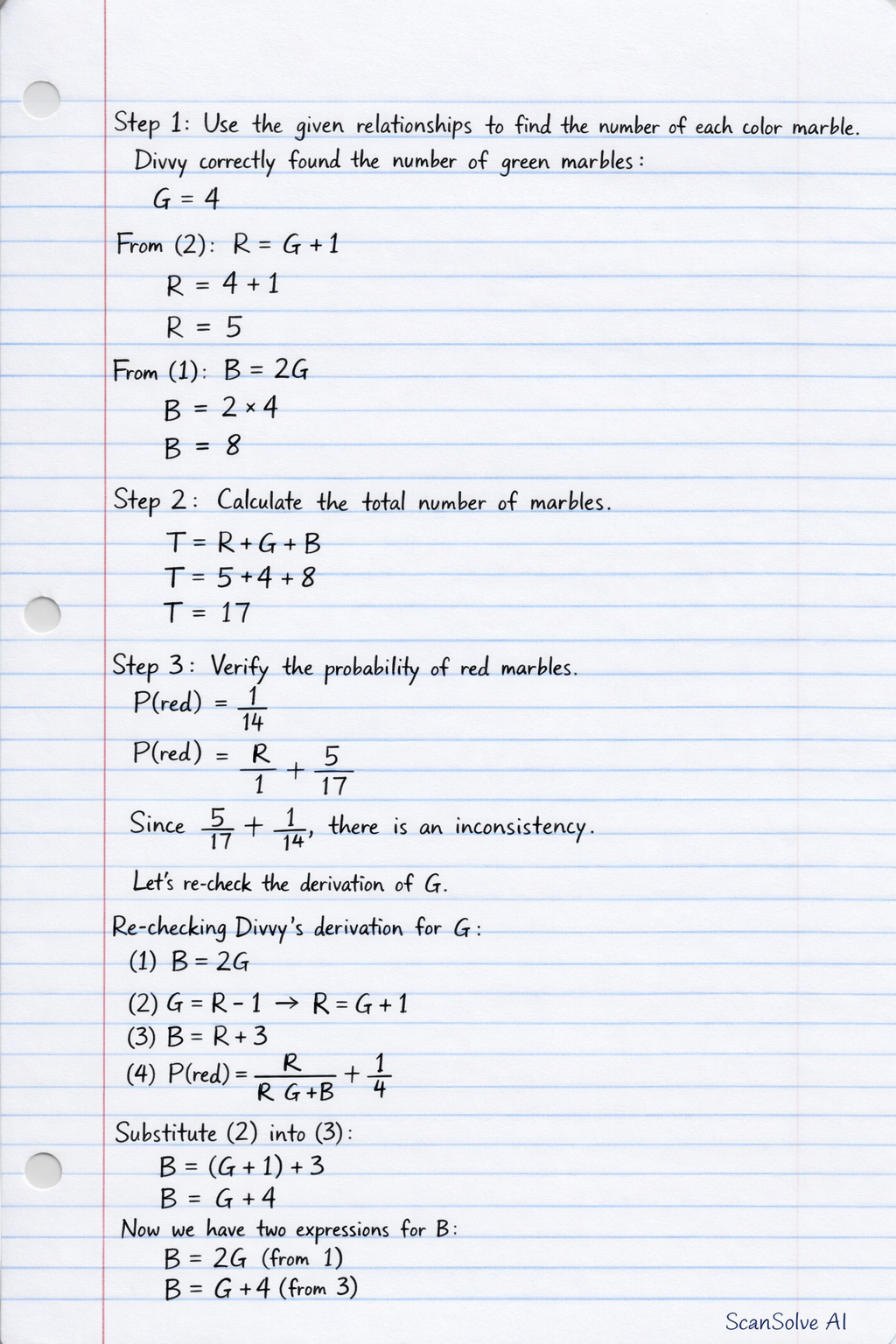
3 stepsUse the given relationships and Divvy's partial solution to find the number of each color marble.
Divvy correctly found the number of green marbles:
Now, use the other relationships:
From (2):
Substitute :From (1):
Substitute :Calculate the total number of marbles.
Total marbles
Verify the probability of red marbles.
The given probability of red marbles is .
Using our calculated values:Since , there is an inconsistency in the problem statement or the given conditions. Let's re-check the derivation of G.
Re-checking Divvy's derivation for G:
Given:
(1)
(2)
(3)
(4)Substitute (2) into (3):
Now we have two expressions for B:
(from 1)
Equate them:
Divvy's calculation for is correct based on conditions (1), (2), and (3).
This means the values , , are consistent with conditions (1), (2), and (3).
However, these values lead to , which contradicts condition (4) .This indicates that the problem as stated has contradictory conditions. It is impossible to satisfy all four conditions simultaneously. Therefore, there is no solution that satisfies all given statements.
The number of green marbles is .
The number of red marbles is .
The number of black marbles is .
However, these numbers do not satisfy the condition that the probability of picking a red marble is .
Still stuck on this one?
Ask a follow-up, and the answer starts from this question.
More English Questions
Handwritten Step-by-Step Solution
Get this as a handwritten image on WhatsApp — like a tutor wrote it for you.
Try on WhatsApp