
Here are 100 JAMB Mathematics practice questions in a clean, copyable format based on the official syllabus. You can easily copy and paste this into a Word document or note-taking app. --- 1. Evaluate (3.2 × 10⁵) ÷ (1.6 × 10²) and express in standard form. A. 2.0 × 10² B. 2.0 × 10³ C. 2.0 × 10⁴ D. 5.12 × 10⁷ 2. Simplify: (27^(1/3) × 16^(1/4))² A. 12 B. 18 C. 24 D. 36 3. If log10 2 = 0.3010 and log10 3 = 0.4771, find log10 72. A. 1.8573 B. 1.2553 C. 1.0333 D. 0.7781 4. Simplify: (√3 + √2) / (√3 - √2) A. 5 + 2√6 B. 5 - 2√6 C. 1 + √6 D. 1 - √6 5. Make P the subject of the formula: I = PRT/100 A. P = 100I/RT B. P = IRT/100 C. P = 100R/IT D. P = RT/100I 6. Given that 3x + 2y = 7 and 4x − y = 24, find the value of x - y. A. -1 B. 1 C. 5 D. 9 7. Find the quadratic equation whose roots are 2/3 and -3/4. A. 12x² + x − 6 = 0 B. 12x² − x − 6 = 0 C. 12x² + x + 6 = 0 D. 12x² − x + 6 = 0 8. Solve for x: 2^(2x+1) = 128 A. 2 B. 3 C. 4 D. 6 9. Find the range of values of x for which 2x² + 5x − 3 ≥ 0. A. x ≤ -3 or x ≥ 1/2 B. -3 ≤ x ≤ 1/2 C. x ≤ -1/2 or x ≥ 3 D. -1/2 ≤ x ≤ 3 10. The sum of the first n terms of an AP is 3n² + 5n. Find the common difference. A. 3 B. 5 C. 6 D. 8 11. The 6th term of a GP is 1215 and the 3rd term is 45. Find the common ratio. A. 2 B. 3 C. 4 D. 5 12. Find the sum to infinity of the series: 1/2 + 1/6 + 1/18 + ... A. 1/3 B. 2/3 C. 3/4 D. 5/6 13. The binary operation is defined on the set of real numbers by a b = a + b − ab. Evaluate (2 3) 4. A. -23 B. -5 C. 5 D. 23 14. If y varies inversely as the square of x, and y = 12 when x = 2, find y when x = 4. A. 3 B. 6 C. 24 D. 48 15. A committee of 3 is to be chosen from 5 men and 4 women. How many committees can be formed if it must contain exactly 2 women? A. 30 B. 36 C. 60 D. 84 16. In how many ways can the letters of the word "MATHS" be arranged such that the vowels always come together? A. 24 B. 48 C. 72 D. 120 17. Find the number of terms in the expansion of (2x + y)⁸. A. 7 B. 8 C. 9 D. 10 18. Find the coefficient of x³ in the expansion of (2 + x)⁵. A. 10 B. 20 C. 40 D. 80 19. If nC2 = 15, find the value of n. A. 5 B. 6 C. 7 D. 8 20. A bag contains 5 red balls and 3 green balls. If 2 balls are drawn at random without replacement, find the probability that both are red. A. 5/14 B. 15/28 C. 25/64 D. 10/28 21. Two fair dice are thrown. What is the probability that the sum of the numbers is 8? A. 1/36 B. 5/36 C. 1/6 D. 5/18 22. A number is chosen at random from the set 11, 12, 13, ..., 30. Find the probability that it is a prime number. A. 1/4 B. 3/10 C. 7/20 D. 2/5 23. The mean of the numbers 3, 5, 2, 6, x, 4 is 4. Find the value of x. A. 3 B. 4 C. 5 D. 6 24. The variance of the numbers 2, 4, 6, 8, 10 is: A. 6 B. 8 C. 10 D. 16 25. The marks scored by students in a test are: 10, 12, 10, 15, 18, 12, 10, 12. Find the mode. A. 10 B. 12 C. 14 D. 18 26. Calculate the median of the following distribution: 2, 5, 7, 9, 12, 15, 18. A. 7 B. 9 C. 10.5 D. 12 27. The ages of students are grouped as follows: 15-19 (5), 20-24 (8), 25-29 (7), 30-34 (4). Find the mean age. A. 24.5 B. 25.0 C. 25.5 D. 26.0 28. A sector of a circle of radius 7 cm subtends an angle of 120° at the centre. Find the area of the sector. (Take π = 22/7) A. 51.3 cm² B. 102.7 cm² C. 154.0 cm² D. 308.0 cm² 29. The length of an arc of a circle is 22 cm. If the radius is 14 cm, calculate the angle subtended by the arc at the centre. (Take π = 22/7) A. 60° B. 75° C. 90° D. 120° 30. Find the equation of a line passing through the point (2, -3) and perpendicular to the line 2y = 4x + 3. A. y + 2x + 1 = 0 B. 2y + x + 4 = 0 C. y − 2x + 7 = 0 D. 2y − x + 8 = 0 31. The midpoint of the line segment joining points A(3, 5) and B(-1, 7) is: A. (1, 6) B. (2, 6) C. (1, 1) D. (4, 2) 32. Find the distance between the points (1, 2) and (4, 6). A. 3 B. 4 C. 5 D. 6 33. The gradient of the line passing through the points (3, -1) and (6, 8) is: A. -3 B. 1/3 C. 3 D. 7/3 34. Find the equation of the circle with centre (2, -1) and radius 5. A. x² + y² − 4x + 2y − 20 = 0 B. x² + y² + 4x − 2y − 20 = 0 C. x² + y² − 4x − 2y + 20 = 0 D. x² + y² − 4x + 2y + 20 = 0 35. Find the value of p for which the line 3x − py + 4 = 0 is parallel to the line 6x + 2y − 5 = 0. A. -1 B. 1 C. -4 D. 4 36. Find the focus of the parabola y² = 12x. A. (0, 3) B. (3, 0) C. (4, 0) D. (0, 4) 37. The locus of a point equidistant from a fixed point and a fixed line is a: A. Circle B. Parabola C. Ellipse D. Hyperbola 38. If tan θ = 3/4, find the value of sin θ + cos θ. (0° < θ < 90°) A. 7/5 B. 5/7 C. 1/5 D. 4/3 39. If sin x = 4/5 and x is obtuse, find cos x. A. 3/5 B. -3/5 C. 4/3 D. -4/3 40. Find the value of sin 75° (without tables). A. (√6 + √2)/4 B. (√6 - √2)/4 C. (√3 + 1)/2 D. (√3 - 1)/2 41. Simplify: (sin² θ) / (1 - cos θ) A. 1 - cos θ B. 1 + cos θ C. 1 + sin θ D. sin θ 42. From the top of a cliff 100 m high, the angle of depression of a boat is 30°. Find the distance of the boat from the foot of the cliff. A. 100√3 m B. 100/√3 m C. 200 m D. 50 m 43. A ladder 15 m long leans against a wall, making an angle of 60° with the horizontal. Find the height of the wall reached by the ladder. A. 7.5 m B. 12.99 m C. 15 m D. 8.66 m 44. In triangle ABC, a = 5 cm, b = 7 cm, and angle C = 60°. Find side c. A. √39 cm B. √74 cm C. √109 cm D. 6 cm 45. The bearings of a point Q from P is 150°. Find the bearing of P from Q. A. 030° B. 150° C. 210° D. 330° 46. Differentiate y = 3x⁴ − 2x³ + x − 5 with respect to x. A. 12x³ - 6x² + 1 B. 12x³ - 6x² - 5 C. 4x³ - 3x² + 1 D. 12x³ - 6x² 47. Find the derivative of y = (2x + 1)³. A. 3(2x + 1)² B. 6(2x + 1)² C. 3(2x + 1)³ D. 6x(2x + 1)² 48. If y = sin(3x), find dy/dx. A. 3 cos(3x) B. -3 cos(3x) C. cos(3x) D. 3 sin(3x) 49. Find the gradient of the curve y = x³ − 3x at the point x = 2. A. 3 B. 6 C. 9 D. 12 50. The minimum value of the function f(x) = x² − 4x + 5 is: A. 1 B. 2 C. 5 D. 10 51. Find the equation of the tangent to the curve y = 2x² − 3x + 1 at the point (1, 0). A. y = x − 1 B. y = x + 1 C. y = 2x − 2 D. y = 4x − 4 52. Evaluate: ∫ (4x³ + 2x) dx A. x⁴ + x² + C B. 12x² + 2 + C C. x⁴ + 2x² + C D. 4x⁴ + x² + C 53. Evaluate the definite integral: ∫1² (3x² + 1) dx A. 8 B. 9 C. 10 D. 11 54. Find the area bounded by the curve y = x(x − 2) and the x-axis. A. 2/3 sq units B. 4/3 sq units C. 2 sq units D. 4 sq units 55. Find the volume of the solid generated when the area bounded by y = 2x, the x-axis, and the lines x = 1 and x = 3 is rotated through 360° about the x-axis. A. 52π/3 B. 104π/3 C. 208π/3 D. 26π 56. In the figure, O is the centre of the circle. If angle ABC = 50°, find angle AOC. A. 25° B. 50° C. 100° D. 130° 57. The angle between a tangent and a chord through the point of contact is equal to the: A. angle in the alternate segment B. angle at the centre C. right angle D. angle in the same segment 58. Two chords AB and CD of a circle intersect at a point X inside the circle. If AX = 8 cm, XB = 3 cm, and CX = 4 cm, find XD. A. 6 cm B. 12 cm C. 24 cm D. 32 cm 59. A cylinder of radius 7 cm and height 10 cm is melted and recast into a cone of base radius 14 cm. Find the height of the cone. A. 2.5 cm B. 5.0 cm C. 7.5 cm D. 10.0 cm 60. Find the surface area of a sphere of radius 7 cm. (Take π = 22/7) A. 154 cm² B. 308 cm² C. 616 cm² D. 1437 cm² 61. A frustum of a cone has top radius 4 cm, bottom radius 6 cm, and height 5 cm. Find its volume. (Take π = 22/7) A. 476.67 cm³ B. 523.33 cm³ C. 628.00 cm³ D. 733.33 cm³ 62. The sum of the interior angles of a regular polygon is 1080°. Find the number of sides of the polygon. A. 6 B. 7 C. 8 D. 9 63. Each interior angle of a regular polygon is 150°. How many sides does it have? A. 9 B. 10 C. 12 D. 15 64. In a parallelogram ABCD, angle A = (3x + 20)° and angle C = (5x − 40)°. Find the value of x. A. 10 B. 20 C. 30 D. 40 65. The diagonals of a rhombus are 16 cm and 12 cm. Find the length of a side of the rhombus. A. 8 cm B. 10 cm C. 14 cm D. 20 cm 66. A point P moves such that it is equidistant from points A(1, 2) and B(5, 4). Find the equation of the locus. A. 2x + y = 9 B. 2x − y = 9 C. x + 2y = 9 D. x − 2y = 9 67. If y = (2x + 1) / (x - 3), find dy/dx. A. 5 / (x - 3)² B. -5 / (x - 3)² C. 7 / (x - 3)² D. -7 / (x - 3)² 68. Given that y = e^(2x) * ln x, find dy/dx. A. e^(2x) (2 ln x + 1/x) B. e^(2x) (ln x + 2/x) C. 2e^(2x) ln x D. e^(2x) / x 69. The maximum value of the function f(x) = x³ − 3x² + 4 on the interval [-1, 3] is: A. 0 B. 2 C. 4 D. 6 70. The position of a particle is given by s = t³ − 6t² + 9t + 4. Find the velocity when acceleration is zero. A. -3 B. 0 C. 3 D. 6 71. If the matrix A = [1 2; 3 4], find the determinant of A. A. -2 B. 2 C. 10 D. 11 72. Find the inverse of the matrix [2 3; 1 2]. A. [2 -3; -1 2] B. [-2 3; 1 -2] C. [2 3; 1 2] D. [1 3; 2 4] 73. If [x 2; 3 y] + [2 1; 0 3] = [5 3; 3 7], find x
Psychology
ScanSolve AI Answer
Answer
B
Step-by-step solution
3 stepsHere are the solutions to the JAMB Mathematics practice questions:
1. Evaluate and express in standard form.
Divide the numerical parts.
Divide the powers of 10.
Combine the results.
This is already in standard form.
The final answer is**
Was this helpful?
Try one yourself
A new problem that tests the same skill.
Still stuck on this one?
Ask a follow-up, and the answer starts from this question.
Got a different question?Ask your own question
More Psychology Questions
QAttempt any nine of the following short questions. Each question carries 4 marks. Solve the system…Q📚 WASSCE 2026 | CORE MATHEMATICS Paper 2 — 10 Practice Questions that may appear Section A…QIf log10(2) = 0.3010, what is log10(8)? A. 0.9030 B. 0.3010 C. 0.6020 D. 0.9040 7. Find the value of…Q1, 5, 9, 13, ? A. 15 B. 17 C. 19 D. 21 3, 6, 12, 24, ? A. 30 B. 36 C. 48 D. 54 Which of the…QIn the diagram A(−8;6); B; C; and D; are the vertices of a rhombus. The equation of BD is 3x-y=0…
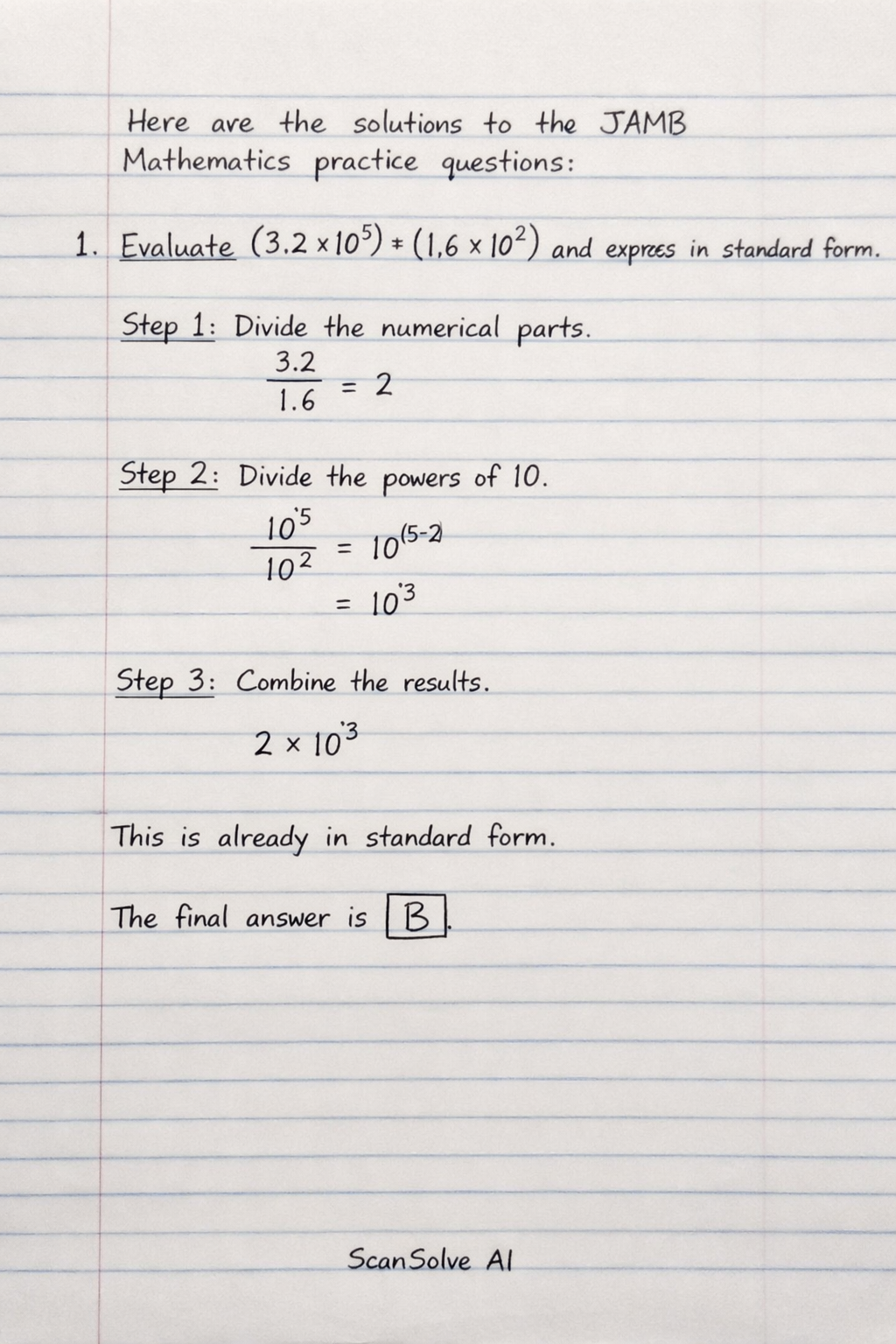
Handwritten Step-by-Step Solution
Get this as a handwritten image on WhatsApp — like a tutor wrote it for you.
Try on WhatsApp