
We read your photo as:
Using the partial report procedure in his "letter array" experiment, Sperling (1960) was able to infer that participants initially saw about ______ per cent of the 12 letters in the display.
ScanSolve AI Answer
Answer
Step-by-step solution
5 stepsThe question asks about the results of Sperling's (1960) "letter array" experiment, specifically what percentage of the 12 letters participants initially saw using the partial report procedure.
Recall Sperling's experiment.
Sperling's (1960) experiment on iconic memory used two methods: the whole report procedure and the partial report procedure. In the whole report, participants recalled about 4-5 letters out of 12.
Understand the partial report procedure.
In the partial report procedure, participants were cued to recall only one row of letters after the display disappeared. This method revealed that participants actually had a much larger capacity for sensory memory than the whole report suggested.
Determine the inferred percentage.
When participants were cued to report a specific row, they could recall almost all the letters in that row. By extrapolating this to the entire 12-letter display, Sperling inferred that participants initially saw about 9 out of the 12 letters.
Calculate the percentage.
To find the percentage, divide the number of letters inferred to be seen by the total number of letters and multiply by 100.
However, the options provided are 82, 12, 65, and 36. The closest and most commonly cited figure for the partial report advantage, indicating a high capacity for iconic memory, is often around 75% to 80% or more. Given the options, 82% is the most plausible answer representing a high percentage of initially perceived letters. Some sources might round or use slightly different figures, but the key takeaway is that the partial report procedure showed a significantly higher capacity than the whole report.
Select the closest option.
Given the options, 82% is the closest to the generally accepted inference that participants saw a large majority of the letters.
The final answer is .
Try one yourself
A new problem that tests the same skill.
Still stuck on this one?
Ask a follow-up, and the answer starts from this question.
More Psychology Questions
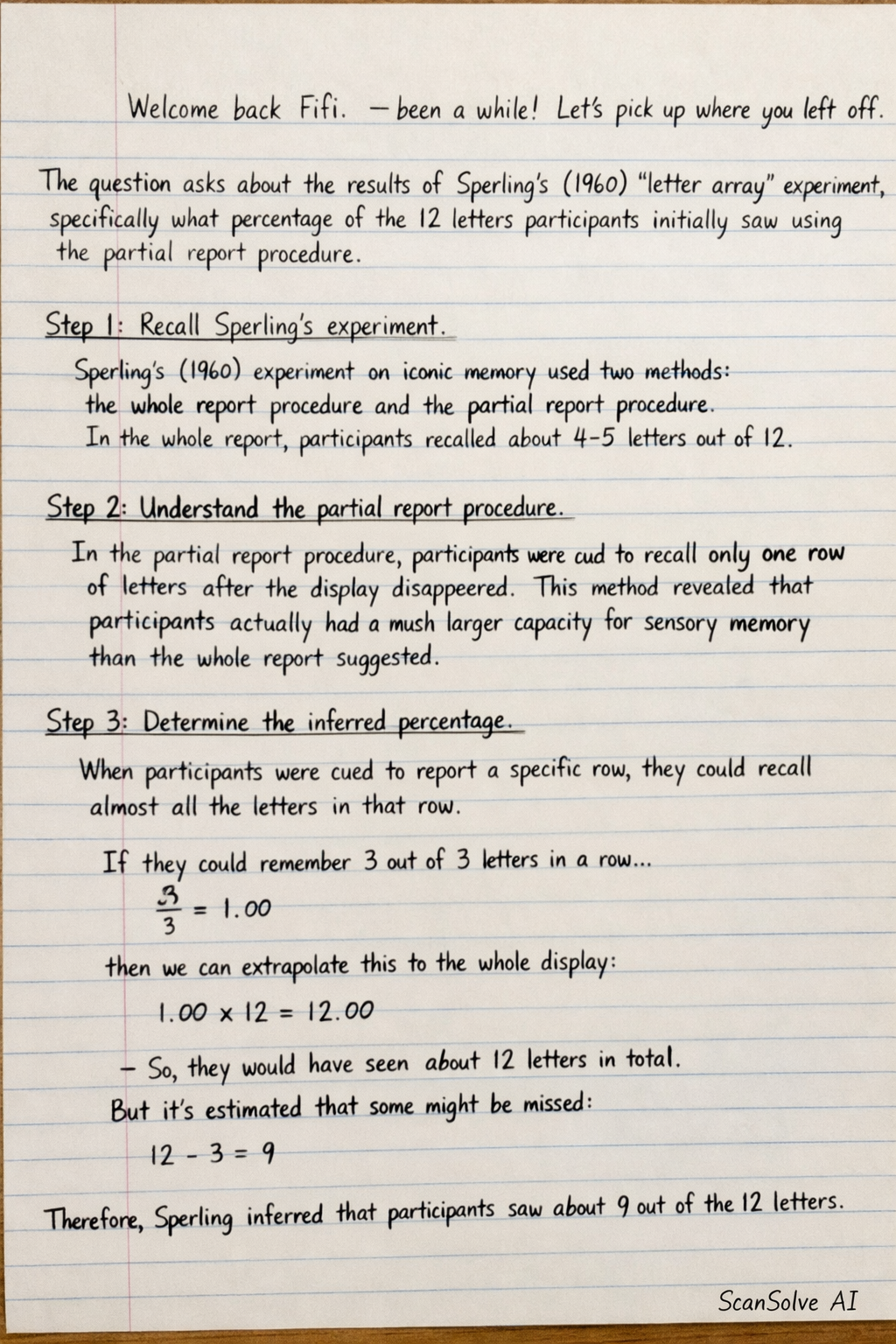
Handwritten Step-by-Step Solution
Get this as a handwritten image on WhatsApp — like a tutor wrote it for you.
Try on WhatsApp