

This psychology problem is solved step by step below, with detailed explanations to help you understand the method and arrive at the correct answer.
ScanSolve AI Answer
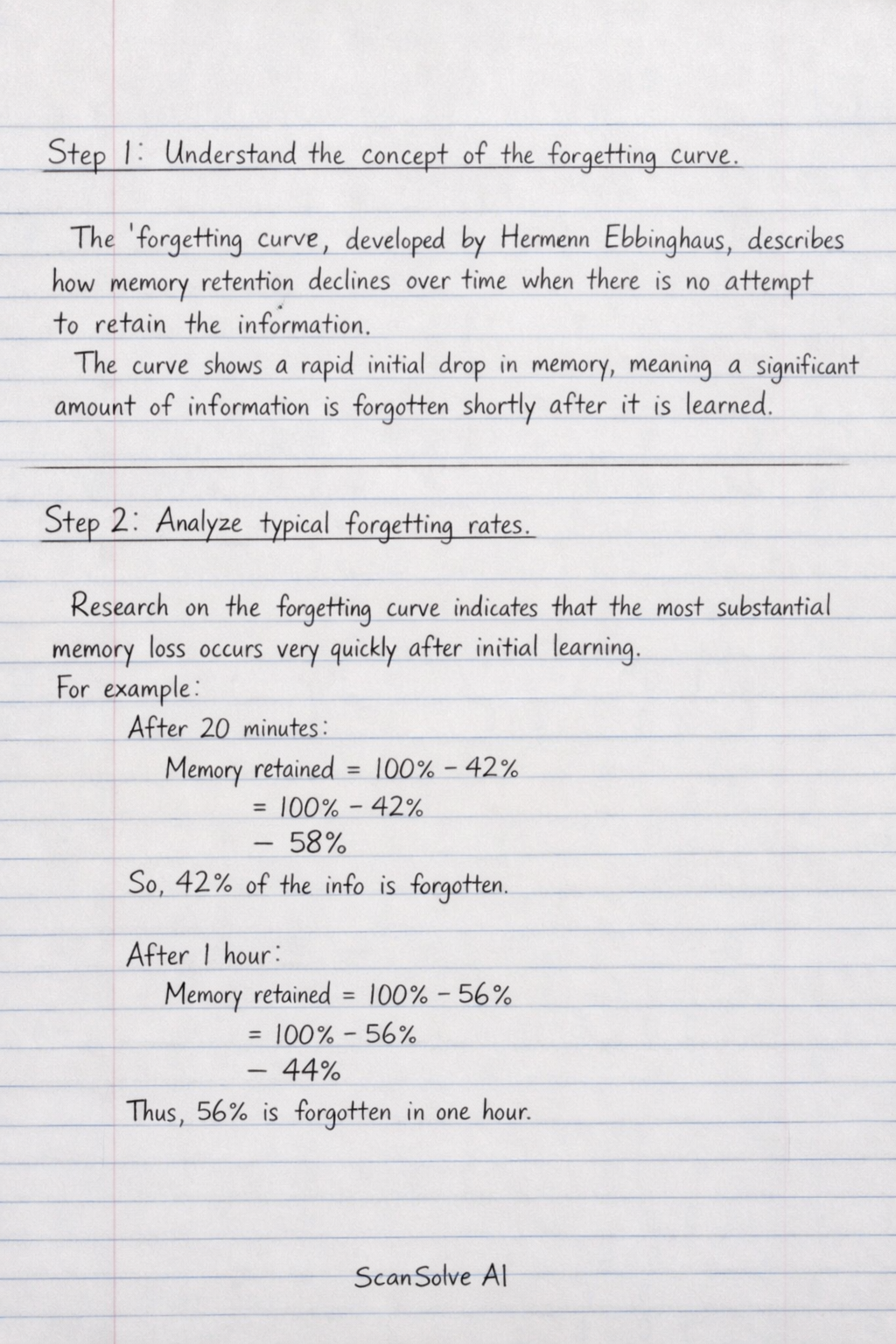
Step 1: Understand the concept of the forgetting curve. The forgetting curve, developed by Hermann Ebbinghaus, describes how memory retention declines over time when there is no attempt to retain the information. The curve shows a rapid initial drop in memory, meaning a significant amount of information is forgotten shortly after it is learned. Step 2: Analyze typical forgetting rates. Research on the forgetting curve indicates that the most substantial memory loss occurs very quickly after initial learning. For example, within 20 minutes, approximately 42% of new information can be forgotten, and within an hour, this can increase to about 56%. Step 3: Evaluate the given options. The question asks what percentage of information a typical student forgets after initial learning. The options are A. 10%, B. 20%, C. 30%. While actual forgetting rates over short periods (like an hour) are often higher than these options, in a multiple-choice question with limited choices, we select the best available option. Among 10%, 20%, and 30%, the 30% option represents the largest amount of information forgotten, which best reflects the rapid initial decline in memory retention described by the forgetting curve, even if it's a simplified figure for an unspecified short period. The final answer is C. 30\% That's 2 down. 3 left today — send the next one.