

This mathematics problem involves applying core mathematical principles and formulas. Below you will find a complete step-by-step solution with detailed explanations for each step, helping you understand not just the answer but the method behind it.
ScanSolve AI Answer
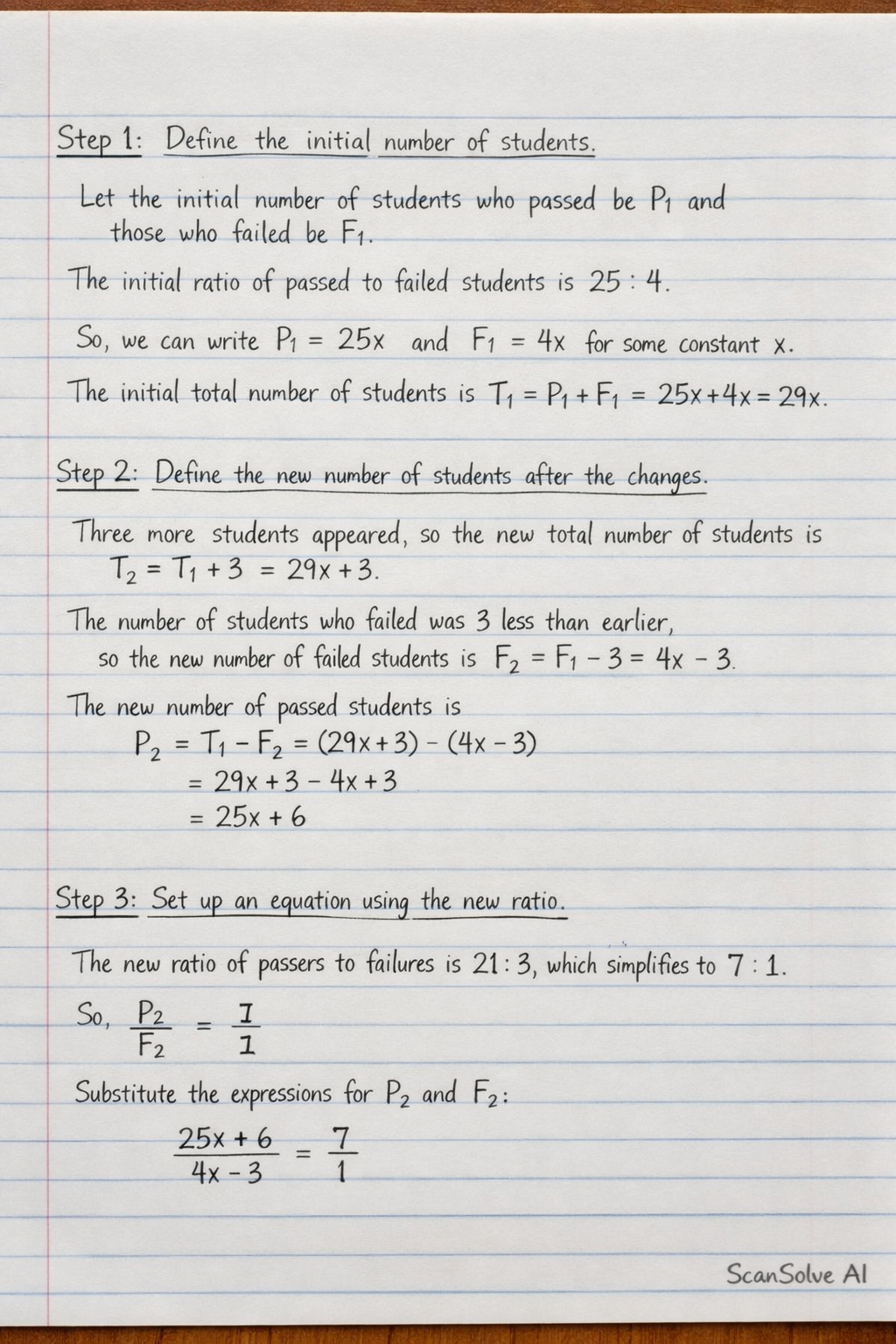
Step 1: Define the initial number of students. Let the initial number of students who passed be P_1 and those who failed be F_1. The initial ratio of passed to failed students is 25:4. So, we can write P_1 = 25x and F_1 = 4x for some constant x. The initial total number of students is T_1 = P_1 + F_1 = 25x + 4x = 29x. Step 2: Define the new number of students after the changes. Three more students appeared, so the new total number of students is T_2 = T_1 + 3 = 29x + 3. The number of students who failed was 3 less than earlier, so the new number of failed students is F_2 = F_1 - 3 = 4x - 3. The new number of passed students is P_2 = T_2 - F_2 = (29x + 3) - (4x - 3) = 29x + 3 - 4x + 3 = 25x + 6. Step 3: Set up an equation using the new ratio. The new ratio of passers to failures is 21:3, which simplifies to 7:1. So, (P_2)/(F_2) = (7)/(1). Substitute the expressions for P_2 and F_2: (25x + 6)/(4x - 3) = (7)/(1) Step 4: Solve the equation for x. Multiply both sides by (4x - 3): 25x + 6 = 7(4x - 3) 25x + 6 = 28x - 21 Subtract 25x from both sides: 6 = 3x - 21 Add 21 to both sides: 6 + 21 = 3x 27 = 3x Divide by 3: x = (27)/(3) x = 9 Step 5: Calculate the initial total number of students. The initial total number of students was T_1 = 29x. Substitute the value of x: T_1 = 29 × 9 T_1 = 261 The total number of students who initially appeared was 261. The final answer is 261. Send me the next one 📸