

This English question involves literary analysis, grammar, or writing skills. The detailed response below provides a well-structured answer with supporting evidence and clear explanations.
ScanSolve AI Answer
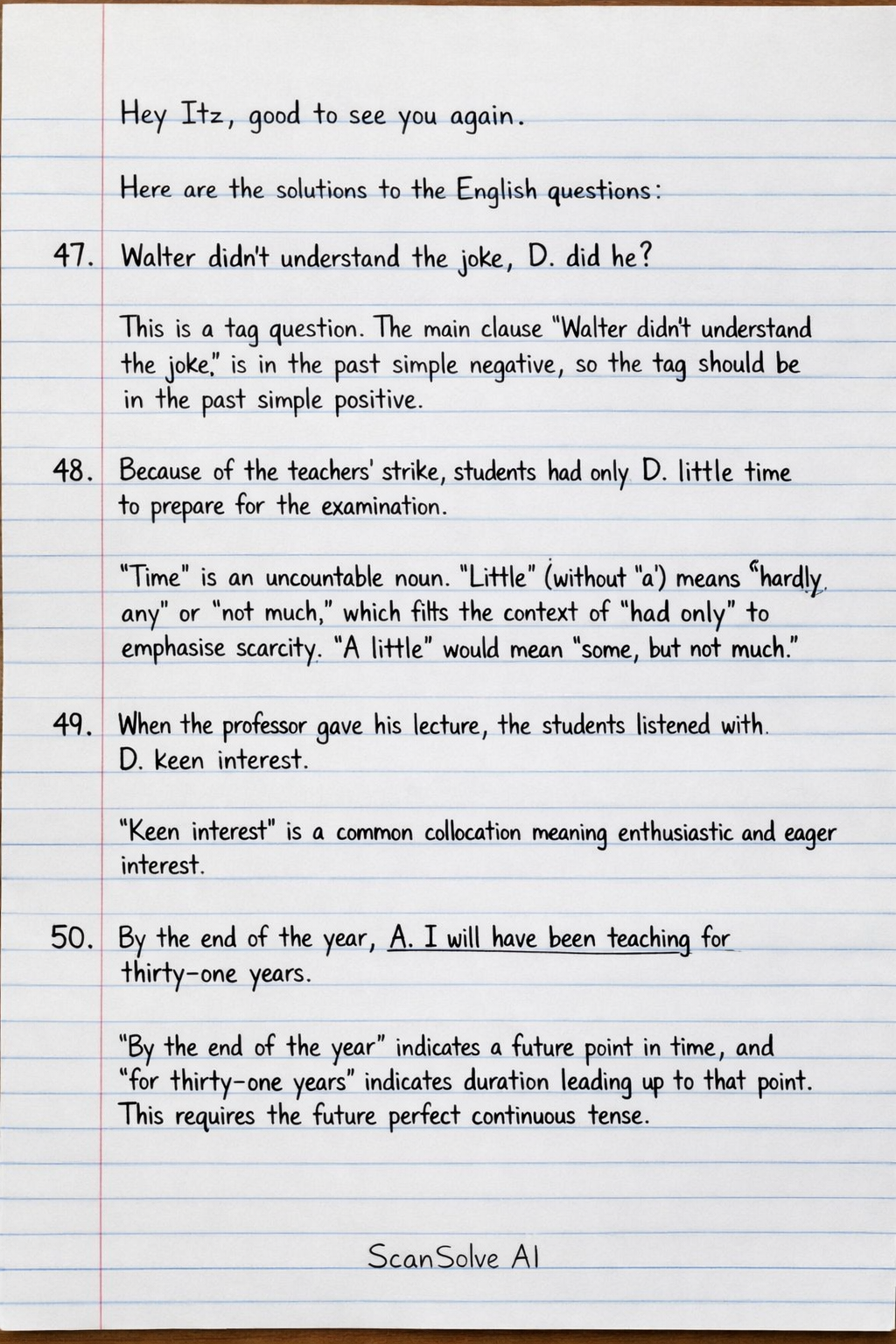
Here are the solutions to the English questions: 47. Walter didn't understand the joke, D. did he? This is a tag question. The main clause "Walter didn't understand the joke" is in the past simple negative, so the tag should be in the past simple positive. 48. Because of the teachers' strike, students had only D. little time to prepare for the examination. "Time" is an uncountable noun. "Little" (without "a") means "hardly any" or "not much," which fits the context of "had only" to emphasize scarcity. "A little" would mean "some, but not much." 49. When the professor gave his lecture, the students listened with D. keen interest. "Keen interest" is a common collocation meaning enthusiastic and eager interest. 50. By the end of the year, A. I will have been teaching for thirty-one years. The phrase "By the end of the year" indicates a future point in time, and "for thirty-one years" indicates duration leading up to that point. This requires the future perfect continuous tense. 51. As Adamu aimed his gun, the lion C. leapt at him. "Leapt" is the past simple form of "leap," indicating a single, completed action in the past. 52. We waited at the D. hospital main entrance for nearly an hour. When a noun modifies another noun (e.g., "hospital entrance"), the first noun acts as an adjective and is typically in its singular form. 53. The post master ought to D. have sent the letter by now. "Ought to" is a modal verb expressing obligation or advisability. "By now" indicates that the action should have been completed, requiring the perfect infinitive (have + past participle). 54. The movie was B. rather disappointing; I expected it to be much better. "Rather" is used as an intensifier meaning "quite" or "to some extent," which fits the context of the movie being disappointing but not excessively so. 55. My father insisted that we should be civil, C. didn't he? In tag questions with a main clause containing a reporting verb like "insisted," the tag usually refers to the main verb and subject ("My father insisted"). 56. I enjoyed this meal of B. yours. "Yours" is the correct possessive pronoun. Possessive pronouns do not use apostrophes. 57. The referee contemplated B. sending the player off the pitch. The verb "contemplate" is typically followed by a gerund (-ing form) when it means "to consider doing something." 58. Jonathan spoke confidently, B. although he was nervous inside. "Although" is a conjunction used to introduce a statement that contrasts with the main clause. 59. Mariam felt D. really very sorry for what she had done. This is the correct and natural order for multiple intensifiers modifying "sorry." 60. The committee A. comprises ten members. The verb "comprise" means "to consist of" or "to include" and does not take the preposition "of." 61. Ada could not live up A. to her parents' expectations. "Live up to" is a phrasal verb meaning to meet or fulfill expectations. 62. The drunk man was D. reeking of alcohol. "Reeking of" means to smell strongly and unpleasantly of something. 63. None of us is keen D. on taking part in the debate. The idiom "keen on" means enthusiastic about something. 64. Could you please D. speak up? "Speak up" is a common phrasal verb meaning to speak more loudly, which is a logical request in a general context. Send me the next one 📸