
We read your photo as:
Based on your understanding of remote sensing, which of the five human senses (sight, hearing, taste, smell, touch), can be considered as remote sensors?
ScanSolve AI Answer
Here are the answers to your questions:
-
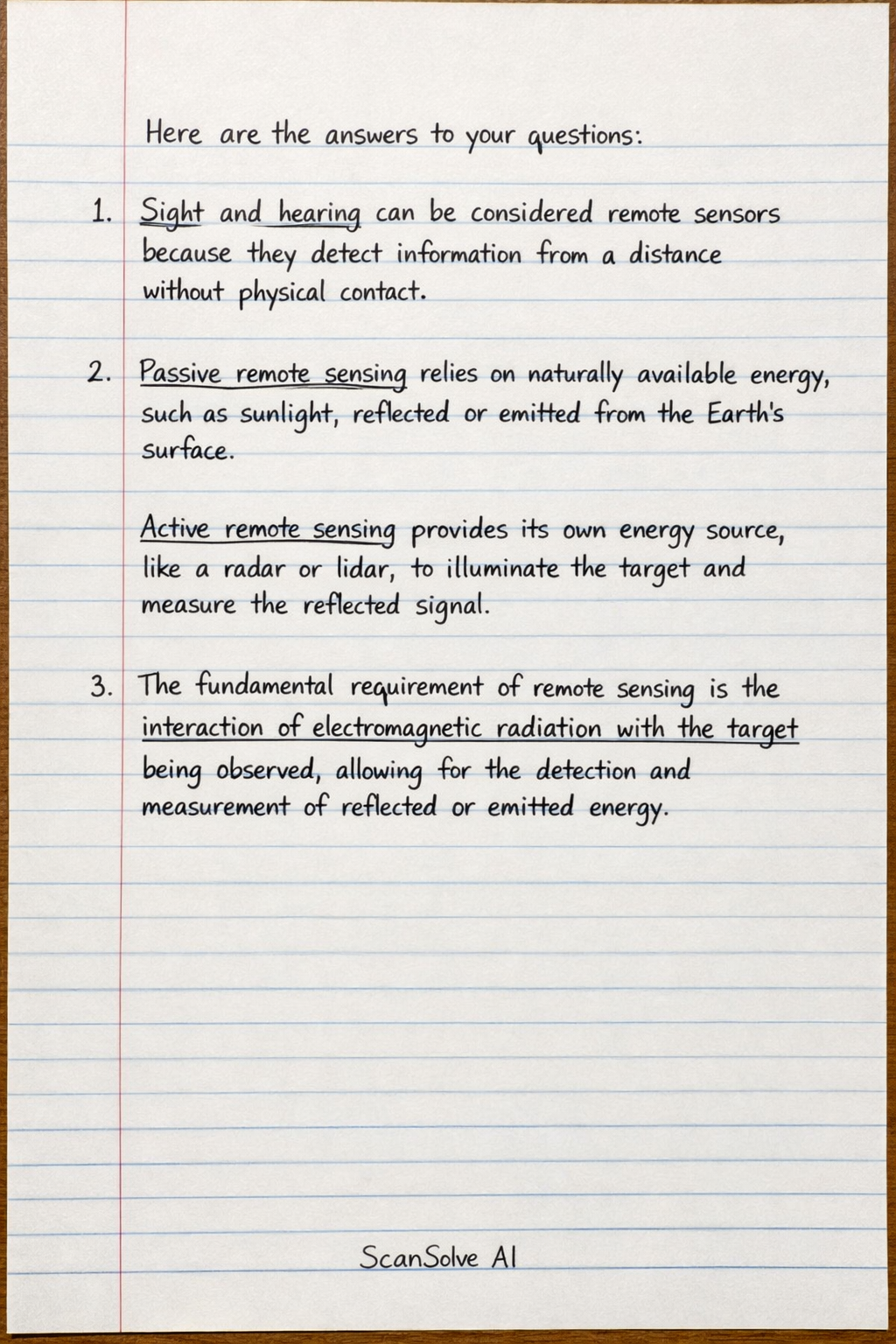
Based on your understanding of remote sensing, which of the five human senses (sight, hearing, taste, smell, touch), can be considered as remote sensors? Sight and hearing can be considered remote sensors because they detect information from a distance without physical contact.
-
In two lines distinguish between passive and active remote sensing. Passive remote sensing relies on naturally available energy, such as sunlight, reflected or emitted from the Earth's surface. Active remote sensing provides its own energy source, like a radar or lidar, to illuminate the target and measure the reflected signal.
-
What is the fundamental requirement of remote sensing? The fundamental requirement of remote sensing is the interaction of electromagnetic radiation with the target being observed, allowing for the detection and measurement of reflected or emitted energy.
-
Which portion of the electromagnetic spectrum is very relevant for vegetation delineation? The visible and near-infrared (NIR) portions of the electromagnetic spectrum are very relevant for vegetation delineation.
-
Why do most vegetation appear green? Most vegetation appears green because chlorophyll, the primary pigment in plants, strongly absorbs red and blue wavelengths of light for photosynthesis and reflects green wavelengths of light.
Still stuck on this one?
Ask a follow-up, and the answer starts from this question.
More Geography Questions
Handwritten Step-by-Step Solution
Get this as a handwritten image on WhatsApp — like a tutor wrote it for you.
Try on WhatsApp