
We read your photo as:
Which type of volcano is typically made up of alternate layers of lava, ash, and cinde...
ScanSolve AI Answer
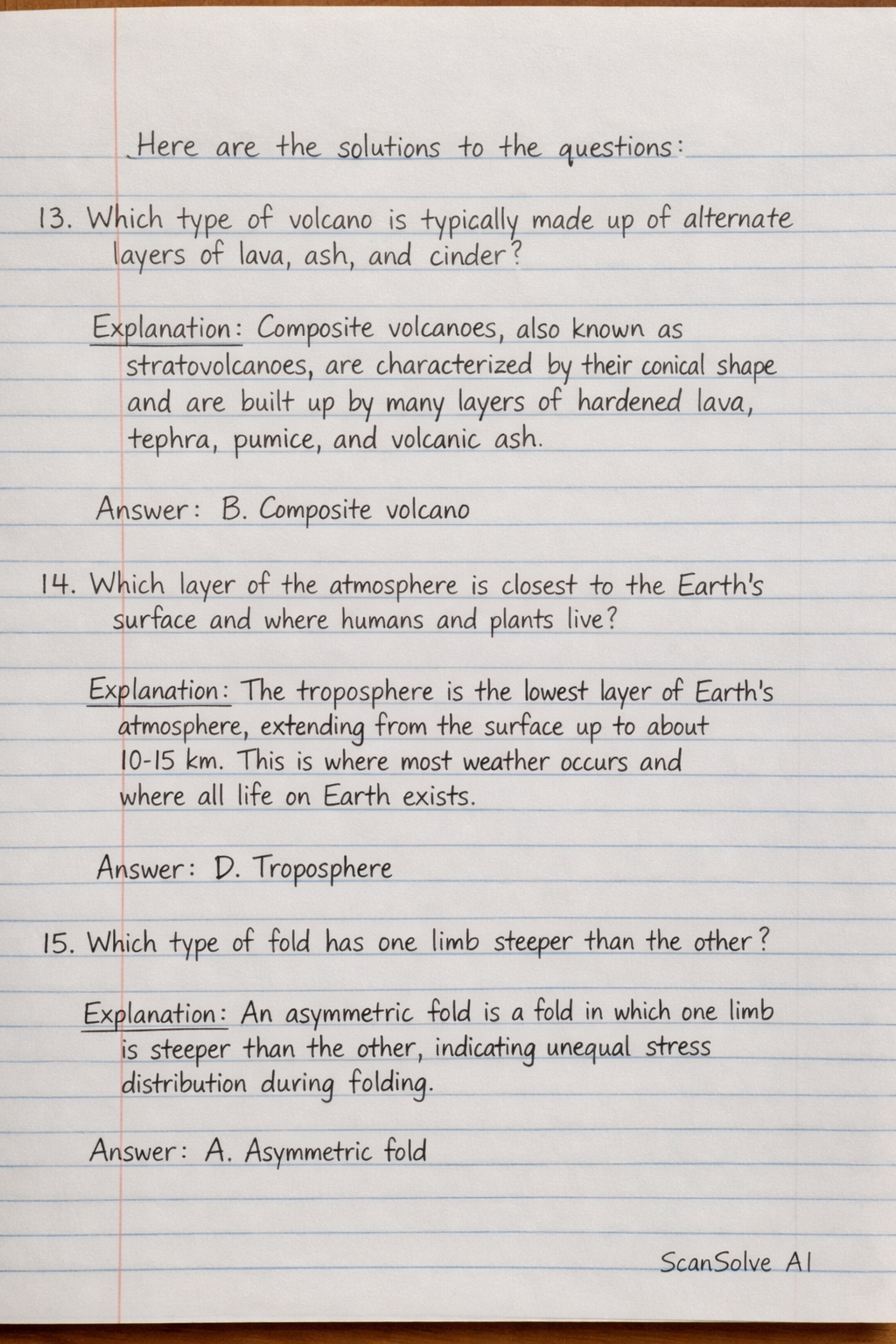
Here are the solutions to the questions:
13. Which type of volcano is typically made up of alternate layers of lava, ash, and cinde...
- Explanation: Composite volcanoes, also known as stratovolcanoes, are characterized by their conical shape and are built up by many layers of hardened lava, tephra, pumice, and volcanic ash.
- Answer: B. Composite volcano
14. Which layer of the atmosphere is closest to the Earth's surface and where humans and plants live?
- Explanation: The troposphere is the lowest layer of Earth's atmosphere, extending from the surface up to about 10-15 km. This is where most weather occurs and where all life on Earth exists.
- Answer: D. Troposphere
15. Which type of fold has one limb steeper than the other?
- Explanation: An asymmetric fold is a fold in which one limb is steeper than the other, indicating unequal stress distribution during folding.
- Answer: A. Asymmetric fold
16. A type of volcano characterized by gentle slopes and no-explosive eruption is termed as
- Explanation: Shield volcanoes are characterized by their broad, gently sloping sides, formed by the eruption of low-viscosity lava that flows easily and spreads out over a large area. Their eruptions are typically effusive (non-explosive).
- Answer: C. Shield volcano
17. The limited processes of chemical weathering in the hot desert environment could be due to
- Explanation: Chemical weathering processes require the presence of water. Hot desert environments are characterized by very low rainfall, which severely limits the extent of chemical weathering.
- Answer: C. Inadequate rainfall
18. The intensity of an earthquake is measured using which instrument?
- Explanation: A seismograph is the instrument used to detect and record seismic waves, which are then used to determine the magnitude and intensity of an earthquake. While the Richter scale is used to express magnitude, it is a scale, not an instrument.
- Answer: C. Seismograph
19. What is the term for minor earthquakes that occur after a major earthquake?
- Explanation: Aftershocks are smaller earthquakes that follow the largest earthquake in a sequence, which is called the mainshock.
- Answer: A. Aftershocks
Still stuck on this one?
Ask a follow-up, and the answer starts from this question.
More Geography Questions
Handwritten Step-by-Step Solution
Get this as a handwritten image on WhatsApp — like a tutor wrote it for you.
Try on WhatsApp