
We read your photo as:
The period in the historical development of geography where geographic knowledge saw strong growth in Europe is called
ScanSolve AI Answer
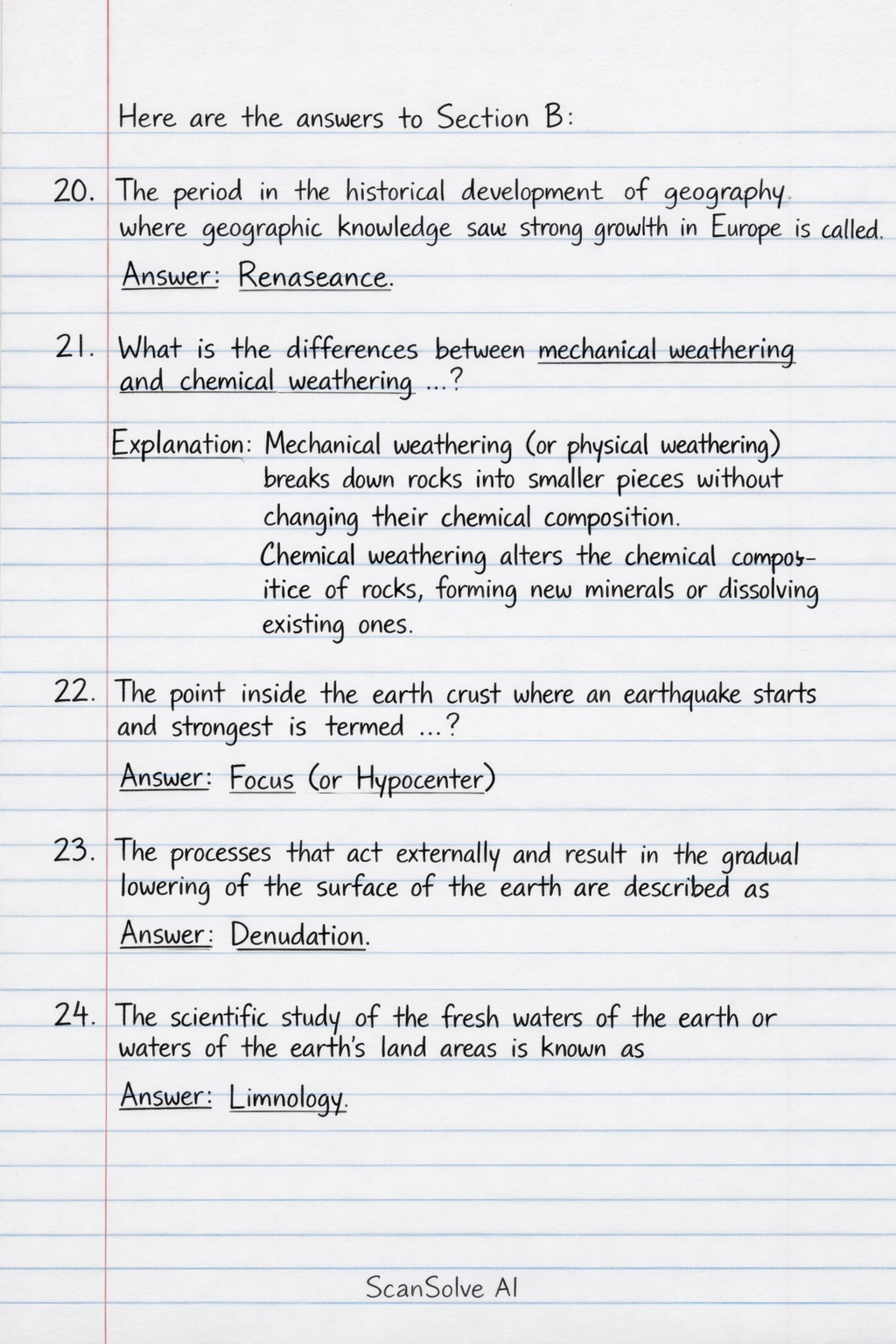
Here are the answers to Section B:
20. The period in the historical development of geography where geographic knowledge saw strong growth in Europe is called
- Answer: Renaissance
21. What is the differences between mechanical weathering and chemical weathering ...?
- Explanation: Mechanical weathering (or physical weathering) breaks down rocks into smaller pieces without changing their chemical composition. Chemical weathering alters the chemical composition of rocks, forming new minerals or dissolving existing ones.
22. The point inside the earth crust where an earthquake starts and strongest is termed ....?
- Answer: Focus (or Hypocenter)
23. The processes that act externally and result in the gradual lowering of the surface of the earth are described as
- Answer: Denudation
24. The scientific study of the fresh waters of the earth or waters of the earth's land areas is known as
- Answer: Limnology
25. State any three landforms associated with water erosion
- Answer:
- V-shaped valleys
- Waterfalls
- Gorges
26. State any three (3) tools used in the study of geography.
- Answer:
- Maps
- GIS (Geographic Information Systems)
- GPS (Global Positioning System)
27. Distinguish between an aftershock and a foreshock as related to earthquake.
- Explanation: A foreshock is a smaller earthquake that precedes a larger main earthquake. An aftershock is a smaller earthquake that follows a larger main earthquake.
28. Give three (3) examples of intrusive volcanic landforms.
- Answer:
- Batholiths
- Sills
- Dikes
29. Differentiate between weathering and mass wasting.
- Explanation: Weathering is the in-situ breakdown of rocks and minerals at or near the Earth's surface. Mass wasting is the downslope movement of rock, soil, and sediment under the direct influence of gravity.
30. The rate at which temperature decreases with altitude in the troposphere is referred to as..?
- Answer: Lapse rate (or Environmental lapse rate)
Still stuck on this one?
Ask a follow-up, and the answer starts from this question.
More Geography Questions
Handwritten Step-by-Step Solution
Get this as a handwritten image on WhatsApp — like a tutor wrote it for you.
Try on WhatsApp