
We read your photo as:
During a chemistry session a teacher places a beaker of ice on heat, observe as it changes to water and then to steam. State the importance of this life by giving five (5) points.
ScanSolve AI Answer
Step-by-step solution
4 steps4. i) During a chemistry session a teacher places a beaker of ice on heat and students observe as it changes to water and then to steam. State the important points in life by giving five (5) points.
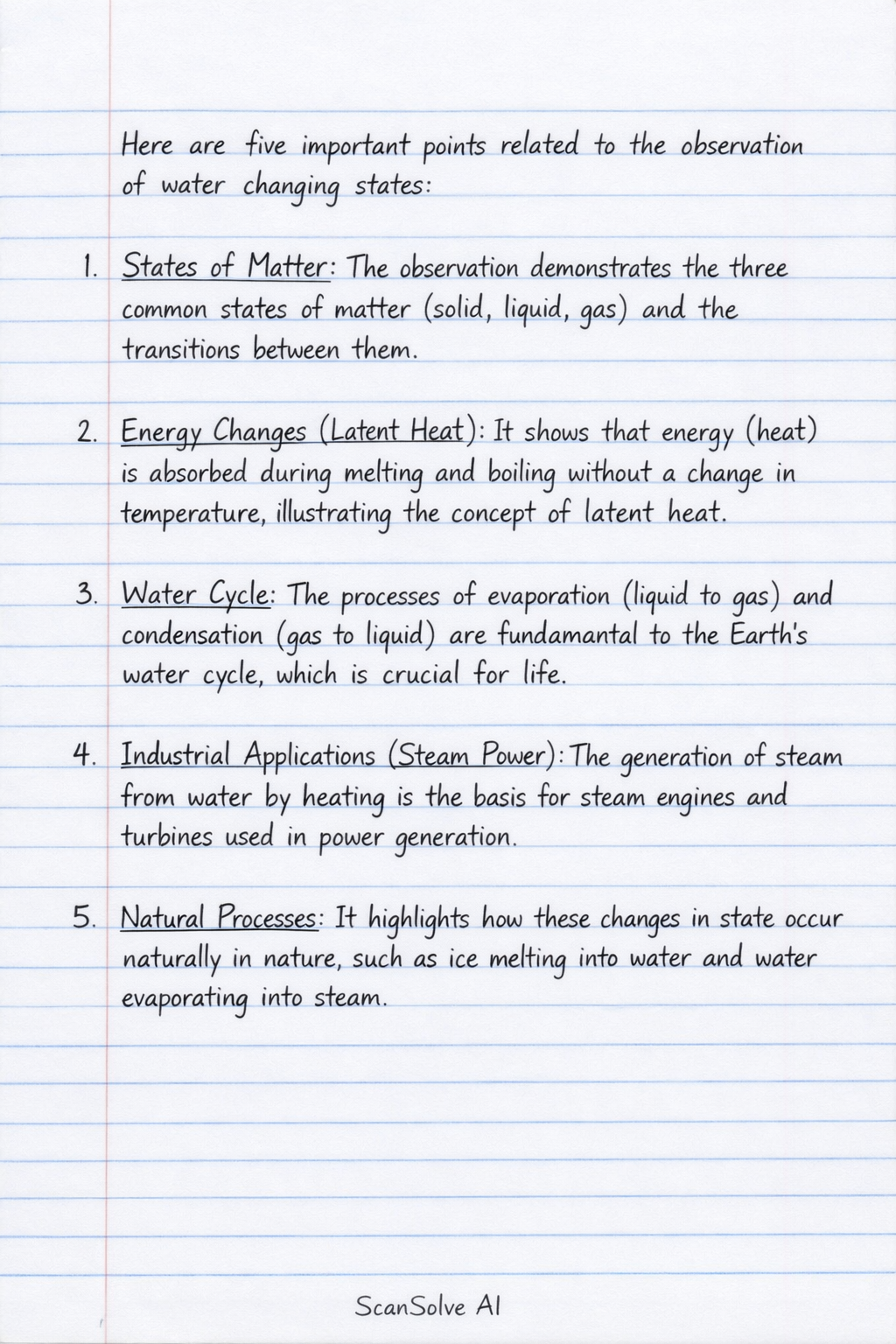
Here are five important points related to the observation of water changing states:
- States of Matter: The observation demonstrates the three common states of matter (solid, liquid, gas) and the transitions between them.
- Energy Changes (Latent Heat): It shows that energy (heat) is absorbed during melting and boiling without a change in temperature, illustrating the concept of latent heat.
- Water Cycle: The processes of evaporation (liquid to gas) and condensation (gas to liquid) are fundamental to the Earth's water cycle, which is crucial for life.
- Industrial Applications (Steam Power): The generation of steam from water by heating is the basis for steam engines and turbines used in power generation.
- Temperature and Phase Transitions: It highlights how temperature is a critical factor in determining the state of matter and initiating phase transitions.
ii) When a metal such as copper is heated, it expands. Explain why during expansion.
Heating increases the kinetic energy of the atoms.
When copper is heated, the thermal energy supplied is converted into kinetic energy of its constituent atoms.
Atoms vibrate more vigorously.
This increased kinetic energy causes the copper atoms to vibrate more vigorously around their fixed positions in the crystal lattice.
Average interatomic distance increases.
As the amplitude of these vibrations increases, the average distance between adjacent atoms also increases.
Overall volume increases.
The increase in the average distance between atoms leads to an overall increase in the volume of the copper metal, which is observed as expansion.
5. a) What do you understand by the following terms:-
i) Mass number
The mass number is the total number of protons and neutrons in the nucleus of an atom. It represents the approximate atomic mass of an atom.ii) Radical
A radical (or free radical) is an atom, molecule, or ion that has at least one unpaired valence electron. This unpaired electron makes radicals highly reactive.iii) Valency
Valency is the combining power of an element, which is determined by the number of electrons an atom can gain, lose, or share to form chemical bonds with other atoms.iv) Proton
A proton is a subatomic particle found in the nucleus of an atom. It carries a single positive elementary charge () and has a mass approximately equal to that of a neutron.b) With reasons explain why air is not termed as a compound.
Air is not termed as a compound for the following reasons:
- i) No Chemical Bonds: The components of air, such as nitrogen (), oxygen (), and argon (), are not chemically bonded together. They exist as individual substances mixed together.
- ii) Retention of Individual Properties: Each component in air retains its original chemical and physical properties. For example, oxygen in the air still supports combustion, and nitrogen remains relatively unreactive.
- iii) Variable Composition: The composition of air is not fixed; it varies slightly depending on location, altitude, and environmental conditions (e.g., humidity, pollution levels). A compound, by definition, has a fixed ratio of its constituent elements.
Still stuck on this one?
Ask a follow-up, and the answer starts from this question.
More Chemistry Questions
Handwritten Step-by-Step Solution
Get this as a handwritten image on WhatsApp — like a tutor wrote it for you.
Try on WhatsApp