
We read your photo as:
A graph shows the percentage of the population with access to various government services in PNG. (a) What percentage of the population has access to Health services? (b) How many services are accesse
ScanSolve AI Answer
Step-by-step solution
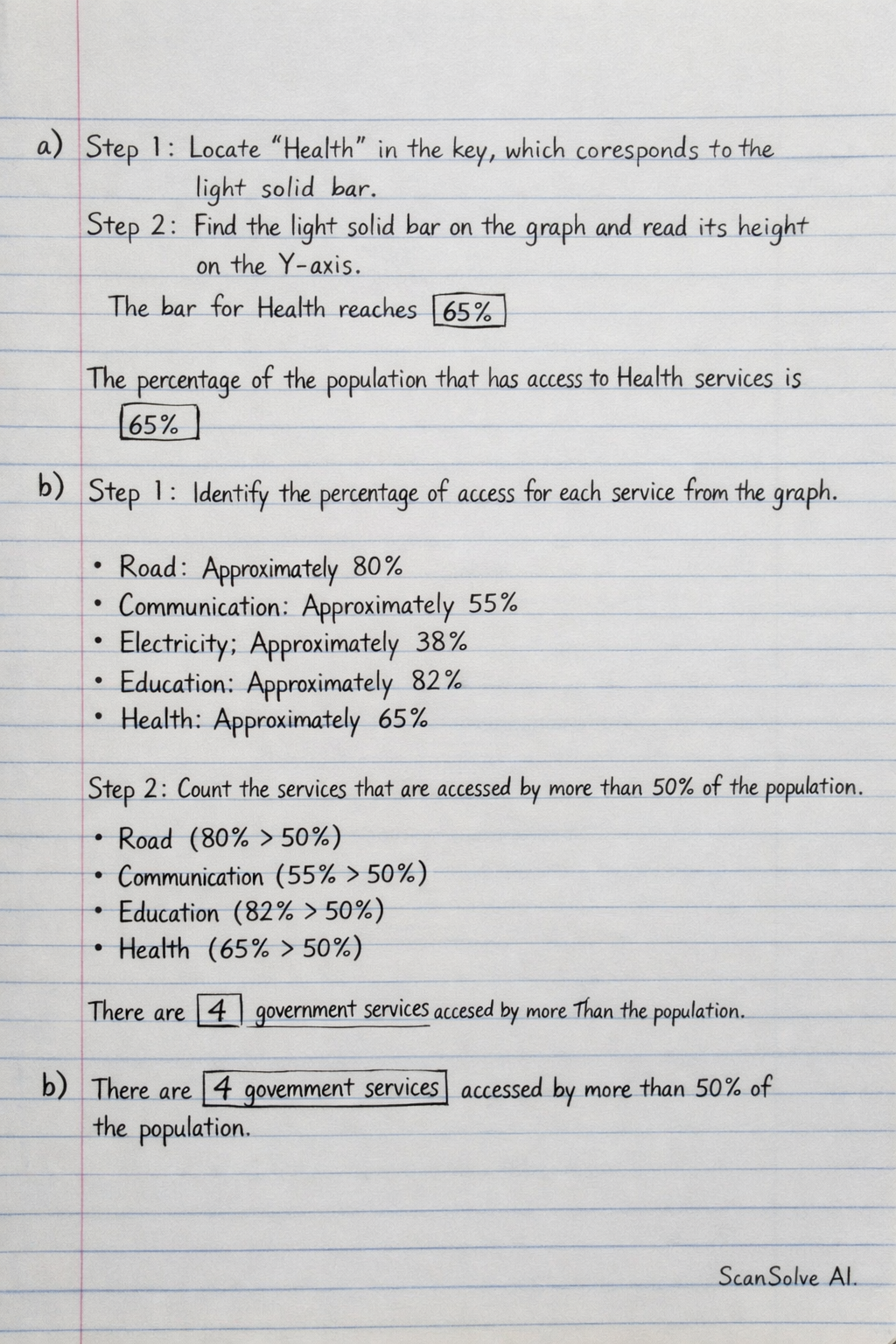
5 stepsa) Step 1: Locate "Health" in the key, which corresponds to the light solid bar.
Find the light solid bar on the graph and read its height on the Y-axis.
The bar for Health reaches .
a) The percentage of the population that has access to Health services is .
b) Step 1: Identify the percentage of access for each service from the graph.
- Road: Approximately
- Communication: Approximately
- Electricity: Approximately
- Education: Approximately
- Health: Approximately
Count the services that are accessed by more than of the population.
- Road ()
- Communication ()
- Education ()
- Health () There are 4 services accessed by more than of the population.
b) There are accessed by more than of the population.
c) Step 1: Identify the service accessed by of the population.
The "Communication" service (dotted bar) is accessed by approximately of the population.The question asks for the name of a PNG-owned company.
The provided graph only shows the type of service and its access percentage, not the names of specific companies.
c) The service accessed by of the population is Communication. The graph does not provide the name of a specific PNG-owned company.
d) Step 1: Determine the percentage of the population with access to Education.
The "Education" service (crosshatch bar) is accessed by approximately of the population.Assuming that "illiterate" refers to the population without access to education, calculate the percentage.
d) The percentage of Papua New Guinea that is illiterate is .
e) Step 1: Examine the access percentages for all services.
- Road:
- Communication:
- Electricity:
- Education:
- Health:
Identify the service with the lowest access, as this often indicates a lower level of development or priority in certain areas, such as rural areas.
"Electricity" has the lowest access percentage at . This suggests it might be less prioritized or harder to implement in rural areas compared to other services.
e) is the service that is not really a priority to those in rural areas, as it has the lowest access percentage.
Still stuck on this one?
Ask a follow-up, and the answer starts from this question.
More Geography Questions
Handwritten Step-by-Step Solution
Get this as a handwritten image on WhatsApp — like a tutor wrote it for you.
Try on WhatsApp