
We read your photo as:
Analyze the provided graph on South Africa's rural population trends from 2016-2023 and discuss its economic impacts.
ScanSolve AI Answer
Answer
Step-by-step solution
2 stepslet's analyze this graph!
1.3.1
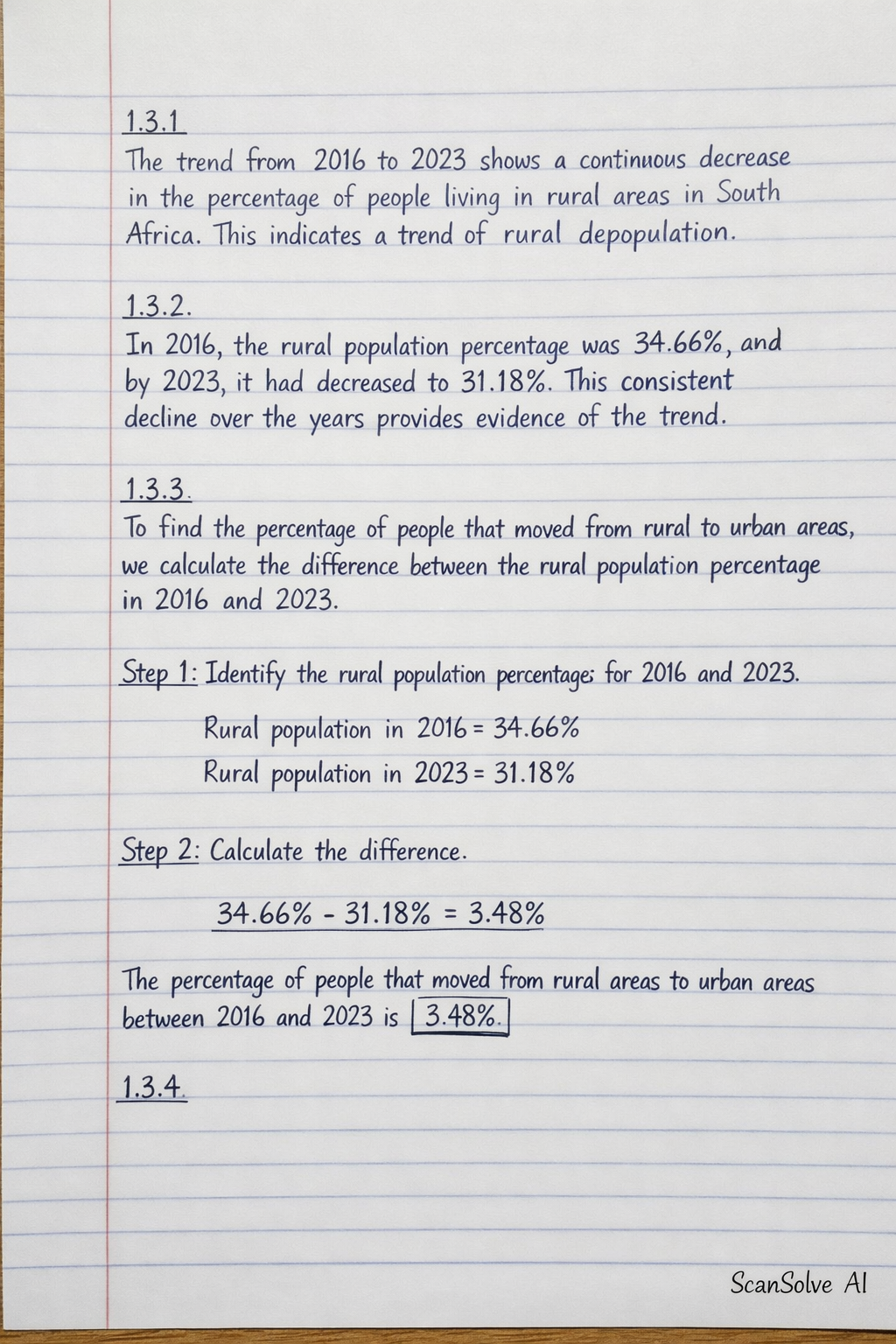
The trend from 2016 to 2023 shows a continuous decrease in the percentage of people living in rural areas in South Africa. This indicates a trend of rural depopulation.
1.3.2
In 2016, the rural population percentage was , and by 2023, it had decreased to . This consistent decline over the years provides evidence of the trend.
1.3.3
To find the percentage of people that moved from rural to urban areas, we calculate the difference between the rural population percentage in 2016 and 2023.
Identify the rural population percentages for 2016 and 2023.
Rural population in 2016 =
Rural population in 2023 =Calculate the difference.
The percentage of people that moved from rural areas to urban areas between 2016 and 2023 is .
1.3.4
Two negative economic impacts of rural depopulation on rural areas are:
- A decline in agricultural production due to a shortage of labor, leading to reduced food security and economic output.
- The closure of local businesses and services as the customer base shrinks, resulting in job losses and a decrease in local economic activity.
1.3.5
Land reform could reduce rural depopulation by providing previously disadvantaged individuals with access to productive land. This enables them to engage in farming and other agricultural activities, creating employment opportunities and income generation within rural communities. Ownership of land can foster a sense of belonging and investment, encouraging people to stay and develop their land. It can also lead to diversification of rural economies beyond traditional farming, such as eco-tourism or small-scale industries, further stabilizing livelihoods. By improving food security and economic prospects in rural areas, land reform can make these regions more attractive and sustainable, thereby slowing down or reversing the trend of people moving to urban centers.
Try one yourself
A new problem that tests the same skill.
Still stuck on this one?
Ask a follow-up, and the answer starts from this question.
More Geography Questions
Handwritten Step-by-Step Solution
Get this as a handwritten image on WhatsApp — like a tutor wrote it for you.
Try on WhatsApp