
We read your photo as:
Name 5 types of inflation.
ScanSolve AI Answer
Step-by-step solution
8 stepsAnswer Question 5.
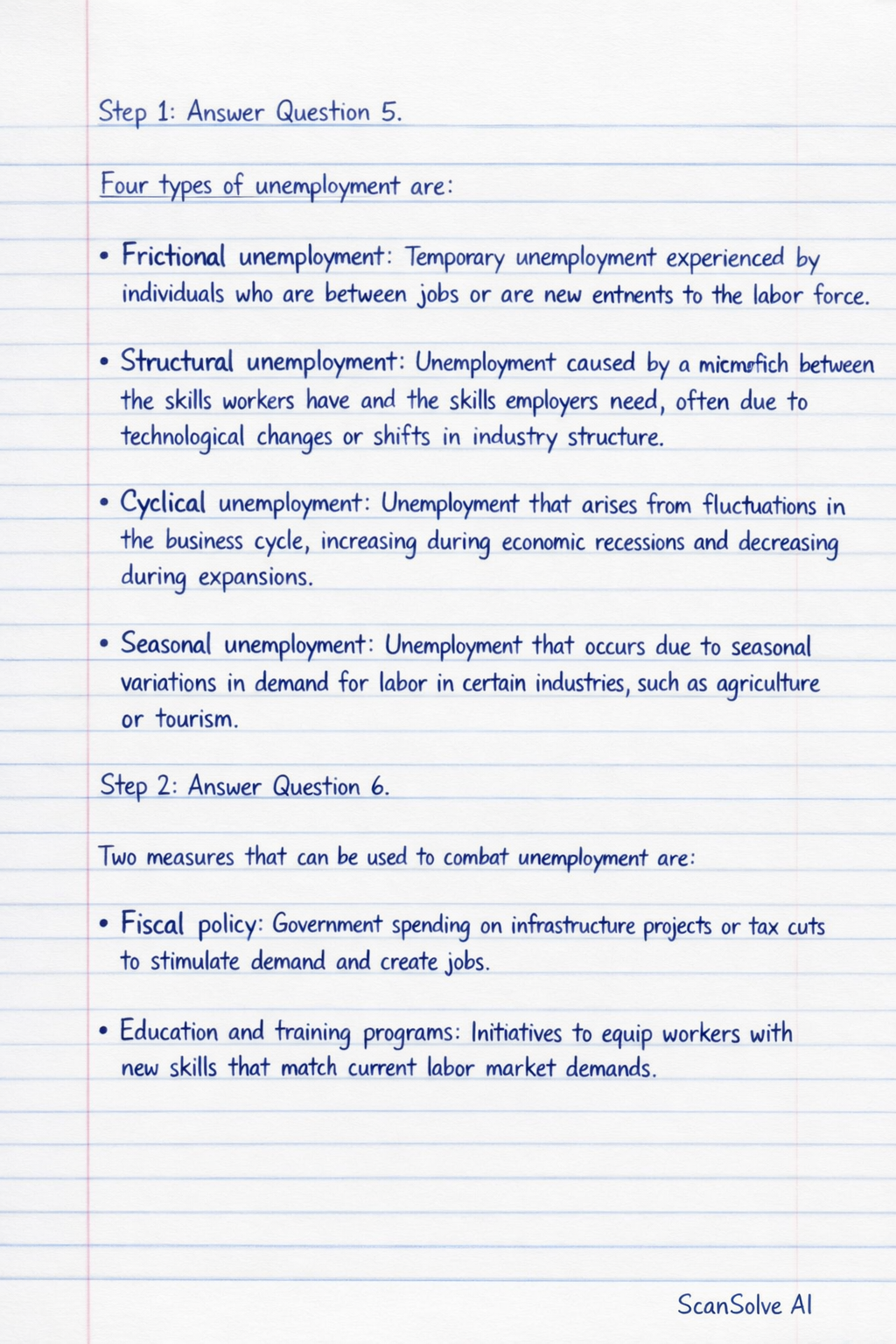
Four types of unemployment are:
- Frictional unemployment: Temporary unemployment experienced by individuals who are between jobs or are new entrants to the labor force.
- Structural unemployment: Unemployment caused by a mismatch between the skills workers have and the skills employers need, often due to technological changes or shifts in industry structure.
- Cyclical unemployment: Unemployment that arises from fluctuations in the business cycle, increasing during economic recessions and decreasing during expansions.
- Seasonal unemployment: Unemployment that occurs due to seasonal variations in demand for labor in certain industries, such as agriculture or tourism.
Answer Question 6.
Two measures that can be used to combat unemployment are:
- Fiscal policy: Government spending on infrastructure projects or tax cuts to stimulate demand and create jobs.
- Education and training programs: Initiatives to equip workers with new skills that match current labor market demands.
Answer Question 7.
This question refers to a graph from a previous interaction. Based on that graph:
- At a wage of 400 kbages, there is a surplus of 20 hours of labor.
- At a wage of 200 kbages, there is a shortage of 20 hours of labor.
Answer Question 8.
Five types of inflation are:
- Demand-pull inflation
- Cost-push inflation
- Creeping inflation
- Hyperinflation
- Built-in inflation (or Wage-price spiral)
Answer Question 9.
The Bank rate (or repo rate) is the interest rate at which a country's central bank lends money to commercial banks. It influences other interest rates in the economy and is a key tool for monetary policy.
Answer Question 10.
Three components of money used in South Africa (referring to money supply aggregates) are:
- M1: Notes and coins in circulation, plus demand deposits (cheque accounts).
- M2: M1 plus short-term and medium-term deposits (e.g., savings accounts, fixed deposits up to 6 months).
- M3: M2 plus long-term deposits (e.g., fixed deposits longer than 6 months).
Answer Question 11.
Since no specific scenarios are provided, the general functions of money are:
- Medium of exchange: Money facilitates transactions by eliminating the need for a double coincidence of wants in a barter system.
- Store of value: Money can be held and exchanged for goods and services at a later time, retaining its purchasing power (though affected by inflation).
- Unit of account: Money provides a common measure of value for goods, services, and debts, simplifying economic calculations and comparisons.
Answer Question 12.
Four factors that can lead to inequality in wages are:
- Differences in education and skills: Higher education and specialized skills often command higher wages.
- Discrimination: Bias based on gender, race, or other factors can lead to unequal pay for similar work.
- Geographic location: Wages can vary significantly between regions or cities due to differences in cost of living and labor market conditions.
- Market power of employers/unions: Strong employers may suppress wages, while strong unions can negotiate higher wages for their members.
Still stuck on this one?
Ask a follow-up, and the answer starts from this question.
More Economics Questions
Handwritten Step-by-Step Solution
Get this as a handwritten image on WhatsApp — like a tutor wrote it for you.
Try on WhatsApp