
We read your photo as:
Compare and contrast the geographic features of India's East Coast and West Coast. Additionally, describe the two major island groups belonging to India and how they differ from each other.
ScanSolve AI Answer
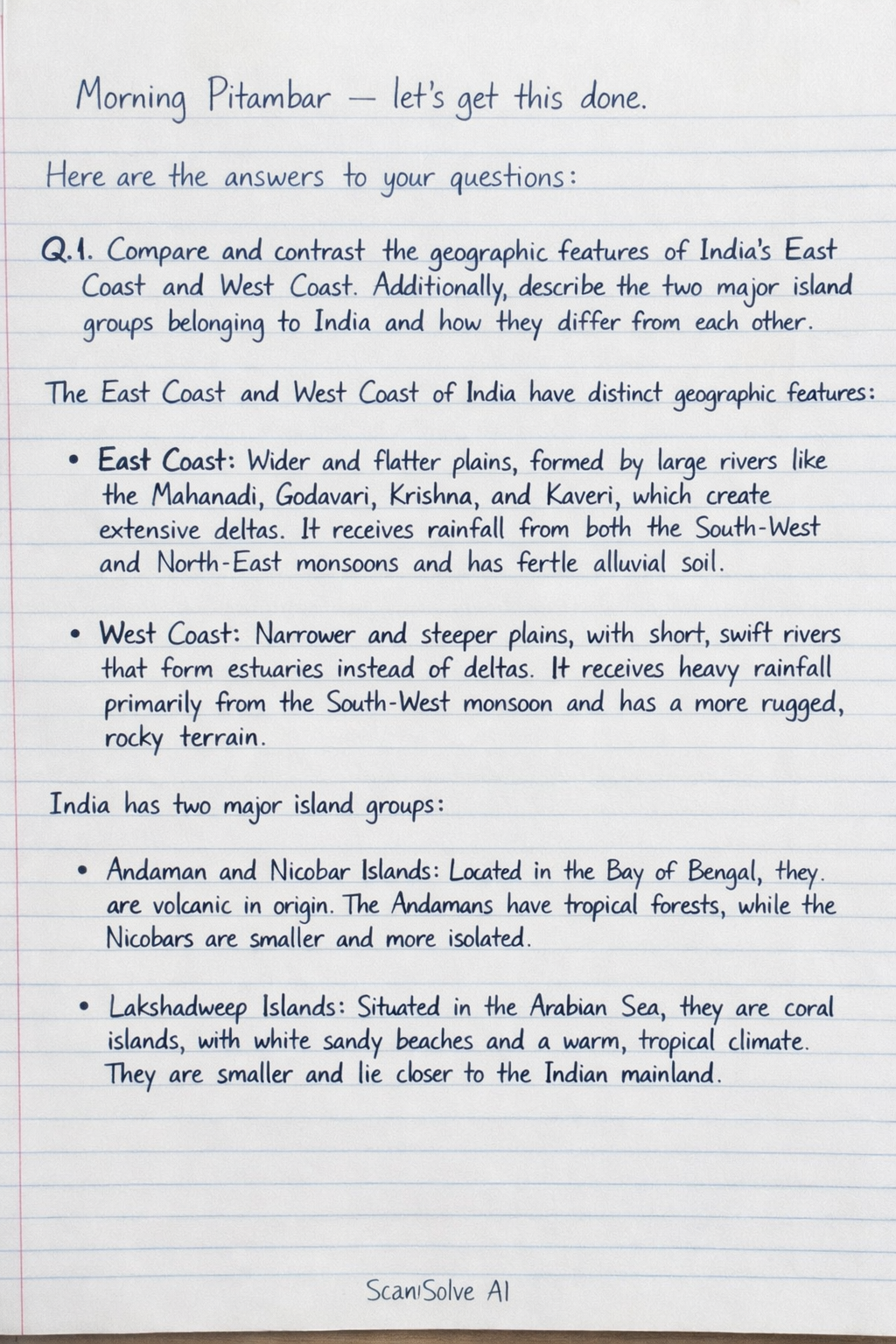
Here are the answers to your questions:
Q.1. Compare and contrast the geographic features of India's East Coast and West Coast. Additionally, describe the two major island groups belonging to India and how they differ from each other.
The East Coast and West Coast of India have distinct geographic features:
- East Coast: Wider and flatter plains, formed by large rivers like the Mahanadi, Godavari, Krishna, and Kaveri, which create extensive deltas. It receives rainfall from both the South-West and North-East monsoons and has fertile alluvial soil.
- West Coast: Narrower and steeper plains, with short, swift rivers that form estuaries instead of deltas. It receives heavy rainfall primarily from the South-West monsoon and has a more rugged, rocky terrain.
India has two major island groups:
- Andaman and Nicobar Islands: Located in the Bay of Bengal, these islands are volcanic in origin, representing the peaks of submerged mountains. They are larger, more numerous, and scattered, with a dense equatorial forest cover.
- Lakshadweep Islands: Located in the Arabian Sea, these islands are of coral origin. They are smaller, fewer in number, and clustered, with tropical vegetation.
Q.2. Explain the process by which the Himalayan mountains were formed. How do geologists describe its continued growth, and what are the three distinct ranges into which the Himalayas are categorised?
The Himalayan mountains were formed due to the collision of the Indian Plate with the Eurasian Plate. The immense pressure from this collision caused the sediments of the ancient Tethys Sea, which lay between the two plates, to fold and uplift, creating the towering mountain ranges.
Geologists describe the Himalayas as young fold mountains that are still rising. The Indian Plate continues to move northward, causing ongoing uplift and frequent seismic activity in the region.
The three distinct ranges into which the Himalayas are categorised are:
- Himadri (Greater Himalayas): The northernmost and highest range, containing the world's highest peaks.
- Himachal (Lesser Himalayas): Located south of the Himadri, known for its rugged mountains and popular hill stations.
- Shiwaliks (Outer Himalayas): The southernmost and lowest range, forming the foothills of the Himalayas.
Q.3. Why are the Gangetic Plains considered one of the most vital regions for India's population and history? Describe how rivers contribute to this region and how the local geography has aided infrastructure.
The Gangetic Plains are vital due to their extreme fertility, which supports a very dense population. Historically, this region was the cradle of major ancient Indian civilizations and empires because of its abundant resources and ease of communication.
Rivers like the Ganga and its tributaries contribute significantly by depositing rich alluvial soil annually, making the land highly productive for agriculture. They also provide a perennial source of water for irrigation, drinking, and historically, served as natural waterways for trade and transport.
The flat and gentle slope of the Gangetic Plains has greatly aided infrastructure development. It makes the construction of roads, railways, canals, and settlements relatively easy and cost-effective, facilitating connectivity and economic growth.
*Q.4. Activity: Imagine you are a conservationist visiting the Thar Desert. Conduct a group research project on traditional water collection structures like taankas or kunds.
- Task: Draw a diagram of how these systems work to trap rainwater. Present three ways urban cities can adapt these traditional desert practices to fight modern-day water scarcity.*
This question requires drawing a diagram and presenting ways urban cities can adapt practices. As an AI, I cannot draw diagrams. However, I can describe the principles:
- Taankas/Kunds: These are underground cisterns or tanks, typically circular or rectangular, built to collect and store rainwater from rooftops or specially prepared catchment areas. The water is filtered and stored for drinking and domestic use, especially during dry periods.
Three ways urban cities can adapt these practices:
- Rooftop Rainwater Harvesting: Collect rainwater from building rooftops and direct it into underground sumps or recharge groundwater aquifers.
- Permeable Pavements and Green Spaces: Use permeable materials for roads and sidewalks, and create more green spaces to allow rainwater to infiltrate the ground, reducing runoff and recharging groundwater.
- Community-Level Storage Tanks: Construct large underground or surface tanks in public areas to collect and store rainwater for non-potable uses like irrigation of parks or flushing toilets.
Q.5. Explain the term 'Second Urbanisation' of India. How did it differ from the first one in terms of geography, technology, and lifestyle?
The term 'Second Urbanisation' of India refers to the emergence of large cities and states, known as Mahajanapadas, in the Gangetic Plain around the 6th century BCE. This period followed the decline of the Indus Valley Civilization.
It differed from the first urbanisation (Indus Valley Civilization) in several ways:
- Geography: The first urbanisation was centered in the Indus River basin (e.g., Harappa, Mohenjo-Daro). The second urbanisation shifted eastward to the fertile Gangetic Plain (e.g., Pataliputra, Rajagriha).
- Technology: The first urbanisation was characterized by Bronze Age technology. The second urbanisation saw the widespread use of iron technology, which revolutionized agriculture and warfare, and the introduction of coinage.
- Lifestyle: The first urbanisation had highly organized urban planning and a trade-based economy. The second urbanisation saw the rise of powerful states and empires, the development of a more rigid Varna system, and the emergence of new religious and philosophical movements like Buddhism and Jainism.
Q.6. Describe the significance of the Uttarapatha and Dakshinapatha routes. How did they facilitate the movement of goods, culture, and ideas?
The Uttarapatha and Dakshinapatha were ancient, long-distance trade routes that were immensely significant for the economic, cultural, and political development of India.
- Uttarapatha was the Northern Route, connecting the Gangetic Plain with Central Asia and the North-West Frontier.
- Dakshinapatha was the Southern Route, linking the Gangetic Plain with the Deccan and Southern India.
These routes facilitated movement in the following ways:
- Goods: They enabled the extensive exchange of various commodities such as spices, textiles, precious stones, and metals across vast regions, fostering trade and economic prosperity.
- Culture: Merchants, pilgrims, and scholars traveling along these routes helped spread religious ideas (like Buddhism and Jainism), art forms, architectural styles, and languages, leading to cultural diffusion and integration.
- Ideas: The routes allowed for the transmission of knowledge, philosophical concepts, scientific advancements, and administrative practices between different kingdoms and regions, promoting intellectual exchange and development.
Q.7. Map Activity-Look at the map on page no. 71 (Ncert Book). Mark the 16 mahājanapadas on a blank physical map of India. Circle the most powerful ones mentioned in the text.
This is a map activity that requires referring to a specific textbook page and marking on a physical map, which I cannot perform directly. You will need to consult your NCERT book (page 71) for this task.
Q.8. Why is democracy considered a better form of government than others despite its problems? What are the hurdles a democracy faces in achieving its ideals?
Democracy is considered a better form of government than others despite its problems because it:
- Promotes equality among citizens by ensuring political rights and opportunities for all.
- Enhances the dignity of individuals by respecting their freedoms and choices.
- Improves the quality of decision-making through deliberation and public participation.
- Provides a mechanism to correct its own mistakes through public debate and elections, making it more accountable and responsive.
- Allows for conflict resolution in a peaceful and respectful manner.
However, democracy faces several hurdles in achieving its ideals:
- Economic inequality can undermine political equality, as wealth can influence political processes.
- Corruption among elected representatives and officials can erode public trust and hinder effective governance.
- Lack of education and awareness among citizens can lead to uninformed electoral choices.
- Social divisions based on caste, religion, or ethnicity can lead to political instability and hinder national unity.
- The criminalization of politics and the rise of dynastic succession can compromise the fairness and representativeness of the democratic process.
Q.9. Read the "Story of Shane" on page no. 203 (Ncert Book), about life in North Korea.
This question requires reading a specific text from your NCERT book (page 203). I cannot access or summarize specific content from your textbook. Please read the story to understand life in North Korea.
Still stuck on this one?
Ask a follow-up, and the answer starts from this question.
More Geography Questions
Handwritten Step-by-Step Solution
Get this as a handwritten image on WhatsApp — like a tutor wrote it for you.
Try on WhatsApp