
We read your photo as:
Compare discharge between site,explain variations in filtration rate, relate your findings to slop, vegetation and evaluate human impact on the system
ScanSolve AI Answer
Answer
Step-by-step solution
4 stepslet's break down this analysis.
Here's an analysis of the discharge, infiltration, and environmental factors:
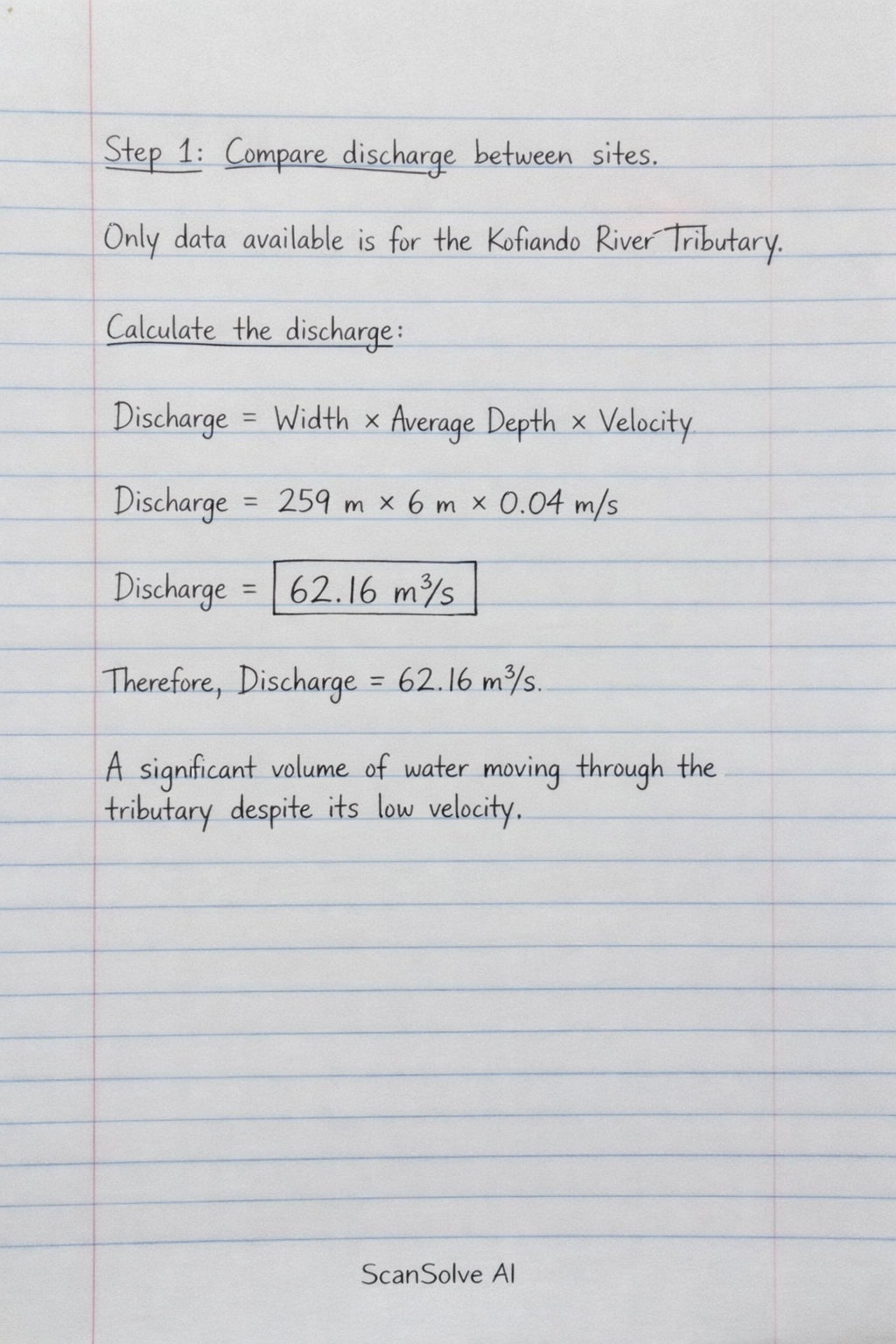
Compare discharge between sites.
The provided data table, "5. Data recording table," only includes information for one site: the Kofiando River Tributary. Therefore, a comparison between multiple sites is not possible with the given data.
The discharge for the Kofiando River Tributary is calculated as:This indicates a significant volume of water moving through the tributary despite its low velocity.
Explain variations in infiltration rate.
The infiltration test results show clear variations based on surface type:
- Vegetated Soil (Grass): Exhibits the fastest infiltration rate (245 seconds). This is because vegetation creates more spaces and root channels in the soil, allowing water to pass through quickly and easily.
- Bare Soil: Shows a moderate infiltration rate (1232 seconds). The soil is denser with fewer air spaces, which limits the ability of water to penetrate.
- Wet Soil: Has the slowest infiltration rate (4053 seconds). This is due to the soil already being saturated with water, leaving no space for additional water to be absorbed.
Relate findings to slope and vegetation.
- Slope: The river tributary flows through a gentle slope, which, along with obstructions, contributes to its low flow velocity (0.04 m/s).
- Vegetation:
- Positive Impact on Infiltration: Areas with vegetation (like grass) show faster infiltration rates, reducing surface runoff.
- Negative Impact on Erosion: Sparse vegetation on the river banks makes the soil loose, leading to frequent erosion.
Evaluate human impact on the system.
Human activities significantly impact the system, primarily by decreasing infiltration and increasing runoff, thereby increasing flood risk:
- Houses and Roads: Construction of houses and roads leads to soil compaction, creating impermeable surfaces. This drastically reduces infiltration and increases surface runoff.
- Pollution/Dumping: The dumping of trash blocks soil pores, which decreases infiltration and further increases runoff.
- Gardening: While gardening can loosen soil, the overall human development on the site, including construction and pollution, leads to a net decrease in infiltration and an increase in runoff, elevating the risk of flooding.
Try one yourself
A new problem that tests the same skill.
Still stuck on this one?
Ask a follow-up, and the answer starts from this question.
More Geography Questions
Handwritten Step-by-Step Solution
Get this as a handwritten image on WhatsApp — like a tutor wrote it for you.
Try on WhatsApp