
We read your photo as:
Analyze the provided hydrograph data, identifying baseflow, peak flow, rising limb, falling limb, and lag time.
ScanSolve AI Answer
Step-by-step solution
5 stepsLet's analyze the provided hydrograph data.
Identify the Baseflow.
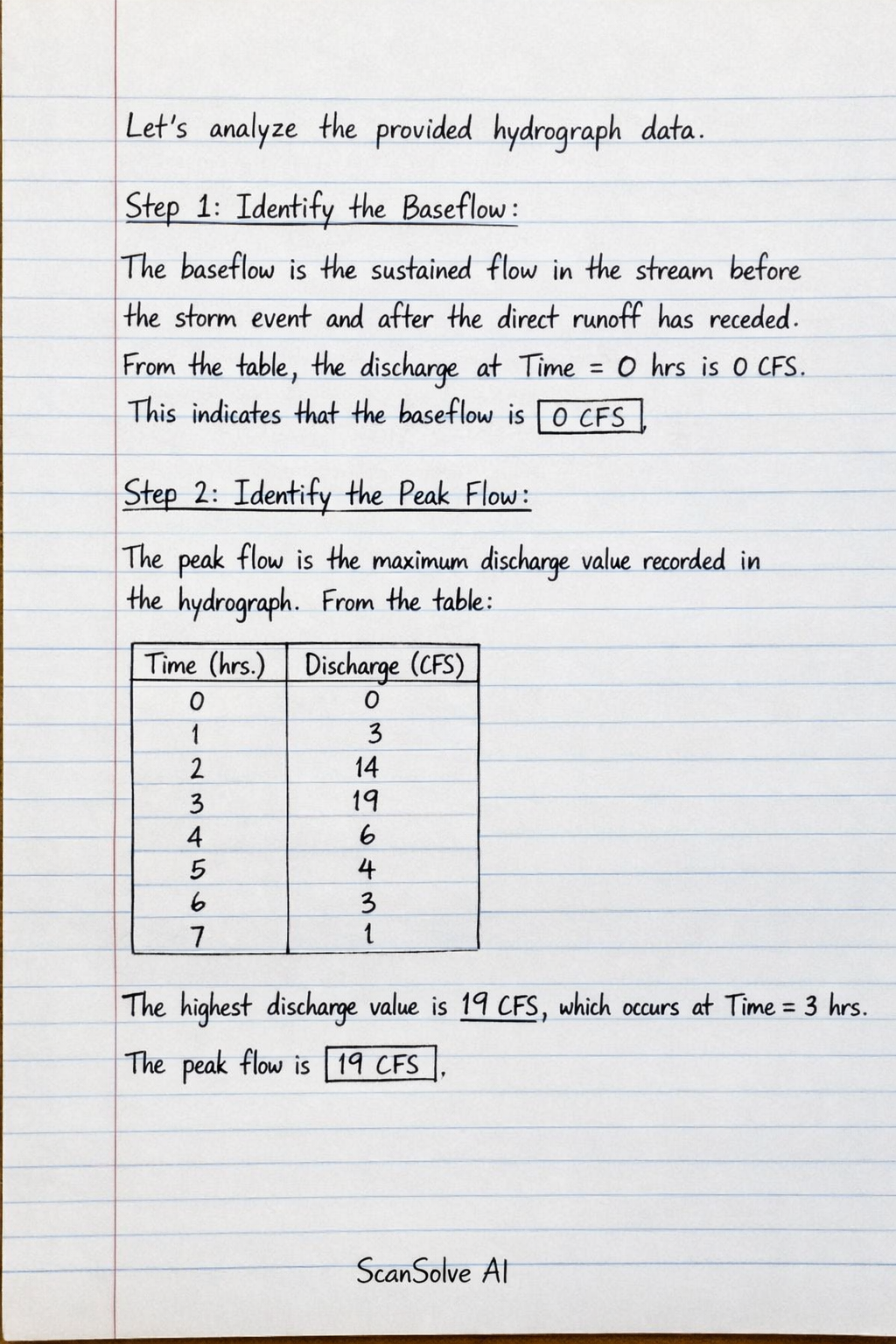
The baseflow is the sustained flow in the stream before the storm event and after the direct runoff has receded. From the table, the discharge at Time = 0 hrs is 0 CFS. This indicates that the baseflow is .
Identify the Peak Flow.
The peak flow is the maximum discharge value recorded in the hydrograph.
From the table:Time (hrs.) Discharge (CFS) 0 0 1 3 2 14 3 19 4 6 5 4 6 3 7 1 The highest discharge value is 19 CFS, which occurs at Time = 3 hrs. The peak flow is . Identify the Limbs.
- Rising Limb: This is the portion of the hydrograph where the discharge is increasing due to the storm runoff.
- It extends from Time = 0 hrs (0 CFS) to Time = 3 hrs (19 CFS).
- Falling Limb (Recession Limb): This is the portion of the hydrograph where the discharge is decreasing after the peak flow.
- It extends from Time = 3 hrs (19 CFS) to Time = 7 hrs (1 CFS).
- Rising Limb: This is the portion of the hydrograph where the discharge is increasing due to the storm runoff.
Identify the Lag Time.
Lag time is typically defined as the time from the centroid of rainfall excess to the peak of the hydrograph. Since rainfall data is not provided, we will identify the time to peak from the start of the hydrograph's rise.
- Start of rise: Time = 0 hrs
- Time of peak: Time = 3 hrs The lag time (time to peak) is .
Create a Graph (Hydrograph).
To create the hydrograph:
- Draw a graph with the X-axis representing "Time (hrs.)" and the Y-axis representing "Discharge (CFS)".
- Plot each data point from the table (e.g., (0,0), (1,3), (2,14), (3,19), (4,6), (5,4), (6,3), (7,1)).
- Connect the plotted points with a smooth curve to visualize the hydrograph.
Still stuck on this one?
Ask a follow-up, and the answer starts from this question.
More Geography Questions
Handwritten Step-by-Step Solution
Get this as a handwritten image on WhatsApp — like a tutor wrote it for you.
Try on WhatsApp